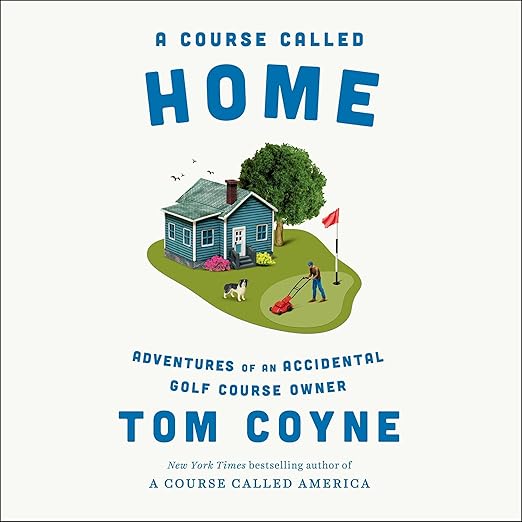
The publisher's paragraph drops Bill Murray and Jason Kelce into a golf book, declines to explain either of them, and adds only the phrase for some reason. That shrug tells you what kind of audiobook is coming. Tom Coyne built a career on courses like St. Andrews and Shinnecock, and the story he came back with this time is set at a nine-hole club in the Catskills that was buried under ice and snow the first time he saw it. Jacques Roy reads the ten and a half hours. Coyne does not read his own book, which is worth knowing before you commit to an account written this far inside one man's head.
What the copy is selling and what it quietly admits are two different books. The first is an adventure story: a globe-trotting golf writer buys a course, learns to contour a fairway and water a green, and famous friends turn up to dig bunkers and cut holes. The second is a rescue operation with a clock on it. Sullivan County Golf and Country Club was heading for closure just shy of its hundredth year, and a superintendent talked Coyne into driving up to look at the wreckage. The copy calls the result his most personal and profound book yet, which is exactly the sort of claim a publisher makes and a listener spends ten hours testing.
Nothing on this record helps you judge the performance. The title arrived in May 2026 with no star average, no vote count, and not one written response, so every promise attached to it is still the publisher's promise and nobody has argued with it in public yet. What the credit tells you is concrete enough. Simon and Schuster Audio handed a memoir written in the first person to Jacques Roy, and Roy therefore has to play a golf writer who spends most of these chapters as a beginner at running a mower and a novice at keeping a green alive. That is a comic register and a mournful one at once, and few readings hold both.
Highlights
Listeners who came to Coyne through the travel books will notice how far the geography has collapsed. The golf travel trilogy the copy keeps invoking crossed continents and centuries of links tradition; this one gets as far as a century-old nine-holer down the road from Woodstock, and then stops moving entirely. I find that shrinkage more interesting than another pilgrimage would have been. A writer who has played the famous courses for a living has to justify a small one on its own terms, without the borrowed grandeur of a name, and the copy sets him exactly that task.
That task shows up first in vocabulary. Tee times become mower hours. The verbs on offer are contour, water, dig, plant, and cut, and the people doing them are groundskeepers putting in long shifts for pride instead of prestige. The membership is described as lifelong regulars who pay in cash and play in jeans, plus visitors and first-timers who get absorbed into the fold, and the copy is blunt that none of this resembles the manicured game shown on television by millionaires in matching polos. Ten and a half hours is a long time to spend in a maintenance shed, and that is more or less the pitch.
Where the story turns is the rescue itself, and this is the material I most want to hear read aloud. Players from around the world bought memberships to a tiny Catskills course they may never set foot on. Companies sent mowers and carts at steep discounts. Friends came to dig bunkers, plant flowers, and cut holes, and some of those friends were Bill Murray, Jason Kelce, and Mike Madden. Whether that lands as a genuine groundswell or as a writer calling in favors will depend on how carefully Coyne sets it up, and the copy gives no clue which way it falls. Underneath all of it sits the superintendent who made the first call, hoping his local nine-hole gem would reach its hundredth anniversary at all.
Before You Commit to A Course Called Home
Two mentions are all the celebrity content the description actually promises. The names appear once in a brief aside near the top and once in the closing stretch with a third name attached, and both times the sentence is over quickly. Anyone buying ten and a half hours for anecdote about a comic actor or a football player is buying the wrong title. Watch, too, for the fundraising campaign, because the copy makes it the turn of the whole book, and a chronicle of memberships sold and equipment donated can sag in audio in a way it does not on paper.
Anyone reading the genre field would guess a swing manual. It says sports and outdoors, the tag says Golf, and yet the subject the copy keeps circling back to is a town: decades of declining tourism and economic downturn have left the club struggling to survive, and saving it required people who live nowhere near it to buy in. Shelved next to instruction titles, a book about rural economics and volunteer labor will meet an audience expecting something else. The mismatch is worth flagging because it changes who will finish this and who will quit at hour three. A listener who wants the sport will get it; a listener who wants the town will get considerably more of it than the labels admit.
Is This One for You?
Once a listener has driven past a shabby municipal course and wondered who keeps it mowed, this book has its audience. It also suits anyone who liked the travel trilogy and will trade airports for a maintenance shed, and anyone who enjoys watching a competent professional be conspicuously bad at something new. Golfers hunting technique should be warned that the only instruction here runs to irrigation and mower hours, and no reviewer has yet confirmed or denied that, because nobody has written a review. Sentiment-averse listeners should know the copy reaches for the phrase love letter without embarrassment.
Whatever the reading turns out to sound like, the shape is clear enough: a writer stopped traveling and bought the thing he had spent a career visiting. Jacques Roy has ten and a half hours to make that turn feel earned, and with an empty rating badge and an empty review column, no listener has reported back on how the performance carries it. Coyne bought the course; this recording is the account he owes for it.
- Read by: Jacques Roy takes on a first-person memoir its author did not record, and with an empty review column nobody has judged the result yet.
- At its heart: Saving a century-old nine-hole club, rural decline in the Catskills, golf as inherited community.
- Vibe: Warm, unhurried, and a little star-struck.
- Short version: Take it for the maintenance shed and the groundskeepers, not for the famous friends who pass through.