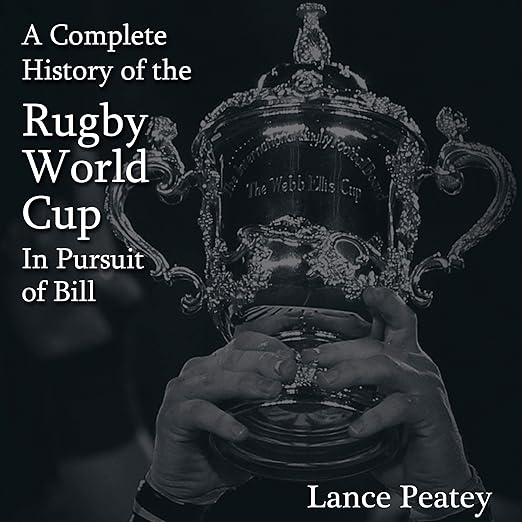
Music is written into the credits of this audiobook, which is not something most sports histories can claim. The description promises clips from the rugby anthem World in Union, sung by Hayley Westenra, plus ambient sound from the tournaments themselves, layered under Dryw McArthur's reading of Lance Peatey's history. That is a produced audio edition rather than a plain narration of a printed book, and across twelve hours and fifty-six minutes it changes what is actually on sale. It also raises a question this page never gets around to answering.
The Review
The synopsis does an unusual amount of work, and most of it is credentialing. Peatey is described as a media business leader with more than twenty years across Disney and ESPN, the BBC, IMG Media, and both the Nine Network and the Seven Network in Australia. The origin story is specific: the idea arrived while working with Seven during the 2003 Rugby World Cup. For a book about boardroom politics as much as about matches, that resume is the argument for trusting the account.
Peatey's other credit is worth noting for what it signals about access. The description says Peatey assisted the former Australian flanker David Pocock with two editions of his autobiography, Openside, in 2011 and 2018. A writer who has worked inside a player's book and spent two decades around broadcast rights is positioned to hear things a fan historian never would. Whether that access surfaces in the recording is a separate question, but the claim is at least a checkable one.
Nine tournaments run through this, from 1987 to 2019, and the framing is deliberately wider than the scoreboard. The description offers the formation of rival codes, the push into professionalism, the claim that rugby fathered every other rugby code and American football besides, and boardroom fights that nearly killed the event before it started. That last strand is the one to listen for. Match narratives age; the account of how the third largest sporting event on earth got built does not. A listener who arrives for the tries and drop goals will end up somewhere else entirely, and that redirection is the book's actual proposition.
The Best Parts of A Complete History of the Rugby World Cup
The audio edition is the genuine reason to choose this format over the page. A written history of the Rugby World Cup cannot play you the anthem or put crowd noise behind a final; this one says it does both. Sound design in long-form nonfiction is rare, expensive, and usually reserved for podcasts, so building it into a nearly thirteen-hour history is a real decision rather than a line of marketing copy. If it lands, this is the version of the book worth owning.
Timing gives the edition a second argument. Peatey's first edition appeared in 2007; this recording arrived in March 2021, after the 2019 tournament in Japan, and the description flags fresh material on that competition specifically, including World Rugby's first push into Asia. So a listener is not simply getting the 2007 text read aloud. How deep the update runs, whether a chapter or a light pass, the page declines to say, but the claim of new Japan coverage is explicit.
Dryw McArthur takes the reading, a single name set against a book stuffed with proper nouns: nine tournaments, dozens of national sides, a century of administrative history, quoted press. One reader carrying every bit of it is ordinary for nonfiction and still worth knowing, because pronunciation across that many countries is where this kind of recording either holds or slips. The description names McArthur once and moves straight on to the music, which tells you where the publisher thinks the value sits.
The Caveats
The praise quoted on this page is not praise for this recording. David Llewellyn of The Independent called it a minor masterpiece, and the description is careful to attach that line to the first edition, published in 2007. Fourteen years and one more tournament separate that assessment from what you would actually be hearing. The quote is honestly labeled, more than plenty of listings manage, and it still says nothing whatsoever about the audio.
Four people have rated this and none of them wrote a word. Those four votes must total twenty out of a possible twenty, so the score is a clean sweep with no dissent and also no detail. On a straightforward narration that would be a small loss. On an edition whose selling point is layered anthem clips and stadium sound, it means the one thing a buyer would most want confirmed, that the production actually works, has no witness at all.
The title on the listing is incomplete too. The description gives the full title as A Complete History of the Rugby World Cup, In Pursuit of Bill, and that subtitle has vanished from the field heading this page. It matters less for a purchase than for a search: someone who half-remembers the Pursuit of Bill line will never find this page by typing it. Metadata gaps that small are how audiobooks quietly disappear inside their own catalogs. A subtitle that survives inside the copy but not in the field above it is a scrap of the original book showing through the audio edition.
Who Should Listen to A Complete History of the Rugby World Cup
Rugby is the entry fee, though less of it than the description implies. The book covers the invention of the codes, the fight over professionalism, and the politics that almost sank the tournament, which is sports-administration history as much as sport. Anyone who enjoys watching governing bodies behave badly will find plenty. Anyone who wants match drama gets that too, across nine competitions, though the runtime is a long runway before reaching the ones they remember. Broadcast professionals and anyone who followed the amateurism argument through the 1990s are the natural core audience.
Pass on it if you need someone else's verdict before you buy, because four silent votes are the entirety of what this page offers on that front. A history of committees, codes and rights deals at this length is a real commitment, and the tournament narratives are only part of it. The anthem clips and the ambient sound are the argument for choosing the audio edition over the printed one, and they are also the part nobody has described. Zero written responses is the one thing this listing will not explain.
- Performance: Dryw McArthur reads, sharing the track with anthem clips and stadium sound.
- What it covers: Nine tournaments from 1987 to 2019, the birth of rival codes, boardroom politics behind a global event.
- Feel: Ceremonial and archival, with the noise of a crowd underneath.
- Our call: The produced audio is the reason to pick this edition, though not one buyer has said whether it works.