Quick Take
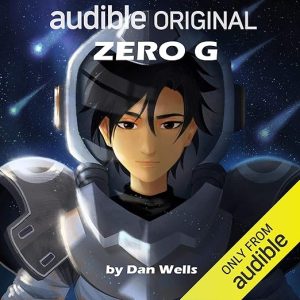
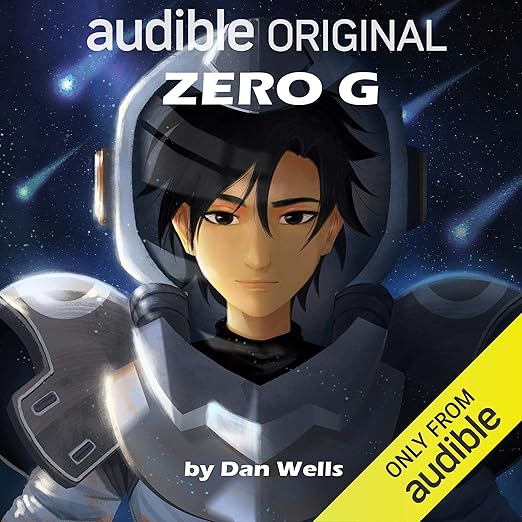
- Narration: Emily Woo Zeller leads a cast of twelve narrators in a Dolby Atmos-enabled production, and her instinct for Zero’s curious, slightly overwhelmed voice sets the tone that carries the whole series.
- Themes: Ingenuity versus impossible odds, solitude and self-reliance, first contact with danger
- Mood: Urgent and playful, designed for listening on the move
- Verdict: One of the most technically innovative middle-grade audiobooks available, and the story itself earns the production investment.
I finished Zero G during a road trip with my niece, and I want to be specific about that context because it matters. We were about an hour into the drive when the pirate faction showed up on the ship, and she reached over and turned up the volume without being asked. That is the best possible review I can give any middle-grade audiobook. The story had pulled her completely out of phone-scrolling territory and into genuine investment.
Dan Wells’s setup is deceptively clean: a kid wakes up a hundred years early on a colony ship, discovers space pirates are hijacking it, and has to stop them alone because everyone else is asleep in stasis. Home Alone in space, as one reviewer correctly labeled it, which is a useful shorthand but undersells the scientific texture Wells brings to Zero’s problem-solving. This is not a book about a kid who gets lucky. It is a book about a kid who thinks carefully and uses what he knows.
What Dolby Atmos Changes About the Listening Experience
This is one of the first middle-grade audiobooks I encountered where the Dolby Atmos production is genuinely load-bearing rather than decorative. The ship’s spatial environment is used purposefully. When Zero is moving through corridors trying to avoid detection, the directional audio creates a low-grade tension that a flat stereo mix simply would not replicate. With headphones, the effect is pronounced. Without them, it is less dramatic but still noticeable. I would strongly recommend the high-quality download setting that Audible flags in the description, particularly for a first listen.
The full cast of twelve narrators might sound excessive for a four-hour middle-grade adventure, but Wells is writing a ship full of people who have distinct roles and relationships. Emily Woo Zeller as Zero is the anchor. Her performance is energetic without being shrill, grounded without being flat. She can shift from Zero’s internal anxiety to his outward bravado in the same paragraph and make both feel true. The supporting cast fills out the pirate faction and the stasis pod passengers who appear in flashback, and the character differentiation is clean enough that you never need to orient yourself mid-scene.
The Science That Earns Its Place
Reviewers consistently highlight the science in this series, and it shows up in Zero G from the first chapter. Zero’s knowledge base is part of the story, not just a background detail. The ship’s mechanics, the stasis systems, the navigation questions all come up in ways that require Zero to actually understand them and use them. One reviewer mentioned their seven-year-old requesting to play the audiobook at home instead of music, which is an unusual testimonial. It suggests the book’s science-forward problem-solving had created the kind of genuine absorption that does not stop when the car does.
Where the Series Starts and Where It Goes
Zero G is the right place to begin the Zero Chronicles, and it functions as a strong standalone even if you do not continue. The colony ship scenario is fully resolved within this volume. Dragon Planet and Stargazer expand the setting to the new planet and bring in more characters, but the core Zero-and-ingenuity formula is established here. Reviewer Katie Karman noted she read it before gifting it to her nephew and found it fun enough to work for adult readers too. That tracks. The pacing does not condescend.
Who Should Listen and Who Should Skip
Listen if you are a parent or caregiver looking for something that holds up for both the child and the adult in the car, if you appreciate middle-grade fiction that takes science seriously, or if the Dolby Atmos format genuinely interests you. Skip if you need character-driven introspection rather than plot-driven momentum, or if just over four hours feels insufficient for the setup time you want from a series opener.
Frequently Asked Questions
Do I need headphones to benefit from the Dolby Atmos audio in Zero G?
Headphones are strongly recommended for the full spatial effect, and the Audible app notes advise setting download quality to High to access the 3D audio. On car speakers or home audio, the immersive effect is reduced, but the story and narration work well in any playback environment.
Is Zero G appropriate for kids who are reluctant listeners?
Multiple reviewers with reluctant young listeners report that the fast pacing and immediate danger of the first chapter tends to pull children in before they have time to resist. The four-hour runtime also makes it a comfortable ask for kids who have not built long listening habits yet.
How does Emily Woo Zeller’s narration in Zero G compare to the narration in Dragon Planet and Stargazer?
Zeller leads Zero G and Dragon Planet, and the continuity of her performance across both volumes is one of the series’ strengths. Stargazer uses a different primary narrator, Cindy Kay, with a larger ensemble cast, which some listeners note as a mild adjustment after two books with Zeller.
Can a child listen to Zero G without any prior knowledge of space or science fiction?
Yes. Wells introduces the ship’s systems and science concepts through Zero’s own learning process, so prior knowledge is not required. The book works as an introduction to science-fiction concepts as much as a story within the genre.