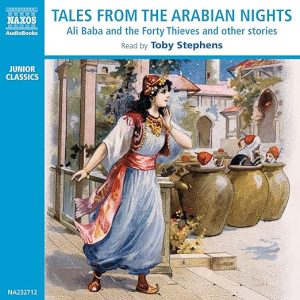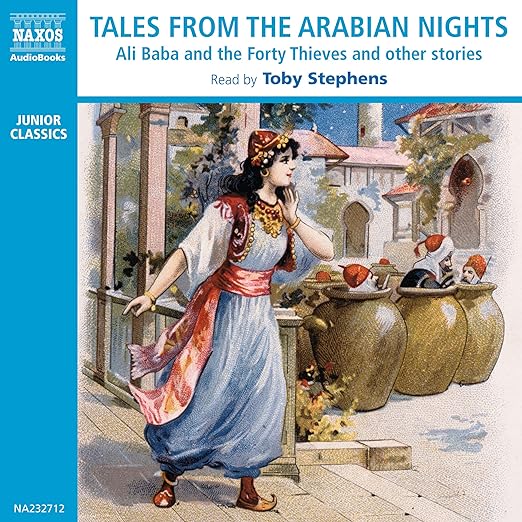
How much of the Arabian Nights fits into two hours and fourteen minutes? Not a great deal, and this audiobook does not pretend otherwise. Naxos leads its description with Toby Stephens rather than with the tales, promises Aladdin and his magic lamp, Sinbad the Sailor and Ali Baba, and sets the whole thing against music by Rimsky-Korsakov. Andrew Lang occupies the author field, which is the tidy way of saying that somebody selected and retold stories nobody owns. What arrives is a sampler built for young listeners, and knowing that in advance changes how you judge it.
A five-star entry from March 2012 states the problem better than any note of mine could. That reader loved a children's adaptation in hard copy as a child, went looking for something a daughter could handle, and was delighted to solve it with a Kindle edition. The entry is warm, specific and entirely about a screen. It sits under a Naxos production dated December 2004, built around a performer and an orchestral score. Somewhere in the plumbing, a reception column belonging to a printed selection was poured into an audio page, and the written responses stacked here run from 2012 to 2020 without ever catching up to the format they are attached to.
Taken on its own terms, the file is a compact anthology with a frame around it. Sheherezade keeps telling stories, the three famous ones arrive, and the running time forces a pace that skips the sprawl the full collection is known for. That is an editorial decision rather than a defect, but it is a decision a buyer should be able to see from the outside, and this page does not spell it out. No word on the listing says abridged, selected or adapted. The tag reading Fairy Tales, Folk Tales and Myths does more honest work than the author line sitting above it.
What Makes Tales from the Arabian Nights Worth Hearing
Two hours and fourteen minutes happens to be exactly the right size for the job most families want done. These are stories that reward being heard rather than decoded, and a child who stalls on a page will stay with a voice through a magic lamp and forty thieves. The Rimsky-Korsakov score is not decoration either. The description makes it part of the design, and scoring folk material is a very old idea that works because music tells a listener when to lean in. For a few hours in the car, or a stretch of quiet before bed, the length is the feature.
A three-star from April 2012 supplies the other reason from an unexpected angle. That response reads the collection as pure adventure with only superficial attempts at moralizing, full of distant lands, magic, appetite and competing palaces, where motives run to love, money and social standing. It is written as a complaint. For anybody choosing a first mythology for a household, it reads more like a specification. Children raised on carefully improving fables often find this material startling, and the startle is rather the point. Stephens fronts a text that never softens its own greed and cunning, which is a large part of why it has outlasted politer competitors.
Things to Know Before Starting Tales from the Arabian Nights
The clearest warning on the page comes from a four-star filed in January 2014, which notes that the stories could confuse anyone unfamiliar with Arabian culture while insisting that such a listener will know a good deal by the end. Both halves of that are fair. Names, titles and geography arrive without a glossary, and audio removes the option of glancing back at a page. Two hours leaves no room for the sort of framing a printed introduction supplies. If you are handing this to a child cold, plan on answering questions, and plan on some of them being about who is telling which story to whom.
The narration slot is where this listing spends its confidence. Naxos put Toby Stephens in the opening clause of its own copy, so the reading is being sold as the reason to buy. What that reading has to manage is not one story but a stack of them inside a frame, with a different register for the sailor, the thief and the storyteller, and music cued underneath the whole arrangement. That is a demanding two hours to build. The page hands you a 4.2 average across 164 ratings and a performer's name in the first line, which is a great deal of confidence and not much detail. Sample the opening minutes before committing.
Who Andrew Lang Is Writing For
It suits a household listen where an adult stays in the room. A five-star from April 2016 liked the variety of the stories and the chance to pick up something about the region they come from, and that is the honest pitch: a short, lively introduction that leaves a child curious rather than informed. Families facing a few hours in the car, teachers looking for a lesson-sized chunk, and anyone who wants the three famous tales in one sitting will get their money's worth out of two hours and fourteen minutes.
A complete Arabian Nights is not what this file contains, so anyone after the full cycle should go looking for an unabridged edition instead. The same applies if you want apparatus of any kind: no introduction, no notes and no translator credit appear anywhere on the record, and the author line names a compiler rather than a source. Older teenagers may find the pace brisk to the point of summary. Buy it for the voice and the score, which is what the page is genuinely selling, and not for coverage.
- Narrator: the performer's name opens the description ahead of the stories, which tells a buyer plainly that the reading, not the coverage, is what the money is for.
- Subjects: folk-tale adventure, cunning and mishap, a frame story that keeps generating more stories
- Tone: brisk, bright, faintly mischievous
- Bottom line: a two-hour sampler that does its job for young listeners, provided you know going in that it is a selection rather than the whole cycle.
Is this audiobook a complete Arabian Nights or a selection?
A selection. Two hours and fourteen minutes covers three of the best known stories plus the frame that holds them together, and no field on the record uses the word abridged. The length settles the matter anyway, since the collection this draws from is far larger than any two-hour file could carry.
What age group is this audiobook aimed at?
The description calls it a treat for young listeners, and the record files it under children's audiobooks with an action and adventure tag. Expect a child of elementary school age to follow it comfortably with an adult nearby. A written response from April 2020 describes being held in suspense throughout, which suits that bracket well.
Does the Rimsky-Korsakov music play a real part, or is it background?
The description treats it as part of the design rather than trim, saying the music sets the scene. If it works as intended on a file this short, it is doing structural work rather than mood work, marking the seams between one tale and the next for a listener who has no page to look at.
Who is credited with the reading, and how prominent is that credit?
Toby Stephens. The description opens on that name rather than on the stories, which tells you where the publisher placed its bet. Andrew Lang holds the author field, and no translator or adapter is listed anywhere on the record, so the performer is the only creative credit foregrounded beyond the composer of the score.