Quick Take
- Narration: Another Virtual Voice production, AI-generated narration, which is a significant limitation for a 52-week devotional curriculum that depends on relational warmth and the teacher-student intimacy its synopsis promises.
- Themes: KJV-based systematic theology for children, family discipleship, doctrinal formation
- Mood: Instructional and structured, curriculum-driven rather than story-driven
- Verdict: The KJV framing and 52-week structure offer a more sustained commitment than similar products, but the print-plus-parent-voice delivery will serve the material far better than audio alone.
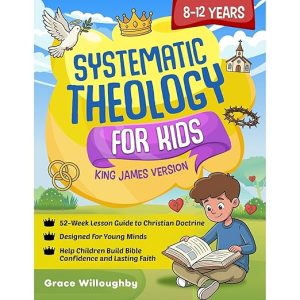
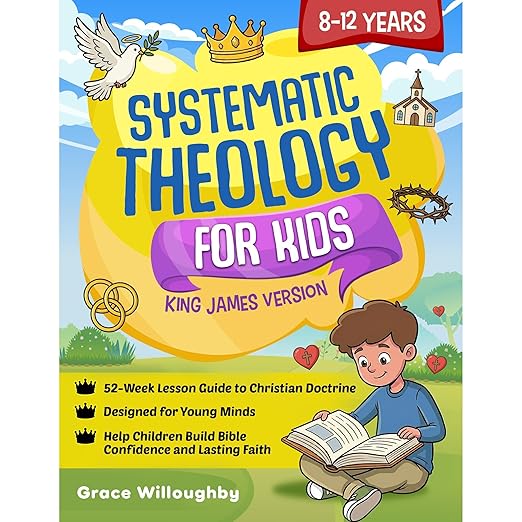
At first glance, Systematic Theology for Kids 8-12 – King James Version looks like a close parallel to the Faith Harper title in this same batch: a structured theological curriculum for children, organized in doctrinal units, aimed at families who want serious faith formation rather than story-based devotional content. The key differentiator Grace Willoughby introduces is the KJV commitment, which signals something important about the intended audience.
Choosing the King James Version as the scriptural foundation is a meaningful denominational and stylistic choice. The KJV’s elevated diction is specifically what many families in certain Baptist, reformed, and independent fundamentalist traditions want their children learning. The reverence of the language is itself part of the faith formation. Willoughby builds this into the curriculum explicitly, with what she calls Word Watch sections that keep the reverence of the KJV while providing simple definitions for older words like Inspiration, Justification, and Longsuffering. That bridging design is thoughtful: the goal is to make the language accessible without flattening it.
Fifty-Two Weeks of Doctrine, Building Brick by Brick
The curriculum covers ten major units across 52 lessons: a full year of weekly family theology. Willoughby moves through Bibliology, theology proper, Christology, pneumatology, soteriology, ecclesiology, and eschatology, using what she calls the Aha! Object Lesson Method, which pairs each abstract doctrine with a concrete household-item demonstration. The flashlight, the sponge, the piece of red yarn: these are the kinds of tactile anchors that make abstract theological concepts genuinely memorable for children. The 52-verse memory challenge adds a catechetical layer that many families will find familiar from Sunday school contexts.
One reviewer confirms that the material works across a range within the stated age group, with both an 8-year-old and a 12-year-old engaging meaningfully with the same lesson. That age-range flexibility is genuinely difficult to achieve in curriculum design, and it suggests Willoughby has calibrated the language and examples carefully rather than writing for a single narrow target.
The Virtual Voice Narration and Its Limits Here
This audiobook also uses Virtual Voice AI narration, which creates the same category of problem I flagged for the Faith Harper systematic theology title. The synopsis explicitly promises a conversational tone, written as a dialogue to help you learn together with your child. That intent is completely at odds with AI-generated speech, which cannot generate genuine dialogue or the spontaneous warmth that makes a conversational tone feel different from a formal lecture. What the print version’s design promises, the audio version structurally cannot deliver.
The 3-hour-43-minute runtime is better understood as a preview of year-long material rather than a complete listening experience. The audiobook may be useful for a parent who wants to understand the full scope of the curriculum before committing to it, or for quickly reviewing a unit before teaching it. As the primary delivery mechanism for the teaching itself, a parent reading aloud with real emotional presence will outperform this narration every time.
The Right Audience for This Book
This belongs in KJV-committed Christian households that want a full year of structured doctrinal education for children ages 8-12. The object lesson design and the conversational framing make it more accessible than a straight lecture curriculum, and the explicit Word Watch bridging between Elizabethan English and modern comprehension is well thought out. The 52-week commitment signals something for families who want theology not as a season but as a sustained way of life at home.
The audiobook version is the least effective way to engage with a curriculum built around discussion, hands-on activities, and conversational engagement. If the content appeals to you, the print edition is the format it was designed for, and your own voice reading it to your child week by week is the narration it deserves.
Frequently Asked Questions
Why specifically King James Version, and how does the curriculum handle the language barrier for modern children?
Willoughby’s choice of KJV is deliberate, reflecting the preferences of many conservative Baptist, reformed, and independent fundamentalist traditions where the KJV is doctrinally significant. To address the language challenge, she includes Word Watch sections that provide plain-language definitions for older vocabulary like Justification and Longsuffering, preserving the reverence while ensuring comprehension.
How does this 52-lesson structure differ from the 33-lesson Faith Harper systematic theology curriculum?
Both cover the same core systematic theology units, but Willoughby’s curriculum is designed for a full 52-week year versus Harper’s 33-lesson structure. Willoughby also incorporates the KJV scaffolding, the Aha! Object Lesson Method using household items, and an explicit 52-verse memory challenge, which adds a catechetical dimension to the doctrinal framework.
Does the audiobook format work for the interactive elements like object lessons and discussion prompts?
Not fully. The Virtual Voice narration reads the curriculum aloud, but the object lessons require household materials and active participation, and the discussion prompts require a present adult to facilitate. The audio version functions best as a planning preview for a parent: the actual teaching moments are designed for print use with a human facilitator.
Is the conversational tone described in the synopsis evident in the audiobook?
The print curriculum is designed with a conversational, parent-child dialogue framing. Virtual Voice AI narration cannot genuinely deliver that quality. Families who want the conversational tone that defines this curriculum’s design will need to use the print edition with a parent reading aloud.