Key Details
- Voice: Paul Mclaughlin is credited on a story most families take a chapter at a time, so what matters is whether the chapter breaks land cleanly enough to stop on.
- Big ideas: a foundling with a hidden destiny, a court undermined from within, ancient prophecy, grief handled honestly for young listeners
- Atmosphere: Warm, perilous and old-fashioned in the best way
- Worth it?: A children's epic that trusts young listeners with real stakes, and one of the few family listens that never talks down to the oldest person in the car.
One Audiobooks brought the first Mistmantle Chronicles book to audio in February 2025 at six hours and fifty-seven minutes, and the counter above the reviews already reads one hundred and sixty-seven. That gap is the first thing to understand about this audiobook: the ratings belong to a story that has been circulating among families for years, while the recording is barely a season old. The series field marks it as book one and says nothing at all about whether the later volumes have followed it into audio.
First, the Big Picture
A tiny squirrel washes up half dead on a beach under a sky of riding stars, is taken in by an island colony that does not ask where he came from, and grows up without knowing a prophecy is waiting for him. That is the setup, and M. I. McAllister does not handle it gently. A five-star response describes reading the book aloud with three children aged eighteen, twelve and eight, reports gasping, crying and cheering across the whole household, and notes that at the end of every chapter they asked for one more. Three ages, one book, no concession made to the youngest.
Good and evil are drawn in hard lines here, and that is a feature rather than a shortcut. The court of King Brushen and Queen Spindle is undermined from inside by animals who want the throne, and the plot turns on a murder the book neither softens nor hurries past. Younger listeners get a clear moral frame to hold on to; older ones get a court intrigue with real casualties in it. The prophecy structure means the ending is never seriously in doubt, so the interest lies entirely in what it costs to arrive there.
Why Listen to Urchin of the Riding Stars
Placing it on a shelf gets easy once you hear the comparison a March 2022 response reaches for: fine animal fiction, not as complex as Tolkien, not as heavily allegorical as Narnia. That is a precise coordinate. The book has the political machinery of an epic without the density, and the moral weight of a fable without the sermon. It sits exactly where a lot of families need something to sit, past the picture-book stage and short of the tonnage a ten-year-old abandons at page sixty.
Voices are the whole job here, and the book hands over a great many of them. An island colony, a king and a queen, a conspiracy inside the court and a small hero at the center of it means Paul Mclaughlin has to keep a large animal cast separate for a listener who may be eight years old and may be listening in the dark. Species offers no help, since they are all animals. Sample a scene where several characters are talking at once rather than the opening chapter, and check whether a child could tell who is speaking without being told each time.
Prophecy and court intrigue are what lift this clear of the animal-adventure shelf. McAllister builds an island with a working political system, a history of its own, and a set of ancient predictions the villains are trying to outmaneuver rather than simply ignore. Nearly seven hours is generous for a children's book, and the length is spent on that world rather than on padding it out. It is also the right length for a family that takes a chapter at a time, which the structure very clearly anticipates.
The Caveats
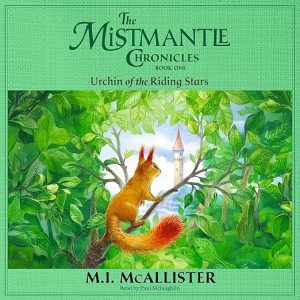
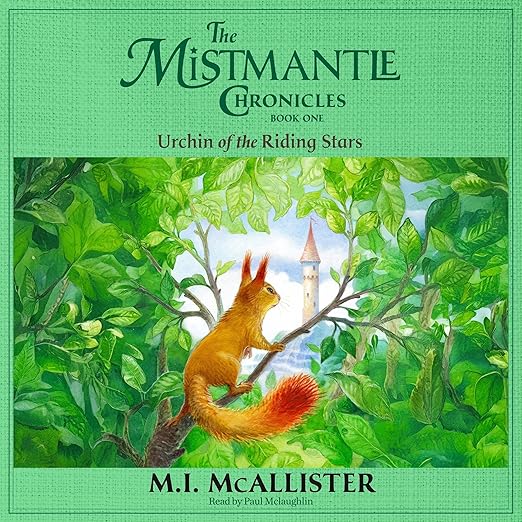
Illustrations do not cross formats, and two responses show why that matters here. A January 2023 five-star praises the lovely illustrations alongside the adventure itself, and a December 2024 entry mentions new covers and a sixth book on the way from a specialist print press. Both are describing a printed object. The audio necessarily drops the pictures, and the reissue news concerns editions you cannot buy in this format at all. Families who want the artwork will need the book as well as the file, and children who like to follow along will want both regardless.
Chronology is the larger caution. Every written response on this record predates the February 2025 recording, several of them by years, so a badge showing 4.7 across one hundred and sixty-seven ratings is measuring a story rather than a reading of it. Nothing about that is misleading on purpose, and it is the normal fate of a beloved book that arrives late in audio. It does mean the column tells you this story is loved and tells you nothing whatever about whether this particular file does it justice.
Who Should Pick Up Urchin of the Riding Stars
Families with a spread of ages are the sweet spot, particularly households that listen together in the car or at bedtime and need something that will not bore the oldest child or lose the youngest. Readers who have finished the obvious animal epics and want another world with a court, a prophecy and a proper villain will find one waiting. Adults who read this kind of thing for themselves, without apology, are well served too, because the writing never condescends and the stakes are allowed to be real.
Sensitive listeners need a warning the copy gives only in passing. A murder drives the plot, the court turns on itself, and the emotional register sits closer to grief than to peril in places. Children who need every animal to survive should wait a year or two. Anyone hoping to hear the whole series should also check what else has been recorded before starting, since the record confirms this is book one and confirms nothing beyond it. Households that avoid death in children's stories should know the plot turns on one.
Questions Listeners Ask
What age is this audiobook right for?
Roughly eight and up for listening together, and older for listening alone. The prose is straightforward and the moral lines are clear, but a murder drives the plot and the book does not hurry past grief. Households that read aloud find it works across a wide spread of ages at once.
Is Urchin of the Riding Stars the first book in the series?
Yes. The record marks it as book one of The Mistmantle Chronicles, and the story stands on its own while plainly setting up more to come. What the page does not tell you is whether the later volumes have been recorded, so check that before planning a whole series listen.
Does the audiobook lose anything from the printed edition?
The illustrations, which readers of the print book single out for praise. Nothing in the plot depends on them, but a child who likes to follow pictures will want a copy sitting alongside the file. Beyond the artwork, nothing else in the book is visual.
How does it compare with other animal adventure series?
It aims higher than a talking-animal adventure and lower than a full epic. The island has a working court, a set of ancient prophecies and a conspiracy with casualties, while the prose stays plain and the chapters stay short. Readers who bounced off the heavier classics usually find this pitched exactly right.