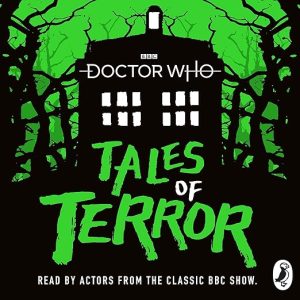
Six writers made these twelve stories and the byline names one of them. Five performers read them aloud and the credit field names one of those too. That is the shape of the record before you reach the audiobook itself, which runs seven hours and twenty-nine minutes and was published for a Halloween back in 2017. My verdict up front: the anthology is considerably better than the page selling it.
This Record Buries a Genuine Five-Hander
The cast is the real story. The description names five performers reading these stories, Sophie Aldred, Adjoa Andoh, Rachael Stirling, David Bailie and Derek Jacobi, and the narrator field names the first of them and stops. Anyone comparing this against a single-voice anthology on length or price is comparing the wrong things. A five-hander across twelve stories is a different product: each reader arrives with a different relationship to the material, and variety of voice becomes structural rather than something one performer has to manufacture. That is the most valuable fact about this recording, and the record buries it.
The writing credits go the same way. Six authors appear in the description, Jacqueline Rayner, Mike Tucker, Paul Magrs, Richard Dungworth, Scott Handcock and Craig Donaghy, and the byline carries Tucker alone. The structure follows from the arrangement: twelve stories, each starring a different incarnation of the Doctor, each supplying a fresh nemesis, with companions including Sarah Jane, Jo, Ace and Donna appearing along the way. An anthology assembled from six hands will be uneven by design, and presenting it as one author's book sets up an expectation of consistency the contents were never built to meet.
Aldred's Credit Is the Only One You See
Reception is warm and unusually specific about the reason. One reader praises the theme running through the collection and says it captures the characters in all their glory, which is the compliment that actually counts in licensed fiction, where the standing risk is a Doctor who sounds like a generic hero with a time machine. Twelve stories at roughly thirty-seven minutes apiece is close to the ideal size for the form. That is long enough for a monster to arrive and be dealt with properly, and short enough that a weak entry costs you half an hour instead of an evening.
Five readers across twelve stories makes the handoffs the thing to test. Each performer takes different Doctors and different companions, which means the anthology's coherence depends less on any individual reading than on whether the moves between them feel deliberate or accidental. Sophie Aldred's credit is the one the record shows you and the other four arrive unannounced, so a buyer who samples the first minutes learns about one voice out of five. Sample across a story boundary instead of inside a single tale, because openings always sound confident and the seam between two readers is where an anthology either holds together or becomes a pile of separate files.
Without Pictures, the Monster Has No Fence
The description promises twelve illustrated adventures, and illustrations are precisely what an audio edition cannot hand over. In a children's horror collection that is not a cosmetic loss. Pictures do a particular job in frightening stories for young readers, which is to fix the outer limit of what the monster looks like, and a fixed limit is what makes the fear survivable. Remove them and the images relocate to the listener's own head with nothing to fence them in, which works brilliantly for some children and backfires badly for others. Nothing on the record points to an accompanying document that would restore them.
Quality varies across the twelve, and the column says so plainly. The one grade below five stars is scored three and a half rounded up, and explains the rounding: some stories worked better than others, though the collection is a nice one overall and any fan will appreciate the classic monsters in it. That is a fair account of every multi-author anthology ever assembled. Read aloud to a school class, according to a December 2019 response, these stories landed well, which is useful evidence about the age range and comes from one classroom rather than from a survey.
One more field is worth noticing. The publisher slot reads BBC Children's Books while the description opens by announcing that Penguin presents the audio download edition, so two houses appear on one record with no explanation of which did what. The shelving is odder still. A spine-chilling collection of terrifying monsters and villains sits under children's audiobooks carrying a Holidays and Celebrations tag, which the Halloween pitch technically justifies and which will still steer a parent toward something considerably darker than a seasonal label implies. Note that the copy uses the words terrifying and frightening about its own contents, which is the most reliable guidance anywhere on the page.
Twelve Separate Adventures, No Single Through-Line
Households with children old enough for genuine scares are the target, and the short-story format solves the bedtime problem a novel creates. Anyone who grew up with the classic run and wants older Doctors served alongside newer ones will find the incarnation-per-story structure does exactly that, without asking anyone to pick a favorite. Teachers and anyone who reads aloud to a group have a ready-made resource, since a story of this length fits a session far better than a chapter of something longer. Collectors of the licensed fiction will want it for the reading cast on its own.
One sustained story is the thing this cannot supply, because twelve separate adventures with twelve separate antagonists is the opposite of an arc and no through-line connects them beyond the seasonal theme. Look elsewhere too if unevenness irritates you, since six writers working independently guarantee it and an anthology has no mechanism for smoothing the difference out. Very young listeners are the genuine caution here: the copy uses the word terrifying without hedging, and a monster nobody can see is much harder to set aside than one printed on a page. Parents buying blind should play a whole story well before bedtime rather than the opening minutes of the first one.
How long is the audiobook, and how is it divided?
A shade under seven and a half hours, split across twelve separate stories, which averages a little over half an hour each. No story depends on any other, so the collection suits short sessions, single-story listening at bedtime, or classroom use where a fixed block of time has to be filled.
How frightening is the audiobook for younger listeners?
Frightening by intention. The publisher's own words are spine-chilling and terrifying, and the collection was pitched at Halloween. It sits on the children's shelf, but the monsters are the point rather than the backdrop, so parents of sensitive listeners should audition a full story before handing the file over.
Do you need to know Doctor Who to follow the stories?
Not really. Each story stands alone and introduces its own threat, so the format forgives newcomers. Familiarity pays off in recognition rather than comprehension, since the companions who turn up arrive carrying histories that the stories never pause to explain.
Which Doctors turn up across the collection?
The description states that each story features a different incarnation without listing which ones, so the exact spread is not published. It does name several companions, which points to a mix drawn from both the classic and the modern run rather than a focus on any single era.