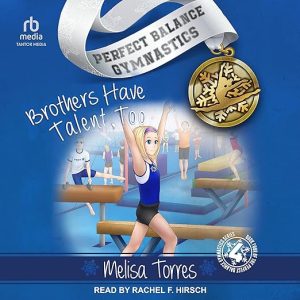
Gymnastics fiction for middle-grade readers is a small enough niche that a well-executed entry stands out quickly. Melisa Torres's Brothers Have Talent, Too, the fourth book in the Perfect Balance Gymnastics Series, arrives with a 4.7 average from 169 ratings, which for a children's audiobook is a strong signal of sustained reader investment rather than statistical noise. The audiobook, narrated by Rachel F. Hirsch, is a compact two and a half hours, appropriate for the age range and the story's particular emotional scale. That the series has built this size of engaged readership over four installments speaks to something Torres is doing consistently right.
I listened to this one on a quiet morning, not the usual listening context for this kind of review, but the short runtime and Rachel F. Hirsch's narration made it a genuinely pleasant hour and a half. This is the fourth book in a series, and Torres assumes listener familiarity with Alexis and her Perfect Balance Gymnastics teammates without making the book impenetrable to newcomers. The series entry point question is real for a book four, but Torres handles continuity gracefully by weaving in enough character context that the stakes feel clear even to listeners who have not followed the team from the start.
Alexis's Brother Drew Adds a New Layer
Rachel F. Hirsch's narration is well-matched to the material. Children's audiobooks require a narrator who can calibrate energy and emotional register for a young audience without tipping into the exaggerated performance that makes adult listeners cringe and sometimes makes child listeners feel talked down to. Hirsch finds the right pitch: engaged and warm, differentiated enough in character voices to keep the ensemble cast distinct, and capable of landing the emotional beats that give the story its stakes without overselling them. The classroom and gymnasium scenes each have their own sonic texture under Hirsch's handling.
The specific challenge of a talent show plot is that it is one of middle-grade fiction's most familiar structures, and Torres earns distinctiveness by grounding the conflict in gymnastics-specific reality. When Alexis's teammates are excluded from the school talent show, the decision she faces is not abstract; it involves real questions about loyalty to her team, her relationships with her brothers, and what it means to shine when the usual context for shining has been removed. The title references Alexis's older brother Drew, who is also a gymnast, adding a sibling dimension that resonates beyond the sport and gives the story an emotional layer that pure athletics fiction often lacks.
Parents Call These Books Compulsively Reread
The reviews from parents consistently highlight their daughters' investment in this series: three separate five-star reviews from parents of nine- and ten-year-old girls describe the books as compulsively reread. That pattern matters because it is easy for children's audiobooks to hold a listener once and fail to pull them back. Torres has built something with a genuine returning audience, which reflects both the series' consistent quality and the authenticity of the characters' voices. The girls in this world feel like real gymnasts facing real social pressures, not idealized versions of young athletes.
For parents listening alongside young listeners, the audiobook's explicit theme framework, each book teaching "girls to be kind to each other, flexible in life, courageous, strong, and most of all, confident," is clearly stated rather than concealed in allegory. Some adult readers might prefer a subtler approach to theme, but for the eight-to-twelve audience this book is written for, clarity of message is appropriate, and the themes are delivered through character action rather than authorial instruction. Alexis makes choices that demonstrate the values Torres is building toward; she does not have them explained to her by a teacher or parent figure.
Alexis Asks for Help Instead of Solving Alone
The two-and-a-half-hour runtime means the book moves quickly, and some of the emotional transitions, particularly around Alexis's decision-making process when her plans fall apart, move faster than a longer middle-grade novel might allow. This is characteristic of the series rather than a specific weakness of this installment; Torres writes efficiently and within the conventions of the genre's expected length for this age group.
New listeners arriving at book four without prior series context may find some of the ensemble dynamics less immediately engaging than readers who have followed the team since book one. The characters are introduced with enough efficiency that the story remains followable, but the depth of the friendships and the specific textures of the team relationships have accumulated across the series. The emotional payoff of certain moments scales with how much time you have spent with these characters in earlier installments.
The talent show resolution itself is satisfying within the series' emotional logic: it requires Alexis to ask for help rather than solve the problem alone, which is a meaningful departure from the self-sufficient heroine template and one that the audiobook earns through the earlier establishment of her family relationships.
New Listeners Should Start at the Beginning
This audiobook is best suited for girls aged eight to twelve with interest in gymnastics, dance, or sports fiction more broadly, and for families with young listeners who have already discovered the Perfect Balance series and want the next installment. Parents seeking audiobooks that model values of teamwork, resilience, and inclusive friendship without being preachy will find Torres's approach satisfying. Listeners arriving at this book cold should ideally start at the beginning of the Perfect Balance series for the full character investment; this fourth installment rewards prior familiarity more than it functions as a standalone entry point for brand-new readers.
A Few Questions About Brothers Have Talent, Too
Is this audiobook appropriate for children who haven't read the earlier Perfect Balance Gymnastics books?
It works as a standalone story, but the emotional investment in Alexis and her teammates is richer for listeners who have followed the series from the beginning. New listeners will follow the plot but may miss some of the relationship depth that series readers bring.
Does the audiobook cover gymnastics technique in enough detail to interest a young competitive gymnast?
The book includes accurate gymnastics elements, and reviewers note that young gymnasts connect with the sport's representation. It is more focused on the emotional and social dimensions of the sport than technical instruction, which makes it accessible to non-gymnast readers while still resonating with those who compete.
How does Rachel F. Hirsch's narration compare to the earlier books in the Perfect Balance audiobook series?
At the time of this review, we do not have narration comparison data across all four books. Hirsch's performance in this installment is warm and well-calibrated for the young audience, with enough character voice differentiation to keep the ensemble cast clear.