Quick Take
- Narration: Bret Baier self-narrates, bringing the authority and familiarity of a news anchor who has lived with this material, confident and well-suited to the historical weight.
- Themes: WWII Allied diplomacy, Roosevelt’s political evolution, wartime leadership under pressure
- Mood: Measured and substantive, with the clarity of a well-produced documentary
- Verdict: Baier self-narrating his own young readers’ edition is a smart choice, his voice carries earned authority, and the Tehran Conference subject matter is genuinely compelling for middle-grade nonfiction.
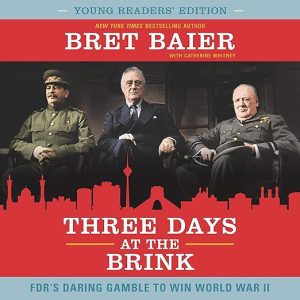
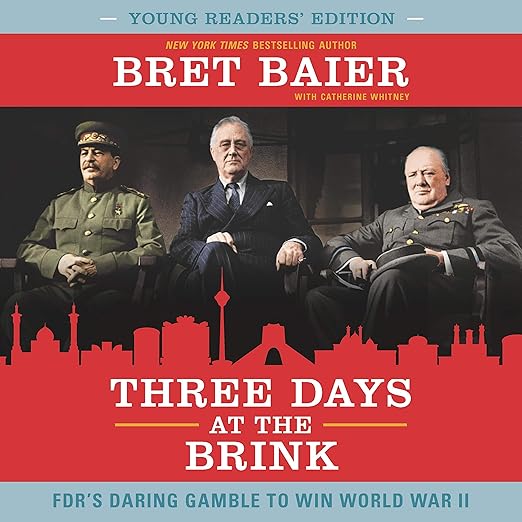
I’ve spent enough time with WWII-era political history to know that the Tehran Conference often gets less attention than it deserves. D-Day gets the documentaries and the memorials; Tehran gets a footnote. But the first face-to-face meeting of Roosevelt, Churchill, and Stalin in November 1943 was, in its own way, just as consequential, the moment when three radically different leaders had to decide whether their shared enemy was enough to hold them together. Bret Baier’s young readers’ edition of Three Days at the Brink makes a strong case that this story belongs in the hands of middle schoolers.
This is the second Baier young readers’ edition in this batch, alongside Three Days in January, which covered Eisenhower’s farewell. The Tehran book is in some ways more dramatically intense: the stakes are immediate, the personalities are larger, and the political fault lines between America, Britain, and the Soviet Union are already visible in 1943 as cracks that will become the Cold War. Baier doesn’t shy away from those tensions while keeping the prose accessible to a younger audience.
Bret Baier Narrating Bret Baier: Why It Works
The decision to have Baier self-narrate is the right one. He is a Fox News anchor who has built a second reputation as a presidential historian, and his voice carries genuine familiarity with the material rather than the formal distance of a hired reader who has learned the subject for the job. Self-narration of nonfiction political history can go either way, authors who are brilliant on the page can be stilted behind the microphone, but Baier’s professional broadcasting background means he is comfortable with audio delivery in a way most print authors are not.
The result is a narration that sounds like a thoughtful person who deeply knows this story, which is exactly the right register for middle-grade historical nonfiction. Reviewers describe the narration as excellent and praise Baier for making the subject come alive. His voice is authoritative without being stuffy.
The Big Three as Characters, Not Icons
Baier’s strength in the adult version, and by reviewer account in this young readers’ edition, is his ability to render historical figures as fully realized people rather than symbols. Roosevelt in 1943 is not yet the icon he will become in memory. He is a man in declining health, carrying enormous political and personal weight, attempting to manage two allies whose worldviews are fundamentally incompatible with American liberalism. Stalin is not a cartoon villain; Churchill is not the pure embodiment of British resolve. They are three men with competing interests trying to win a war together.
One reviewer specifically praised the book’s exploration of the personalities of the Big Three and how they interacted, and noted the way the diplomatic strategy maps onto the military progress of the Allied armies. That synthesis of personality and strategy is what elevates good political history above mere chronology, and it’s clearly present here in age-appropriate form.
The Supplemental PDF and Glossary as Pedagogical Tools
This edition comes with a supplemental enhancement PDF accompanying the audiobook, along with a glossary of terms built into the text. Both are meaningful additions. The glossary matters because WWII-era political and military vocabulary, terms like Allied forces, Axis powers, second front, requires more context than most middle-grade readers will have coming in. The PDF expands the pedagogical value for classroom use and for curious young listeners who want to follow up on specific events or people mentioned in the narrative.
The combination of a glossary and PDF companion makes this edition more classroom-ready than a standard audiobook. A teacher using this for a unit on WWII Allied strategy would find the supporting materials useful in a way that isn’t true of most audio products. At five hours and one minute, this is also a well-proportioned listen, long enough to develop the story fully, short enough for a classroom unit or a weekend family listen.
How This Compares to Three Days in January
Both Baier young readers’ editions cover pivotal transition moments in American political and military history. The Tehran book is arguably the more dramatically urgent of the two, the world is still at war, the outcome is not yet certain, and the personalities involved are more overtly in tension with each other. The January book, covering the Eisenhower-Kennedy transition, has a quieter but perhaps more philosophically interesting conflict at its center. Both are solid middle-grade nonfiction, and listeners who enjoy one should seek out the other.
Who Should Listen, Who Should Skip
Middle school students studying WWII, curious readers ages ten to fourteen, and families who use history audiobooks as educational tools on road trips will all find this well-suited to their purposes. The self-narration, supplemental PDF, and glossary make it particularly functional for classroom supplementary use. Adults already familiar with the Tehran Conference at a detailed level should go directly to the adult edition for greater depth.
Frequently Asked Questions
Does Bret Baier narrate this young readers’ edition himself, and does his broadcasting background help?
Yes, Baier self-narrates. His Fox News anchor background means he is comfortable and authoritative behind a microphone in a way many print authors are not, and his deep familiarity with the material comes through. Reviewers specifically praise his delivery.
What is the supplemental enhancement PDF, and how is it useful?
The PDF is an additional reference document accompanying the audiobook, and the main text also includes a glossary of terms. Together, these make the edition more useful for classroom settings and for listeners who want to explore specific people or events mentioned in the narrative.
Is this a good starting point for middle-grade readers who are new to WWII history?
Yes, though the glossary signals that some vocabulary support is built in precisely because prior knowledge isn’t assumed. Baier provides historical context throughout, making this accessible even to listeners who haven’t studied the period before.
How does this compare to Baier’s Three Days in January young readers’ edition?
Both cover pivotal moments in American history, but the Tehran book is set during active wartime with three international leaders in direct tension, the dramatic stakes are more immediate. The January book’s Eisenhower-Kennedy transition is quieter but philosophically rich. They complement each other well and can be listened to in either order.