Quick Take
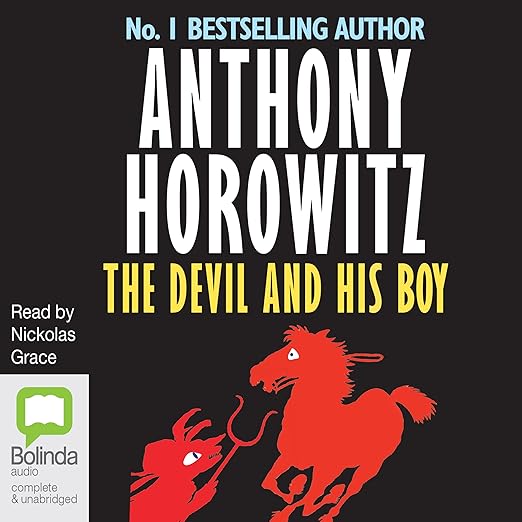
- Narration: Nickolas Grace brings the Elizabethan London milieu alive with a voice perfectly calibrated for both the comedy of Tom’s street survival and the menace of the conspiracy that catches him up.
- Themes: survival and reinvention through performance, the theater as a world of masks and danger, history lurking beneath adventure
- Mood: Brisk and darkly atmospheric, with the grime and intrigue of Elizabethan London in every scene
- Verdict: A compact, historically grounded adventure from Horowitz that uses the Elizabethan theater world to frame a genuinely tense political thriller pitched at a middle-grade audience.
Anthony Horowitz has written enough middle-grade adventure fiction across enough different historical periods that it would be easy to assume his output follows a formula. The Devil and His Boy resists that assumption. I came to it expecting efficient entertainment and found something with slightly more ambition: a novel that uses the Elizabethan theater as more than backdrop, making the world of performance and role-playing central to how its protagonist survives and ultimately acts. Tom Falconer fits into a line of Horowitz heroes who are resourceful and slightly cunning and placed in danger too large for a boy his age, but the Elizabethan setting gives this particular entry a density of historical material that lends texture beyond the adventure mechanics.
Tom is hungry and being hunted when we meet him. The notorious criminal Ratsey is on his trail, and London in 1593, described with enough grime and noise and social stratification to feel genuinely present, offers few safe harbors to a parentless boy on the street. The mysterious Dr. Mobius offers a role in a play to be performed before Queen Elizabeth, and Tom, who has no better options, takes it. The novel then moves toward the revelation of Mobius’s real purpose, an international conspiracy involving the fate of the English empire, and Tom’s unwilling position at its center.
London 1593 as Active Historical Setting
Horowitz did the research. The London that Tom navigates has a specific historical texture: the theater world, the street life, the proximity of political violence, and the particular anxieties of a court at the end of a long reign all feel grounded rather than decorative. One reviewer noted that the book is based on real-life facts, and while the mystery plot is invented, the framework of Elizabethan London theater, including the presence of real historical figures in the background, gives it the pleasurable density of historical fiction that takes its setting seriously. The author’s note at the end, acknowledged in reviews, confirms that deliberate historical liberties are signaled rather than hidden, which is the right approach for fiction that wants to borrow from history without misrepresenting it.
What Tom Falconer Is Actually Doing
The novel’s real subject, below the adventure plot, is role-playing as survival. Tom has no status, no protection, no resources beyond his wits and his ability to appear to be something other than what he is. Dr. Mobius’s play offers him a costume and a function, a recognizable pattern in the Horowitz catalog but particularly well-suited to the Elizabethan theater world where identity was always partly performance. The conspiracy that eventually engulfs Tom places him in a version of the plot that the play was rehearsing, a layering of fiction-within-danger that gives the novel a self-awareness unusual for its length. At three hours and fifty-seven minutes, it doesn’t linger over this theme, but the structure is there for readers who want to notice it.
Nickolas Grace and the Period Voice
Grace is a British actor with extensive classical theater experience, and that background is audible in his narration. He handles the Elizabethan idiom and the period street language with fluency rather than performance, giving the London scenes the texture of lived space rather than costumed backdrop. The menace of Ratsey is rendered without melodrama, and the slipperiness of Dr. Mobius comes through in Grace’s handling of the character’s dialogue, always slightly too reasonable, always one step ahead of Tom’s understanding. The pacing is brisk, which suits the novel’s adventure priority, and Grace keeps the conspiracy’s complexity navigable for its middle-grade audience.
Who Should Listen and Who Should Skip
This is for middle-grade readers aged ten and up who enjoy historical adventure with political complexity and don’t require a comfortable hero from the beginning. Tom is sympathetic but not always likable, and the thriller elements of the conspiracy plot give this a slightly darker edge than some Horowitz entries. Fans of his Alex Rider series will find the pacing familiar and the protagonist recognizable in temperament. Listeners who prefer fantasy settings or contemporary adventure should note the historical focus. The compact runtime makes this an ideal one-sitting listen for a child on a long journey or an adult who wants efficient, well-crafted adventure entertainment with genuine historical texture.
Frequently Asked Questions
Does The Devil and His Boy require knowledge of Elizabethan history to follow the conspiracy plot?
No prior knowledge is necessary. Horowitz provides enough context within the narrative to make the political stakes clear, and the adventure structure keeps things moving even when the historical details are new. The author’s note at the end adds useful context for interested readers.
Is this related to Horowitz’s other middle-grade series, or is it a standalone?
This is a standalone novel, unconnected to the Alex Rider or Diamond Brothers series. It shares Horowitz’s characteristic middle-grade adventure tone and his facility with conspiracy plots, but there are no continuing characters or world connections.
One reviewer mentioned the book contains deliberate historical mistakes. Should that concern a parent or teacher using this as a supplement to history study?
Horowitz’s author’s note acknowledges the deliberate liberties openly, which is the appropriate approach for historical fiction. The liberties are in service of plot rather than designed to mislead, and the note invites readers to identify them. As a historical supplement the novel works best as an introduction to the period and an encouragement to further reading rather than as a factual source.
Is the menace of the criminal Ratsey and the conspiracy plot too frightening for younger middle-grade readers?
The peril is real and the villain is genuinely threatening within the adventure genre’s conventions, but the tone is thriller-adventure rather than horror. Confident readers aged ten and up will find the stakes exciting rather than frightening. Sensitive readers or younger children under nine might find Ratsey’s pursuit and the conspiracy’s violence a little intense.