Quick Take
- Narration: Simon Vance brings his characteristic precision to Lev Grossman’s middle-grade voice, the storytelling is confident and immersive, though some of the younger-character exchanges feel slightly formal in his delivery.
- Themes: Environmental responsibility, rule-breaking and consequences, the tension between growing up and holding on to magic
- Mood: Propulsive and warm, with genuine environmental urgency underneath the adventure
- Verdict: A stronger, more emotionally complex second installment than the first, series fans will find the Golden Swift’s identity reveal genuinely satisfying.
I finished The Golden Swift on a Sunday morning when my nephew was visiting, and we ended up listening to the last ninety minutes together on the couch. He had not read The Silver Arrow and kept asking me to pause and explain things, which tells you something useful about this book: it is not a standalone, but the world Lev Grossman has built is immediately compelling enough that a newcomer wants in from the first chapter. By the end, my nephew wanted to go back and start the series from the beginning. That is probably the best word-of-mouth an author can get.
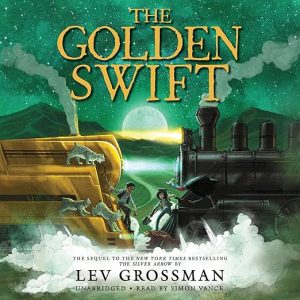
The Golden Swift picks up roughly a year after the events of The Silver Arrow. Kate and her brother Tom are now seasoned conductors on the Great Secret Intercontinental Railway, the steam-powered magical network that transports endangered animals to safety. The climate has worsened, which means more animals need rescuing and the work is harder and more relentless than ever. Into this already complicated picture comes Uncle Herbert’s disappearance, Kate’s humiliating audition loss to her archenemy Jag, and a mysterious rival train called the Golden Swift that appears to have its own agenda out on the rails.
The Environmental Stakes Feel Earned This Time
One of the things Grossman handles unusually well here is the weight of the ecological crisis underneath the fantasy. Kate’s exhaustion is real, she has saved the world before and it did not stay saved, which is a genuinely sophisticated observation to make in a middle-grade novel. Grossman does not soften this. The animals Kate and Tom encounter across the Scottish Highlands, the Australian outback, and the floor of the Bering Sea are specific and vividly rendered, and the book does not pretend that magic railway rides are enough to fix habitat destruction at scale. The moral complexity of whether humans can ever truly be allies of nature rather than its most persistent threat becomes the book’s central question, and Grossman earns the right to ask it without providing a tidy answer.
What the Golden Swift Actually Is
The rival train’s identity and allegiance form the book’s primary mystery, and it is handled with real craft. Grossman plants enough ambiguity early on that readers and listeners will genuinely not know whether the Golden Swift represents a threat or a salvation. A reviewer noted enjoying this entry more than The Silver Arrow precisely because of this moral texture, Kate and Tom encounter new conductors with different philosophies, and the collision between them raises the question of whether there is one right way to care for the natural world. This is the kind of story that works better in audio than on the page, because Simon Vance’s measured delivery lets the ethical weight of these scenes accumulate without rushing past them.
Simon Vance and the Middle-Grade Voice Problem
Vance is one of the most accomplished audiobook narrators working today, but his strengths lean toward adult literary fiction and thriller material. In The Golden Swift, he is mostly excellent, the world-building sequences, the description of the railway’s impossible geography, and the quieter emotional scenes all benefit from his precision and control. Where he occasionally feels slightly miscast is in the faster, more chaotic exchanges between Kate and Tom, which call for a register that is a little looser than Vance naturally provides. This is a minor observation rather than a real problem; a reviewer who listened with their seven-year-old (and then had the child return to it independently at nine) described the experience as appropriate and engaging at both ages, which speaks well of how the narration sustains across re-listens.
Who Should Listen / Who Should Skip
Read The Silver Arrow first. This is not a book that functions well as an entry point, and Grossman does not waste time re-establishing the world’s rules for newcomers. For readers who loved the first book, this delivers everything the first established and adds a layer of moral complexity that makes it the stronger of the two volumes. It works for ages seven and up, though the environmental themes and the genuine sadness of some animal encounters may prompt conversations for younger listeners. Adults who enjoy middle-grade fiction with actual ideas, in the tradition of Eva Ibbotson or classic Diana Wynne Jones, will find this completely readable in its own right.
Frequently Asked Questions
Can my child listen to The Golden Swift without having read or listened to The Silver Arrow first?
Not ideally. Grossman assumes familiarity with the Great Secret Intercontinental Railway, its rules, and the relationships between Kate, Tom, and Uncle Herbert. Starting here will leave gaps. The Silver Arrow is a quick listen at under four hours and is well worth the setup.
How dark does The Golden Swift get? My child is sensitive to animal harm in stories.
Some animal encounters are emotionally heavy, the climate crisis framing means that not every animal the Railway encounters can be saved, and the book does not shy away from that. It is not traumatic, but it is honest in a way that may prompt conversation with younger or more sensitive listeners.
Is the question of whether humans are villains in the natural world addressed at a level kids can understand?
Yes, and it is one of the book’s real achievements. Grossman frames the question through Kate’s own guilt and confusion, she loves nature and is trying to help it, yet keeps being confronted with evidence that human presence is itself part of the problem. The book does not resolve this cleanly, which is actually more reassuring than a false ending would be.
Does Simon Vance’s narration style work for a seven-year-old listener or does it skew older?
It works across ages, though younger listeners may respond better to a co-listening experience. His pace is deliberate enough that complex geography and world-building register clearly. The child reviewer who first heard it at seven and re-read it independently at nine found it engaging at both stages, which is a good indicator of Vance’s pacing judgment.