Quick Take
- Narration: Lisa Flanagan brings real investment to the rainforest animal cast, differentiating between panther, bat, tree frog, and monkey with consistent vocal choices across nearly eight hours.
- Themes: Hidden power and identity, the cost of crossing cultural boundaries, unlikely community under threat
- Mood: Vivid and mythic, with an ecological pulse underneath the adventure
- Verdict: A strong series opener that gives Warriors fans something with more magic and more urgency, Flanagan’s narration is a genuine asset to a book that demands a skilled performance.
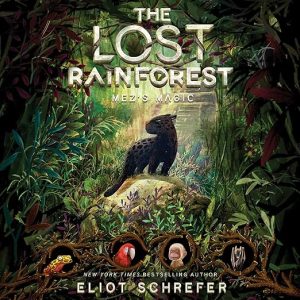
I came to The Lost Rainforest through Eliot Schrefer rather than through the Warriors connection, having read his earlier animal-perspective novels aimed at adult readers. Schrefer is a National Book Award finalist whose work with animal consciousness has always been more sophisticated than the average children’s fantasy, and Mez’s Magic is not, in any meaningful way, a step down from that earlier work. It is a recalibration: the same intelligence applied to a younger audience, the same commitment to making the animal perspective feel genuinely inhabited rather than anthropomorphized into a kid in a fur suit.
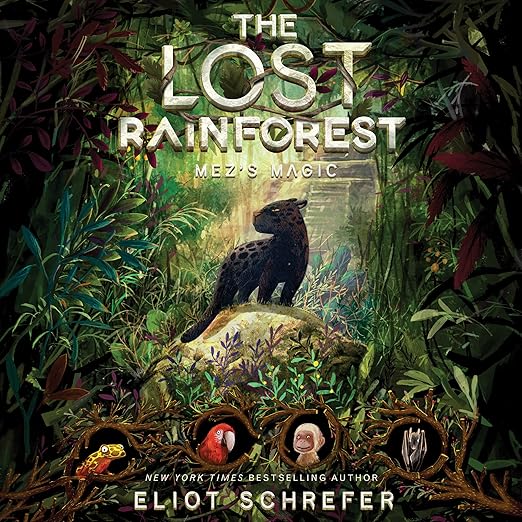
Caldera, the world Schrefer builds in this series opener, is a rainforest divided between nightwalkers and daywalkers, animals separated not by predator-prey dynamics but by the literal boundary between darkness and light, what the book calls the Veil. Mez, a young panther, discovers she can cross that boundary, which should be impossible. What she crosses into is a world of myth made real: the daywalkers she has feared turn out to be complicated rather than monstrous, and the ancient evil she must face requires her to build something she has never needed before, a coalition across the nightwalker-daywalker divide. The animal companions she gathers are specific and well-drawn: Gogi the anxious monkey, Rumi the scholarly tree frog, and Lajja the courageous bat. Each represents a different relationship to fear and knowledge, and their dynamics generate the book’s best character moments.
What Schrefer Does With the Rainforest Ecosystem
The ecological specificity in this book is remarkable for middle-grade fantasy. Schrefer is not using the rainforest as generic exotic backdrop. The canopy levels matter. The relationship between nocturnal and diurnal animal behavior matters. The biodiversity pressure that forms the book’s climax is rooted in something real about actual rainforest ecosystems. For a listener who has never thought about why specific animal species occupy specific niches, Mez’s Magic offers a genuinely educational experience that does not announce itself as educational. It is built into the world rather than bolted on top of it.
Lisa Flanagan and the Multi-Species Cast Across Eight Hours
A book with four main animal protagonists requires a narrator who can maintain four distinct vocal signatures across nearly eight hours without drift or confusion. Lisa Flanagan has narrated the Keeper of the Lost Cities series across multiple volumes, she knows how to manage ensemble casts and sustain character voices through long runtimes. Her Mez has a wariness that softens as the book progresses. Her Gogi is higher-pitched and quicker, conveying the monkey’s nervous energy without making him grating. Her Rumi is measured and precise in ways that fit the scholarly frog. Lajja the bat has a calm that reads as courage rather than flatness. These are considered choices that serve a demanding runtime.
How This Stands Alongside and Apart From the Warriors Comparison
The Warriors comparison on the cover is accurate but slightly limiting. Warriors is primarily a clan-politics series with battle sequences as its emotional engine. The Lost Rainforest has more magic, more mythology, and a more explicit environmental conscience. A child who loves Warriors will likely enjoy this, but the appeal extends beyond that readership to anyone who found the Warriors world too focused on feline hierarchy and not enough on wonder. Kirkus gave this a starred review and described it as a series stunner, and that assessment holds up on audio where Flanagan’s performance and the immersive world-building combine to make an eight-hour listen feel purposeful rather than long.
Frequently Asked Questions
Is this appropriate for a child who has not read the Warriors series, or is it written for that specific audience?
No Warriors knowledge is required. The cover comparison is a marketing shorthand for ‘children’s fantasy with animal protagonists and serious world-building,’ not a statement about shared continuity. Mez’s Magic is a completely independent story with its own mythology, and it works equally well for readers who have never encountered the Clan cats.
At seven hours and fifty minutes, is this too long for a middle-grade listener who is new to long-form audio?
The pacing is generally strong enough that the runtime does not feel excessive, but it is a commitment for younger listeners. For a child aged eight to ten who has not built up much audio stamina, listening in daily sessions of thirty to forty-five minutes works well with this episodic-feeling narrative. The book does not require marathon sessions to follow the plot.
Does the series continue, and is Lisa Flanagan the narrator throughout?
The Lost Rainforest is a trilogy, continuing with Gogi’s Gambit and Rumi’s Riddle. Lisa Flanagan narrates across the series, which is a meaningful continuity benefit for listeners who become attached to her character voices in this first volume.
The synopsis mentions this is for fans of Spirit Animals, is the magic system similar?
The magic in Mez’s Magic involves the ability to cross between daylight and nighttime worlds and individually discovered animal powers tied to specific characters. It shares with Spirit Animals the idea of animals as bearers of ancient magic and the ensemble-quest structure, but the systems themselves are distinct. Schrefer’s magic feels more mythological and less mechanical than the Spirit Animals approach.