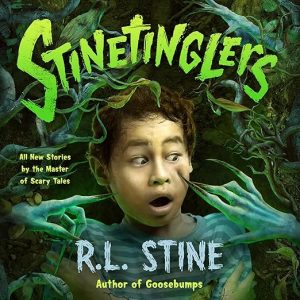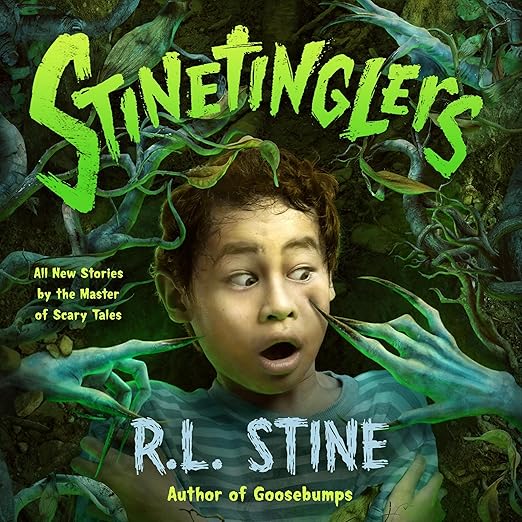
Ten stories, ten introductions and a boy who starts seeing bugs everywhere: this audiobook collects short horror written for young listeners by R. L. Stine, alongside a basketball player whose skin seems to be sliding off his hands where nobody else can see it, and three friends who find a hole in the ground that keeps getting bigger. Four hours and forty-six minutes, ten separate helpings of dread, and no story long enough to outstay its welcome.
The numbering on this record does not add up, and a buyer should sort it out before spending anything. The title says three. The series field says one. The description announces ten new stories with no reference to any earlier volume, and one written response reviews the collection explicitly as the first book of five. Three fields, three different answers, and only the title supports the number printed on the cover.
Publication data settles nothing either. Macmillan Young Listeners dated this recording August 30, 2022, while the written responses run from October 2022 through to January 2026, so the pool spans more than three years of opinion attached to a single ambiguous number. Anyone buying a particular volume for a particular child should confirm the contents against the story list rather than against the digit on the cover.
Stine's formula holds up exactly as the packaging promises. An ordinary kid, one wrong detail, escalation, and an ending that lands a beat earlier than you want it to. The description places the collection alongside Scary Stories to Tell in the Dark and his own Goosebumps books, which is an accurate description of the neighborhood, and the signature humor runs underneath the scares rather than replacing them. Nothing here reaches for gore, which is the other reason the formula has lasted this long: the fear is structural, built out of a rule of the world quietly breaking, and it clears before bedtime does.
Why It Works in Audio
Two voices share this file, and the record credits just one of them. Katharine Chin holds the narrator field, while the description states plainly that Stine reads the introduction to every story himself. For a horror collection aimed at children, an author stepping in before each piece is not a footnote, it is most of what the audio edition offers over the paperback, and the record gives it no credit line whatsoever.
Short-form horror is close to ideal for audio, and for this age group in particular. Ten stories inside four hours and forty-six minutes averages out at under half an hour each, which fits a bedtime, a car journey or a reluctant reader's attention span exactly. Nobody has to carry a plot across several days, and any story that lands badly is finished quickly.
The premises the publisher previews are the right kind of specific. Bugs multiplying in a boy's field of vision, skin that appears to be coming loose on a basketball player's hands while everyone around him sees nothing wrong, a hole in the ground that will not stop growing. Each one is a single wrong detail dropped into an ordinary afternoon, which is the mechanism that has always worked on a nine-year-old at ten at night.
What to Watch For in Stinetinglers 3
Every enthusiastic response on this page describes reading rather than listening. A four-star from June 2023 reports a son who enjoyed it and a household that still rereads the stories, and a five-star from May 2023 describes a child who enjoyed reading the book and is already waiting for the next one. Both are recommending the writing. What the audio edition adds on top of it, introductions included, is not what those responses are measuring.
No age guidance appears anywhere on this record. The publisher aims the collection at young listeners and promises nightmarish fun with a joke about sleeping with the lights on, which is playful rather than informative. Parents of a sensitive child get nothing to calibrate against, and short horror is precisely the format where one story out of ten can land far harder than the other nine.
Format is the final consideration. These are self-contained stories, and a listener who wants a single arc to live inside will find the collection restless by design. Nearly five hours of ten separate escalations is a great deal of setup, and a child who prefers to stay in one world for a while may do better with a novel. The introductions complicate the portioning slightly as well, since every story arrives with a preamble attached, and anyone stopping between pieces will want to save the next introduction for the next session rather than starting it and breaking off.
Who Will Get the Most From It
Handing it down is the use case this page keeps describing. A five-star from October 2022 comes from a grandparent whose daughter read Stine at the same age and whose ten-year-old grandson is now following the same path, bought specifically so the two of them could read it together. That is the audience: households where the name already means something, and where the point is shared scares rather than solitary ones.
Newer arrivals are just as welcome, since nothing in these ten stories depends on the others, and a December 2023 five-star recommends it as a gift on exactly that basis, noting that the collection is current enough to include the technology children actually use. Check the volume number before you buy, though, because this record cannot decide which one it is selling.
A Few Questions About Stinetinglers 3
Does R. L. Stine appear on the audiobook himself?
Yes. The description says he reads the introduction to each of the ten stories, which makes him a second voice on the recording. Katharine Chin is credited for the narration, and that is the only name the record's narrator field carries, so the author's contribution goes unlisted.
How long is the Stinetinglers 3 audiobook and how many stories does it contain?
Just under five hours holding ten new stories, which works out below half an hour apiece once the introductions are counted in. Portioning it across bedtimes or a long drive is easy enough, and nobody gets stranded halfway through something at lights out.
Is this actually the third Stinetinglers collection?
The record contradicts itself. A three sits in the title, a one sits in the series field, and the description introduces ten new stories without placing them after anything earlier. Check the individual story titles before buying it as a particular volume in a sequence.