Quick Take
- Narration: Suehyla El-Attar delivers a warm, grounded performance that honors Muhammad’s first-person voice without over-dramatizing, steady and accessible throughout.
- Themes: Identity and belonging, faith in sport, overcoming racism and exclusion
- Mood: Uplifting and personal, with real emotional weight beneath the inspirational surface
- Verdict: A well-paced memoir adaptation that works best for young listeners aged 10 and up who want both a sports story and a story about finding your place in the world.
I had just finished a long drive back from visiting my sister when I put this one on during the final stretch of highway. Something about the openness of a late-afternoon road felt right for a memoir about a young woman learning to occupy space in worlds that didn’t always make room for her. By the time I pulled into my driveway, I hadn’t moved for ten minutes. I just sat there and kept listening.
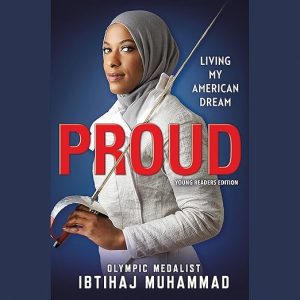
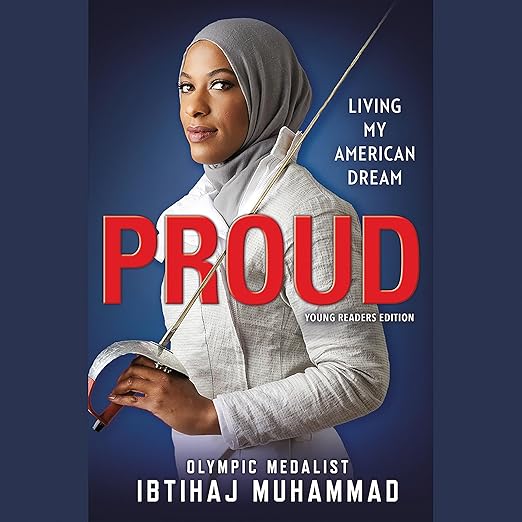
Proud is Ibtihaj Muhammad’s adaptation of her own story for young readers, covering her childhood in suburban New Jersey as the only African American Muslim student in many of her classes, through her discovery of fencing, and eventually to the 2016 Olympics, where she became the first American competitor to wear hijab and the first Muslim American woman to win a medal. It’s a significant story, and the young readers edition strips away some of the adult-memoir texture to focus on the emotional core: a kid who loved a sport that consistently told her she didn’t belong.
Finding Fencing When You’re Already the Odd One Out
What makes the middle portion of this audiobook particularly strong is the specificity of Muhammad’s experience within fencing. This is not a sport that has historically welcomed working-class Black Muslim girls from New Jersey, and the book doesn’t smooth over that reality. Rivals and teammates told her she would never succeed. The cultural mismatch was constant. But Ibtihaj didn’t come to fencing looking for approval, she came because she needed a sport where the uniform covered her arms and head, satisfying her family’s religious requirements. That practical origin story reshapes the entire narrative in a way that feels honest rather than tidy. It wasn’t about finding herself through sport. It was about refusing to be excluded from one more thing.
El-Attar’s narration understands this. She doesn’t over-emote during the harder passages, which is the right choice. The resilience in Muhammad’s story is best served by a voice that stays even-keeled through the difficult stretches, letting the facts carry their own weight. When the emotional moments arrive, and they do, particularly around family and faith, they land more cleanly because El-Attar hasn’t spent the previous hour signaling that we should feel something.
The Faith Thread That Runs Through Everything
Some reviewers approaching this as a straight sports story might be surprised by how consistently and naturally Islam is woven into the narrative. It’s not presented as background context or as an obstacle to be explained. It is simply part of who Ibtihaj Muhammad is, and the book treats it that way. Her family’s faith shapes their decisions, her mother’s approach to her children’s upbringing, and the specific way Ibtihaj has always understood her own identity. For young Muslim listeners, this integration is likely to feel rare and significant. One reviewer noted that the book made them feel that being Muslim and being great at something were not in tension, which is perhaps the book’s most important contribution.
The young readers edition also includes what the synopsis describes as never-before-published photographs and practical advice woven through the chapters. These elements don’t translate to audio in any direct sense, of course, but Muhammad’s storytelling is detailed enough that the visual absence doesn’t hollow out the experience.
The Olympic Story, and What Comes Before It
For a book that gets shelved primarily under sports, Proud spends a surprisingly large portion of its runtime on the years before any medals were in view. This is by design, and it’s the right call. The 2016 Olympics is the climax, not the premise. We spend real time with young Ibtihaj figuring out her place in a largely white, largely affluent sport culture, building the context that makes her eventual success feel earned rather than inevitable. Brown’s The Boys in the Boat Young Readers Adaptation does something similar with Joe Rantz’s early hardship, both books understand that the struggle before the triumph is where young readers most need to live for a while.
At nearly seven hours, this is a substantial listen for its target age group of roughly ten and up. The pacing is sustained rather than driving, which suits the memoir format. It’s not a sprint. It asks young listeners to settle in with a life as it was actually lived, with patience and uncertainty built in.
Who Should Listen and Who Should Skip
Proud works well for: young listeners aged 10 and up who are interested in sports memoirs, anyone looking for representation of Black Muslim identity in children’s audio, classroom use in discussions of identity, belonging, and athletic perseverance, and parents looking for a conversation-starting family listen. Skip this if you’re expecting an action-packed sports narrative with wall-to-wall game coverage, the fencing itself is one element of a larger personal story, not the book’s whole focus. Adults who have already read the original adult edition will find this adaptation covers familiar ground at a somewhat gentler depth.
Frequently Asked Questions
Is this the same as the adult edition of Proud, or is it meaningfully different?
The young readers edition is a distinct adaptation written with younger audiences in mind. It retains Muhammad’s personal voice and the major narrative arc but adjusts the depth and framing for listeners roughly aged 10 and up. The adult memoir has more texture around her professional career and post-Olympics work; this version focuses more tightly on her childhood, faith, and path to fencing.
Does the audiobook cover the 2016 Olympics directly, or does it end before that?
The 2016 Rio Olympics, where Muhammad became the first American to compete in hijab and the first Muslim American woman to win a medal, is covered in the audiobook. The bulk of the listening time builds toward that moment rather than dwelling on it, but the history-making achievement is part of the narrative.
Is Suehyla El-Attar’s narration a good match for this memoir?
El-Attar brings a calm, authentic quality to the narration that suits Muhammad’s measured, resilient voice. She doesn’t over-perform the emotional beats, which keeps the more difficult passages about racism and exclusion from feeling manipulative. Listeners who prefer a warmer, more expressive narrator might find her slightly reserved, but the choice serves the material.
Are the photographs and activity tips mentioned in the synopsis accessible in the audiobook?
The physical photographs and visual elements described in the synopsis are part of the print edition and do not appear in audio form. The companion material is a meaningful loss for this particular book given that Muhammad’s story is so rooted in specific visual moments. That said, the narration is detailed enough that the audiobook stands on its own as an experience.