Quick Take
- Narration: David Van Der Molen reads with a light, game-native energy that matches the first-person chicken narrator’s comic bewilderment, approachable and consistent for young listeners.
- Themes: Unexpected identity, reframing perceived weakness as strength, the internal logic of game worlds
- Mood: Silly and adventure-ready, with a low hum of self-discovery
- Verdict: A short, cheerful piece of Minecraft fan fiction that earns its audience through genuine comic voice and a surprisingly warm message about underestimated creatures.
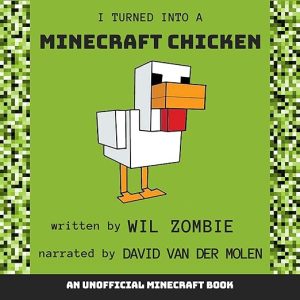
I will admit I had low expectations. Fan fiction framed around game mechanics is a crowded shelf, and the title of this one, I Turned into a Minecraft Chicken, reads as either the best possible pitch or an absolute guarantee of nonsense. It turned out to be something in the middle, and significantly better than the title suggested. I listened to it in one fifty-five-minute commute on a morning when I needed something that made no demands on me at all.
The setup is efficient and genuinely clever in miniature: a player character has been transformed into a Minecraft chicken and must now navigate the world from inside the perspective of an animal widely regarded as the most useless creature in Minecraftia. The narrator opens by apologizing for accidentally lapsing into clucking, which is the right joke to make first and Wil Zombie makes it well. From there, the book tracks the narrator’s transformation from embarrassed chicken to something approaching grudging pride in what chickens can actually do, if you pay attention.
The First-Person Chicken Problem, Solved
The central challenge of this premise is sustaining a first-person narrative from inside a creature that, by the game’s own logic, exists primarily to drop feathers and eggs before being dispatched by something larger. Wil Zombie sidesteps the obvious trap, having the narrator simply complain about being a chicken for fifty-five minutes, by building a genuine arc around the discovery that chickens have capabilities the narrator had not previously considered. The book’s thesis, delivered through the logic of the game world, is that the things you dismiss as weak often turn out to be stranger and more capable than you assumed. That is a fine message for a Minecraft-adjacent listen, and it is delivered through comedy rather than lecture.
David Van Der Molen’s narration earns its keep here. The first-person voice works because he commits to the narrator’s specific blend of mortification and gradually increasing confidence. He does not play the chicken as a joke to be laughed at, he plays the narrator as someone slowly revising their assumptions, which is more interesting and more respectful of the premise.
What This Is and What It Is Not
This is not an official Minecraft product and carries the fan fiction disclaimer clearly. That matters for a specific category of parent: the one who wants to know whether this is endorsed by Mojang or is a third-party title before handing it to their child. The answer is third-party. The production is competent, the content is clean, and the Minecraft game logic is rendered accurately enough for players who know the world. What it is not is a high-production Scholastic or Audible Original title. The ambition is modest and the execution matches the ambition, which is exactly the right relationship.
At fifty-five minutes, it is short enough for a single listening session for children ages six through nine, long enough to have a beginning, a comedic middle, and a satisfying resolution. Reviewer Lisa mentioned reading it over four nights at bedtime, which works equally well.
The Gateway Function
The reviews for this title share a specific common thread: parents of Minecraft-devoted children discovering that Minecraft-adjacent books and audiobooks are one of the more reliable gateways into reading and listening for children who have otherwise resisted. The game logic creates immediate familiarity, the humor lands because it draws on knowledge the child already has, and the reading level feels achievable rather than daunting. Reviewers Stephanie and MK both mentioned wanting a sequel, that is the response you want from a child who has just finished a book without being forced to.
Who Should Listen and Who Should Skip
This is for Minecraft fans ages six through ten, especially for children who prefer gaming to reading and whose parents are looking for a bridge between the two. The short runtime makes it ideal for a single bedtime session or a car ride. Adults listening alongside children will find it consistently lightweight but not objectionable.
Listeners looking for serious world-building, complex plots, or literary ambition should look elsewhere. This is cheerful, competent, single-joke comedy built around a premise that delivers exactly what it promises and nothing more.
Frequently Asked Questions
Do you need to actively play Minecraft to understand this book, or is it accessible to non-players?
The book explains its game-world logic as it goes, so a child who has watched Minecraft videos without playing will follow it fine. Some of the specific jokes about chickens’ in-game value land better with players, but they are not load-bearing for the story.
Is this an official Minecraft product, or is it fan fiction?
It is fan fiction, not approved by or associated with Mojang. The book states this clearly. It uses Minecraft’s world and mechanics as a setting but is a third-party independent production.
How does David Van Der Molen handle the first-person chicken narrator?
He plays the narrator as genuinely embarrassed but recovering, rather than as a joke to be laughed at. The performance is light and understated, which is the right choice, the concept is already inherently silly, and a less grounded narrator would push it into self-parody.
Is fifty-five minutes long enough to be satisfying, or does it feel too brief?
The length is appropriate for the format and audience. The arc is complete, the narrator transforms, adapts, and arrives at something resembling self-respect as a chicken. It does not overstay its welcome or feel artificially extended. For the target age of six-to-nine, fifty-five minutes is a natural single-session listen.