Quick Take
- Narration: Suzanne Toren navigates the full emotional range of the material with remarkable control, from playful childhood innocence to the weight of concentration camp testimony, she holds both without forcing either.
- Themes: Holocaust testimony, the resilience of childhood, faith and identity under extreme persecution
- Mood: Intimate and quietly devastating, carried by the specific weight of first-person survivor testimony
- Verdict: A first-person Holocaust memoir written from a child’s vantage point and narrated with profound care, essential listening for middle-grade audiences ready to encounter this history through an individual life.
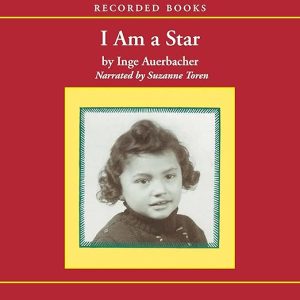
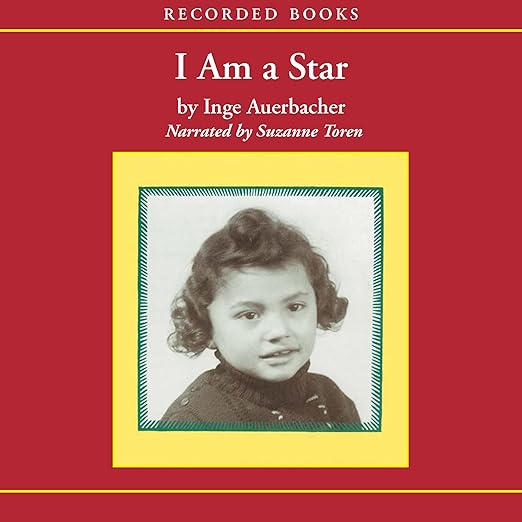
I have a particular relationship with Holocaust literature for young readers, I wrote my undergraduate thesis on it, and I have come to feel that the best of it does something that academic history cannot: it makes the weight of individual experience irreducible. You cannot argue with Inge Auerbacher’s six-year-old self being made to wear a yellow star. That fact, that moment, has a mass that statistics do not.
I Am a Star is narrated by Suzanne Toren, whose work across Holocaust literature for young readers has made her one of the most trusted voices in this specific, difficult category. I listened one quiet weeknight, in one sitting. Auerbacher’s poems, woven through the narrative at regular intervals, are among the most disarming elements of the memoir, there is something about a child’s verse, with its rhythms and its small certainties, that makes the surrounding darkness more rather than less visible.
Six Years Old and the Yellow Star
The memoir opens with Inge as a happy German girl, a specific, important framing. The Auerbachers were German. They were not recent immigrants or obvious outsiders; they were embedded in their community, their country, their neighborhood. The yellow star does not arrive in a context of otherness; it arrives in a context of belonging, which is precisely what makes it devastating. Auerbacher’s account of watching her family’s status, citizenship, and finally their home stripped away follows the historical arc of Nazi persecution with the specificity that only lived experience can provide.
Toren’s narration of these early sections has the quality the synopsis describes as playful innocence, there is a child’s register in her voice for the early material, a lightness that makes what follows more rather than less bearable. She is not performing distress; she is honoring the gap between what a child understood and what an adult now knows she was living through. That gap is the emotional center of the best Holocaust memoirs for young readers, and Toren maintains it with rare precision.
Terezin and What Came After
The transit to the Terezin concentration camp in Czechoslovakia is the memoir’s axis. What Auerbacher experienced there, the hunger, the loss, the cultural life that prisoners maintained against all reason, the final liberation, is rendered with the directness of someone who was a child when it happened and has spent decades trying to make it comprehensible to audiences who were not there. The background material on Hitler, the Nazi plan, and World War II is woven carefully through the personal narrative, providing context without interrupting the flow of first-person testimony.
Reviewer Dr. Jud Newborn, who identifies Auerbacher as one of the most important and active Holocaust survivors and notes her involvement in United Nations Holocaust Remembrance Day events, is pointing toward something that matters: this is not a historical reconstruction. Auerbacher was alive at the time of this recording, and her survival and her advocacy are themselves part of the story. That knowledge gives the memoir a different weight than fictional treatments of the same period.
The Place Alongside Anne Frank
The synopsis positions I Am a Star alongside Anne Frank’s diary and Elie Wiesel’s Night, and while that comparison is bold, it is not wrong. The memoir occupies a specific niche: first-person testimony, written in a child’s voice, with the poems providing a formal element that distinguishes it from both diary and traditional memoir. For teachers introducing the Holocaust to middle-grade students, it works as a companion to Frank rather than a replacement, different country, different experience, different formal strategy, same essential witness.
The reviewer who said simply everyone needs to read this book is responding to that quality of essential witness. Toren’s narration honors it without making it easy, which is exactly the right approach. The 4.6 rating from 177 listeners reflects an audience that came looking for something serious and found it fully realized.
Who Should Listen / Who Should Skip
Appropriate for ages ten and up, with classroom use requiring teacher guidance for younger listeners encountering the Holocaust for the first time. The combination of first-person testimony, historical context, and the formal presence of the poems makes this one of the most formally sophisticated Holocaust memoirs available for young readers. Adults will find it moving on its own terms, independent of any educational context. Those approaching Holocaust history for the first time should not be discouraged by its weight, the child’s voice is what makes it accessible, but they should be prepared for a memoir that asks something of them in return.
Frequently Asked Questions
How does Inge Auerbacher’s memoir compare to Anne Frank’s diary as an introduction to the Holocaust for young readers?
The two work as complements rather than alternatives. Anne Frank’s diary is a document written during events, with the particular vividness of a teenager who did not know how her story would end. Auerbacher’s memoir is retrospective testimony shaped by decades of advocacy and perspective. The poems woven through Auerbacher’s text add a formal dimension Frank’s diary does not have. Teachers often use both together for the different vantage points they provide.
Is the memoir appropriate for children ages eight or nine, or should it wait until middle school?
The memoir is best suited for ages ten and up, with younger children benefiting from having a parent or teacher present to provide context and discussion. The subject matter is not gratuitously graphic, but it deals honestly with persecution, loss, and the realities of the concentration camp experience. Emotional readiness matters more than a specific age cutoff.
What role do Auerbacher’s poems play in the memoir, and how does Toren handle them in the narration?
The poems are integrated throughout the text rather than gathered at the end, functioning as a formal counterpoint to the prose narrative, the child’s voice in verse against the adult’s retrospective testimony in prose. Toren distinguishes the poems in her narration, giving them slightly more deliberate pacing to honor their formal difference from the surrounding text.
Is the audiobook narrated by a single voice throughout, or are there multiple voices or sound design elements?
Suzanne Toren is the sole narrator throughout the approximately 97-minute runtime. The production is straightforward, no dramatization, no music, no multiple voices. This simplicity suits the testimony format; the text is the entire event, and Toren is its vehicle.