Quick Take
- Narration: Barrie Kreinik carries the memoir’s child narrator voice with precision, the restraint in her delivery matches Eva Mozes Kor’s own spare, unembellished prose style.
- Themes: Twin sibling bonds under extreme duress, Holocaust survival, the long path toward forgiveness
- Mood: Spare and devastating, with genuine light in the final chapters
- Verdict: Eva Mozes Kor’s memoir stands apart from most children’s Holocaust literature because it operates at the level of physical and emotional specificity that makes history feel undeniable, and the forgiveness arc is earned rather than imposed.
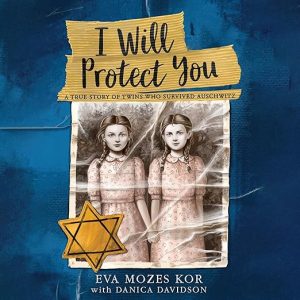
I started I Will Protect You on a quiet Wednesday evening and did not listen casually. There are some books that require you to stop doing other things while you listen, and this is one of them. Eva Mozes Kor’s account of her experiences as a ten-year-old subject of Dr. Mengele’s twin experiments at Auschwitz demands full attention. Not because it is relentlessly harrowing, though it is that, but because the specificity of her observations carries a kind of moral urgency that background listening would dilute.
Eva and her identical twin sister Miriam were deported to Auschwitz from their small Transylvanian village in 1944. At the camp’s gates, they were separated from their parents and siblings and selected for Mengele’s medical experiments on twins. Of the 3,000 twins he experimented on during the war, 160 survived. Eva and Miriam were among them. This book is Eva’s account of how.
Two Girls Inside the Numbers
Holocaust literature for young readers faces a particular challenge: how to convey the scale of industrial murder without abstracting the victims into statistics, while also not traumatizing young listeners with graphic detail. Kor solves this by staying inside her own experience and her sister’s, refusing to generalize beyond what she personally witnessed. The result is a narrative with the intimacy of a diary and the moral clarity of testimony. One reviewer who used this with a reading student noted that it hit them harder than The Diary of Anne Frank, specifically because of the physicality of what Eva and Miriam went through at the hands of Mengele. That comparison is not a ranking. It is a description of different kinds of truth. Anne Frank’s diary is the truth of waiting. Kor’s memoir is the truth of endurance under direct assault.
The Promise That Holds the Narrative Together
The title comes from a promise Eva made to Miriam when they arrived at Auschwitz: I will protect you, she told her sister. An impossible promise made by a ten-year-old in the most powerless circumstances imaginable. That promise becomes the narrative’s moral spine. Every decision Eva makes in the camp, every small act of resistance and adaptation, is filtered through it. Barrie Kreinik understands this and lets the title’s weight accumulate across the full four hours rather than invoking it at set-piece moments. The memoir is not sentimental about the promise. Eva cannot always keep it. What she can do is refuse to stop trying.
Forgiveness as the Hardest Chapter
Eva Mozes Kor became famous in later life not only for her survival but for her public act of forgiving the Nazi doctors who experimented on her and her sister. This memoir, written with Danica Davidson, brings that forgiveness into the narrative. Not as a political statement but as a personal necessity. The memoir is honest that forgiveness was not natural or easy or immediate. It was a choice, made decades after the events, that Eva found freed her rather than the people she forgave. Listeners, young and adult alike, will find this section the most discussed and debated element of the book. Several reviewers called out the power of forgiveness as the central theme. Kor does not ask readers to agree with her choice. She explains it, and the explanation is itself significant.
Spare Prose for Unspeakable Events
The book was cowritten with Danica Davidson and calibrated for younger readers without falsifying the experience. Kor’s own voice comes through clearly in the prose, and the memoir’s spare, direct style is Kor’s natural register rather than a simplification. One reviewer described it as hitting so much stronger than other Holocaust accounts for young readers, responding to this quality: Kor does not soften what happened, but she locates it precisely in two people, two sisters, which makes it navigable. The four-hour runtime is appropriate. Long enough to develop the story with full emotional weight, short enough not to overwhelm.
Who should listen: Middle school students studying the Holocaust, particularly those who have already encountered broader historical accounts and need a personal narrative; families looking for testimony-level literature that handles forgiveness and resilience with nuance; adult readers who want a short, essential survivor memoir. Who should skip: Young listeners under 9 or 10 who may not have the emotional or historical context to process the medical experimentation content; listeners who want Holocaust history without the spiritual dimension that Eva’s eventual faith provides.
Frequently Asked Questions
What age is I Will Protect You appropriate for, given the Holocaust content?
Most educators recommend this for ages 10 and up, with middle school being the typical target audience. The content includes medical experimentation and the deaths of family members, handled honestly but without gratuitous detail. Younger children should ideally read it with adult guidance.
What happened to Miriam after the war, and does the memoir cover their later lives?
The memoir follows both twins through liberation and into their lives afterward. Miriam’s long-term health was damaged by the Mengele experiments and she died in 1993. Eva’s advocacy work and her public act of forgiveness are also part of the narrative arc.
Is Eva Mozes Kor’s forgiveness of the Nazi doctors controversial, and does the memoir address that controversy?
Yes, Kor’s forgiveness was publicly contested. Some survivors and scholars felt it minimized the crimes committed. The memoir presents forgiveness as Eva’s personal act of liberation rather than an exoneration of perpetrators, and it acknowledges that others may have different responses. It does not advocate for forgiveness as a universal prescription.
Is Barrie Kreinik’s narration suitable for a story told from a child’s perspective?
Kreinik handles the child narrator voice with restraint rather than overt performance, which serves the memoir’s dignified, spare prose style. The narration doesn’t overreach toward innocence or sentimentality. It treats Eva’s child perspective as testimony rather than illustration, which is the right choice for this material.