Key Details
- Performance: Carlotta Brentan is the only voice on the file, so Rosie and Germ have to be told apart by performance alone.
- What it covers: A mother who cannot love, stories used as weapons, grief made literal, friendship against something much older.
- Feel: Tender and eerie in equal measure, closer to a ghost story than a romp.
- Our call: Strong middle-grade fantasy with real sadness in it, best shared aloud with younger listeners rather than handed over.
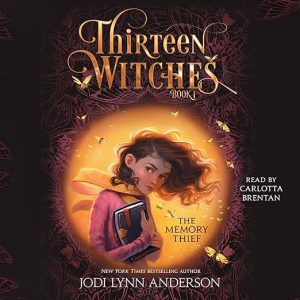
Rosie Oaks is twelve, and her mother is missing whatever it is that makes mothers love their daughters. That line sits near the top of the publisher's description, and it explains why this audiobook lands harder than its shelf suggests. It is not a puzzle Rosie is asked to solve, it is a fact she has grown up inside, and her response has been stories, told and written and hoarded, until the night she decides to throw them all away. Something invisible stops her and puts a book in her hands instead: the Witch Hunter's Guide to the Universe, which claims every evil in the world traces back to thirteen witches nobody can see. One of them took her mother's memories.
A Closer Look at The Memory Thief
Anderson builds a world that keeps opening sideways rather than outward. Ghosts linger as shades of the past. Clouds witness what happens underneath them. A ladder hangs from the moon and leads somewhere larger. Rosie's friend Germ, described in the copy as wild and loyal and earning both words, goes with her into it. The rule of the place is that words are weapons and imagination is the ammunition, which sounds like a slogan on the page and works better than expected in practice, because Rosie's stories are established as a coping mechanism long before they become a defense. The magic grows out of the grief instead of arriving to fix it.
Booklist gave the novel a starred review, calling it a story that thrums with magic, love and tense action, and the last of those three is where one reader pushed back: the battles, when they come, resolve faster than the buildup promises. That is a fair reading. This is a book much more interested in atmosphere and in what Rosie is willing to believe about herself than in choreographing a fight. The witch at the center is a thief of memory rather than a physical threat, and the confrontations reflect that. Tension here is mostly a matter of what might be lost, not who might be hurt.
Words carry unusual weight in this story, and hearing them read gives that idea a second life. The publisher pitches it at readers of The Girl Who Drank the Moon and the comparison holds in register rather than plot: the same willingness to sit inside sadness, the same lyric handling of magic, the same trust that a young audience can take it. One response called the writing intelligent and said it came from someone who understands teenage girls, recommending it for preteens and teens with a taste for fantasy and adventure, which is a more accurate audience note than the childrens shelf this listing sits on.
Reading a twelve-year-old aloud for seven hours is a specific job, and Carlotta Brentan holds the reading credit. Rosie narrates her own life in a voice that has to hold sadness, defiance and a running commentary of invented stories without tipping into performance, and Germ has to sound genuinely unlike her. Use the sample for one thing in particular, which is whether Rosie sounds twelve rather than like an adult performing twelve. Seven hours and nine minutes is roughly three bedtimes of shared listening.
Things to Know Before Starting The Memory Thief
Age guidance is the practical problem, and the written column contradicts itself usefully. One household reports an eleven-year-old who enjoyed the book thoroughly when a parent read it with her, but who found it a little advanced to manage alone. Another reports a third grader who loved it outright and would not give away a single plot point. Both are true, and they describe different activities: shared listening versus solo reading. Since this listing files the title under childrens audiobooks with a growing up and facts of life tag, neither the shelf nor the tag prepares a parent for how melancholy the opening premise actually is.
One-line gift reports make up part of the written column and shape what you can learn from it. A grandparent records only that the recipient loves it, which is warm and almost entirely content-free. Two further cautions belong on the record. This opens a trilogy and does not resolve the larger arc, since twelve witches remain in play after the one named in the title. And nothing on this listing indicates whether the later volumes exist in audio at all, which is worth establishing before a child gets attached to the first one.
Who It's For
Children roughly nine to thirteen who like their fantasy sad around the edges are the target, and the story rewards them properly: a heroine whose weapon is her imagination, a best friend who never becomes a sidekick, and a villain whose crime is subtraction rather than violence. It works especially well as a shared listen, because the premise raises a question a child may want to ask out loud, and a parent in the room is a better answer than a chapter break. Adults who read middle grade for the prose will find enough here to stay.
Parents of very young or sensitive listeners should sample the opening before committing. A mother who cannot love her daughter is a hard idea stated plainly in the first minutes, and no content note on this listing warns anyone it is coming. Households looking for something light-footed and funny are in the wrong place entirely. So is anyone hoping for large set-piece battles, since the confrontations are brief by design and the book spends its energy on atmosphere, on memory and on what Rosie decides to believe she is capable of.
A Few Questions About The Memory Thief
What age is this audiobook actually right for?
Roughly nine to thirteen, with a caveat. The listing shelves it as a childrens title, but the story opens on a daughter certain she has never been loved by her own mother, and the prose is lyrical rather than simple. Younger listeners generally do better with an adult present than alone with the file.
Does the audiobook divide well into bedtime sittings?
Seven hours and nine minutes, which divides comfortably into three or four sessions. The chapter structure follows Rosie's discoveries in sequence, so natural stopping points arrive regularly. For bedtime listening, expect roughly a week at twenty to thirty minutes a night.