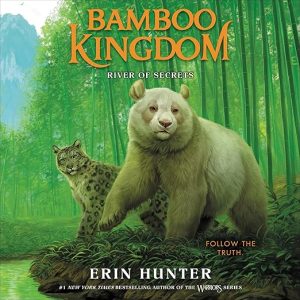
Pandas with names, a stolen title and a prophecy about triplets: the second Bamboo Kingdom audiobook picks up in the middle of a crisis and refuses to slow down for latecomers. Rain, Ghost and Leaf have just learned the truth about their families and have almost none of the facts that would make that truth usable. Six hours later the situation is considerably worse. For a middle-grade animal fantasy this moves with real urgency, and the reason is structural: the villain here is not a predator or a flood but a liar with an official title, which is a harder problem for three young pandas to solve.
Sunset calls himself the Dragon Speaker, and the whole second book turns on the gap between what that title is supposed to mean and what he is actually doing with it. He has an agenda, the prophecy about the triplets threatens it, and so the arrival of any information about those cubs is a danger to him rather than a revelation. Erin Hunter builds the tension by separating the siblings instead of uniting them. Rain and Leaf cannot agree on what to do next. Ghost, still failing to make sense of panda life at all, falls under Sunset's influence and starts working against his own family without understanding that he is doing it.
Splitting a trio is the oldest move in serial middle grade and it works here because each thread carries a different kind of pressure. One is political, one is a search, one is essentially a story about manipulation told from inside the person being manipulated. That last strand is the most interesting thing in the book and the reason it earns its place as a middle volume rather than a holding pattern. The three of them cannot take down a corrupt leader while they are apart, and the book is honest that finding each other is the easy half. Trusting each other afterward is the part that costs something.
Highlights
Six hours and eleven minutes is well judged for the target reader, fitting a run of bedtime sessions or a family drive, and the publisher's own comparisons on the record, the Warriors books by the same author plus Wings of Fire and Endling, tell you precisely which shelf this sits on. A household with a twelve-year-old already following the series wrote in to say exactly that, which is the most useful thing anybody has said on this listing: this is series reading, and the audience for it is a child who has already decided they like animal sagas with clans and prophecies in them.
The reading falls to James Fouhey, and the assignment has one genuinely difficult requirement. Animal fantasy fails the moment the characters sound like people in costume, and it fails differently when a young listener cannot tell the cubs apart. But the real test is Sunset. A villain whose entire power comes from being believed has to sound trustworthy, warm even, in the scenes where he is lying to a child who has no reason to doubt him. Sample one of those exchanges rather than an action sequence, because chase scenes flatter every reader and manipulation scenes do not.
What to Watch For in Bamboo Kingdom #2: River of Secrets
Look closely at the written column and it shrinks. Two of the entries are word-for-word identical, same phrasing, same date, one filed in the United States and one in Canada, which is one person's account of the book appearing twice under two marketplaces and being counted twice. That same account is also the only place on the page where anybody describes what actually happens in the story, and it does so in detail, walking through exiles, betrayals and reversals that a child would rather meet in the book. Parents scrolling for guidance should be aware they are reading a plot summary, not a review.
What remains once the duplicate collapses is thinner than a 4.8 average suggests. A five-star entry from mid-2025 grades the delivery speed and the price and says nothing about pandas at all. A four-star from September of the same year records that the book was bought as a gift for a granddaughter who liked the series. Both are perfectly honest, and both are grading a transaction rather than a story. A hundred and sixty-five ratings sit behind that average, so the number itself is probably reliable enough, but nothing readable underneath it will help you decide.
Entering at volume two is the other thing to weigh. The description assumes you know who Rain, Ghost and Leaf are and why the truth about their families is a shock, and the book opens with that knowledge already in play. A listener who has not heard Creatures of the Flood can follow the plot mechanically but will miss why the reveals land, and the record offers no recap.
Is This One for You?
It suits a household listen where an adult is in the room, particularly for children who have already worked through one animal-clan series and want another. Readers who came through the author's Warriors books will recognize the machinery immediately, and that recognition is the point rather than a criticism. The runtime makes it a practical car choice, and the separated-siblings structure gives natural stopping places, which matters more in children's audio than in anything else.
Give it a pass as a first purchase for a child who has never met this series, since starting at book two means starting after the emotional groundwork is done. Look elsewhere too if you need standalone stories, because this one ends with the Dragon Speaker still in place and the siblings still working toward each other. Sensitive listeners should know that manipulation of a child character by an adult figure is the central engine here, handled at middle-grade pitch but sustained for most of the book. Six hours also assumes a listener who can hold three separate threads in mind at once, which is the real age gate here, rather more than the peril is.
- Narrator: James Fouhey has to make a lying leader sound worth believing, which is a harder job than the action scenes.
- Subjects: Prophecy and inheritance, manipulation by a trusted figure, separated siblings, corrupt leadership in an animal kingdom.
- Tone: Urgent, anxious, middle-grade adventure with a real villain.
- Bottom line: A strong second volume for children already in the series, sold under a review column that counts one person twice.