Quick Take
- Narration: Cary Hite delivers the Big Cheese’s pomposity with comedic precision, finding the right register for a character whose defining trait is extravagance suddenly confronted by its limits.
- Themes: Simplicity over spectacle, community in crisis, the meaning of celebration without the trappings
- Mood: Warm and gently philosophical, wrapped in seasonal silliness
- Verdict: Eleven minutes of Jory John’s characteristic moral lightness, with a holiday message that doesn’t announce itself, well-served by Hite’s comedic timing.
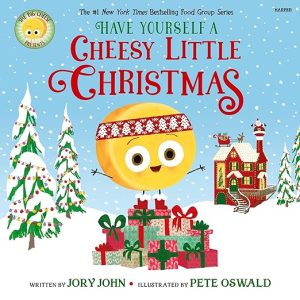
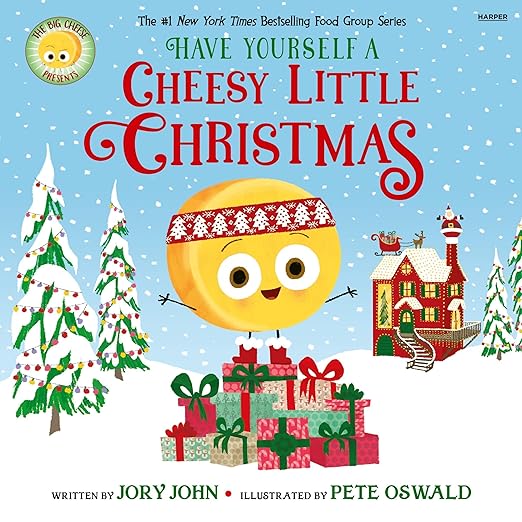
I was in a bookstore in early December when I first encountered the Food Group series properly. The display had The Bad Seed, The Good Egg, The Cool Bean, and the Big Cheese all facing outward, and what struck me wasn’t any individual title but the coherence of the series as a design object. Pete Oswald’s illustration style creates characters whose faces do enormous emotional work in very simple shapes. The Big Cheese, whose cover shows a wheel of cheese wearing an imperious expression, communicates everything about the character’s personality before you open to page one. Jory John and Pete Oswald have built one of the more elegant children’s picture-book universes of the last decade, and the Christmas special is a smart deployment of one of its more recently introduced characters.
The Big Cheese was introduced in an earlier series volume, and the character’s defining trait is magnificent self-regard. Every December, the Big Cheese hosts a jamboree of overwhelming grandeur: flashy decorations, sparkling outfits, extravagant gifts, ear-bursting music. It’s the number one party in town. Then, hours before this year’s festivities, disaster strikes. The Big Cheese has to call in a big favor. And the question the book asks, with John’s characteristic gentleness, is whether Christmas can still be Christmas without the grandeur.
When the Jamboree Falls Apart
The disaster premise is well-chosen because it requires the Big Cheese to function under constraint, which is exactly the situation that reveals character in Jory John’s books. Across the Food Group series, the characters are most interesting when they cannot rely on their defining trait. The Bad Seed is most interesting when forced toward decency. The Good Egg is most interesting when its goodness becomes unsustainable. The Big Cheese, stripped of extravagance, has to discover whether celebration can exist without production values. John doesn’t answer this in a didactic way. The lesson arrives through what the Big Cheese experiences, not through what the Big Cheese announces having learned. That’s the craft the series has always had, and the Christmas special maintains it.
Jory John’s Method: Teaching Without Announcing
The best thing about Jory John’s writing across the Food Group series is that the moral observations arrive without the fanfare of a lesson. The characters are not avatars of pedagogical intent. The Bad Seed is genuinely difficult. The Good Egg has genuine anxiety about being good. The Big Cheese is genuinely pompous in ways that are more than affectation. When the Christmas disaster forces the Big Cheese into dependency on others, what emerges isn’t “and then the Big Cheese learned humility.” It’s more complicated and more honest than that, more in the territory of discovering something that hadn’t been accounted for in the calculations. That’s a more sophisticated emotional argument than a simple moral, and it’s why the series works across adult and child audiences simultaneously.
Cary Hite and Eleven Minutes of Sustained Pomposity
The Big Cheese requires a narrator who can sustain comedic pomposity without making the character unlikeable. Pomposity in children’s fiction walks a narrow line: too much and the character becomes a villain, too little and the eventual humbling has no stakes. Hite finds the register well. He gives the Big Cheese’s pre-disaster grandeur the right theatrical quality, the voice of someone who has never seriously considered that their plans might not execute perfectly. The shift when disaster strikes is played for comedy rather than pathos, which is the correct choice for the book’s tone. Reviewers described children asking to hear it again immediately after it finished, which is the picture-book audiobook’s highest mark of success: the eleven-minute runtime feels like the right length rather than a limitation.
Who Should Listen, Who Should Skip
This is for ages 4-8, and it works best for families already in the Food Group universe. The Big Cheese’s character is established in an earlier volume, and while the holiday special works as a standalone, it has more resonance with that context. Adults reading alongside will appreciate John’s restraint with the holiday message. For pure holiday entertainment with a gentle lesson embedded rather than announced, this is a reliable choice in a format that has few genuinely good options at this age level. It is short enough to listen to every December and substantial enough to merit returning to it.
Frequently Asked Questions
Do you need to have read ‘The Big Cheese’ first to understand this holiday special?
The holiday special works as a standalone, but familiarity with the Big Cheese’s character from the earlier book enriches the comedy. The character’s defining pomposity is established quickly in the special, so new listeners won’t be lost, but existing fans will get more from the contrast between the character’s usual mode and their disaster response.
Is the holiday message heavy-handed, or does it work subtly the way the rest of the Food Group series does?
John’s approach across the series is to embed the moral in the character situation rather than announce it, and the Christmas special maintains that standard. The lesson about simplicity over spectacle arrives through what happens to the Big Cheese rather than through explicit statement. It’s among the gentler holiday messages in recent children’s picture books.
At eleven minutes, is this better as an audiobook or a read-aloud with the physical book?
Both work. The audiobook narration is strong enough to stand alone, but Pete Oswald’s illustrations are a significant part of the Food Group experience. For the richest experience, the physical book remains primary. The audio version suits car rides or as a bedtime supplement best.
How does this compare to other Food Group series entries? Is it among the stronger books in the series?
Reviewer consensus positions it as a solid seasonal entry consistent with the series’ quality. It benefits from the Big Cheese being a character whose specific traits, extravagance and self-regard, are particularly well-suited to a Christmas premise about disaster forcing scaled-back celebration.