Quick Take
- Narration: Jaina Lee Ortiz reads with genuine warmth and cultural attunement, her Puerto Rican-American background resonates in the familial passages and the South Bronx chapters, giving the audiobook an authentic texture.
- Themes: Class mobility and the cost of belonging, family as foundation and wound, the dream of justice as a personal commitment
- Mood: Warm, determined, and honest about hardship, never maudlin, always forward-looking
- Verdict: A substantial, nine-hour adaptation that does not soften the complicated circumstances of Sotomayor’s childhood and earns the inspiration it asks young listeners to feel.
I was halfway through my morning commute when Sonia Sotomayor, through Jaina Lee Ortiz’s voice, described learning that she had type 1 diabetes at age seven and deciding on the spot that she would learn to give herself insulin injections rather than depend on her mother to administer them each day. It is a small moment in a nine-hour audiobook, but it crystallizes the particular quality of Sotomayor’s character that makes this memoir worth listening to: the relentless decision to be capable, even when capable is harder than being helped. I drove the rest of the way to work thinking about that seven-year-old with a needle.
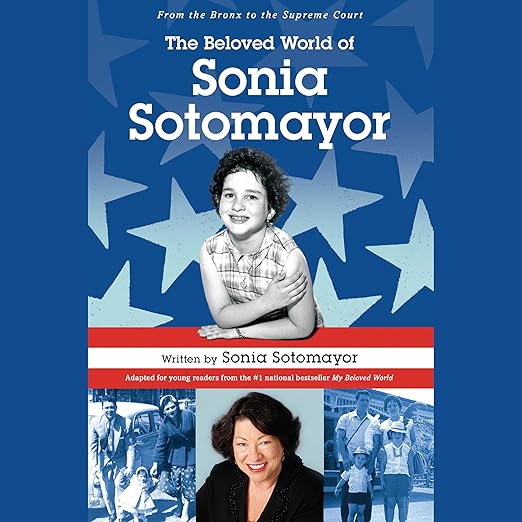
The Beloved World of Sonia Sotomayor is an adaptation of the Justice’s adult bestseller My Beloved World, edited for middle grade readers without being simplified into something unrecognizable. At nine hours and nine minutes, it is the longest audiobook in this batch, and it earns that runtime. Sotomayor’s life between the South Bronx housing projects and the Supreme Court is not a story that can be told briefly without losing most of what makes it instructive.
The South Bronx as Character and Setting
The audiobook’s portrait of the South Bronx in the 1960s and 1970s is one of its great strengths. Sotomayor doesn’t sentimentalize poverty, but she also doesn’t present her childhood neighborhood as simply blighted. There was richness in the extended family networks, in the food and language and music of a Puerto Rican community that had built something real inside structural hardship. Her father’s alcoholism, her mother’s complex coping strategies, the constant financial precarity, these are rendered with adult candor translated into an emotional register that middle grade readers can process without being overwhelmed. The adaptation trusts its young audience to handle complexity, which is the correct call.
Reviewer Juice described being a Latina who fights for the rights of people and finding the story of Sotomayor’s journey wonderful, particularly her navigation of being first-generation, managing a disability, her relationship with her family, going away to college, and finding her way. Those are the chapters where the adaptation does its most significant work: Sotomayor at Princeton, navigating a world that hadn’t fully decided whether she belonged there, discovering her own intellectual capacity through the discomfort of being under-prepared and choosing to prepare herself.
Dreaming What You Cannot Yet Name
The audiobook’s central argument is contained in Sotomayor’s own words as quoted in the synopsis: you cannot dream of becoming something you don’t even know about. She knew nothing about the Supreme Court as a girl. She knew no lawyers and no judges. The book traces how she came to know those things and why that pathway of exposure matters. For a middle grade audience that may themselves have no visible models in the professions they might one day occupy, that argument is the direct purpose of the audiobook’s existence, and it’s made honestly rather than through uncomplicated triumph. Sotomayor experienced discrimination at Princeton, made mistakes, doubted herself, was underestimated by institutions that should have known better. The inspiration in this book is earned rather than asserted.
Jaina Lee Ortiz Reads a Living Voice
When the subject of a memoir is still alive, a narrator faces a particular kind of accountability. Ortiz handles it with care. Her reading doesn’t imitate Sotomayor but finds a vocal register consistent with what the words on the page convey, determined, warm, precise, occasionally funny. The passages about Sotomayor’s Puerto Rican family are where Ortiz’s own cultural background is most audible in the performance, giving the Spanish words and the family dynamics a lived quality that a narrator without that background might have missed. Reviewer Joao Carlos Souto, a Brazilian professor of Constitutional Law, described the book as remarkable and used it as a teaching resource, that breadth of use, from young readers to legal scholars, speaks to how Ortiz’s narration serves both the intimate memoir and the public record.
Who Should Listen and Who Should Skip
Strongly recommended for young listeners ages ten and up, particularly those navigating their own first encounters with institutions that weren’t built with them in mind. The nine-hour runtime is appropriate for the scope, shorter would have meant cutting the material that makes the story credible rather than merely uplifting. Adults without children will find this as absorbing as they would the original memoir.
Frequently Asked Questions
Is this adaptation of My Beloved World significantly different from the adult memoir?
The young readers edition adapts the language and structures the narrative for a middle grade audience, but preserves the major themes and events including Sotomayor’s diabetes diagnosis, her father’s alcoholism, her experience of poverty in the South Bronx, and the discrimination she encountered at Princeton and Yale Law School. The adaptation does not sanitize the difficult aspects of her story.
Does the audiobook cover Sotomayor’s Supreme Court appointment?
The memoir focuses primarily on Sotomayor’s early life and the path to becoming a lawyer and eventually a judge, following the arc of the adult memoir My Beloved World, which ends before her nomination in 2009. The Supreme Court appointment is referenced in the context of introducing who she became, but her tenure on the court is not the focus.
Is Jaina Lee Ortiz Puerto Rican, and does that background matter for the narration?
Jaina Lee Ortiz is of Puerto Rican heritage, and that background is audible in the narration, particularly in how she handles the cultural specificity of Sotomayor’s family life in the South Bronx and the Spanish-language elements of the text. It is one of the cases where casting authenticity produces a tangibly richer listening experience.
At nine hours, how does this compare in scope to other Supreme Court justice biographies for young readers?
The nine-hour runtime is extensive for a middle grade audiobook but reflects the genuine scope of Sotomayor’s life story from the South Bronx to Princeton to Yale Law to the federal bench. Shorter biographies of comparable subjects cover less ground with less emotional depth. This adaptation earns its length.