Quick Take
- Narration: Tim Gregory brings his characteristic warm, even-handed delivery to the Alden siblings, his voice is so associated with the Boxcar Children series that it functions as an audio trademark at this point.
- Themes: Sibling teamwork, curiosity as a virtue, the pleasure of a contained mystery
- Mood: Cozy and gently suspenseful, perfectly calibrated for the 6-10 age range
- Verdict: A reliable Boxcar Children entry that gains something extra from its Caribbean cruise setting, families who discovered the series through travel will find this one particularly resonant.
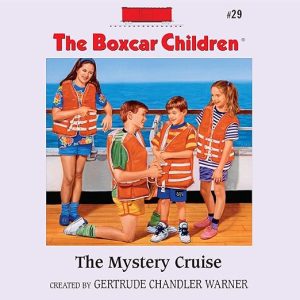
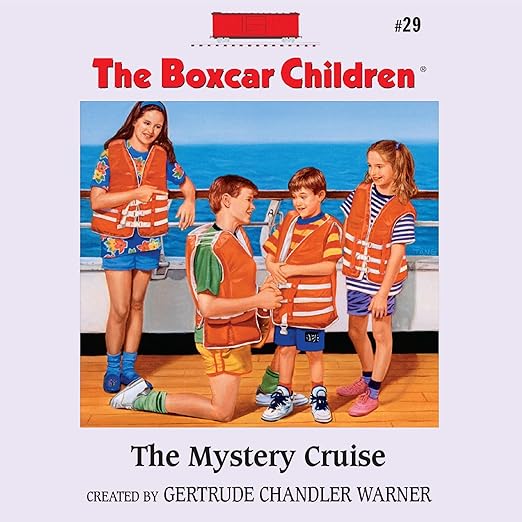
We were somewhere in the middle of a long flight to visit family when I queued up a Boxcar Children title for my nephew, who was seven at the time and had recently discovered the Aldens. I had forgotten, until that moment, what the series actually does well: it creates a world where children are the competent ones, where their observation and reasoning matter, and where adults are present enough to be reassuring but absent enough not to solve anything. That dynamic works at thirty thousand feet. It works on a Caribbean cruise, which is exactly where The Mystery Cruise deposits the Alden children in one of the series’ many location-specific entries.
The setup is clean and efficient, as Gertrude Chandler Warner’s original formula tends to be. The ship’s radio breaks. Someone appears to have fallen overboard, a false alarm that still rattles the passengers. And then the engines develop trouble. The Aldens, who have investigated everything from missing bicycles to art thefts in the series’ long run, correctly identify deliberate sabotage. The question is who, and why, and whether they can find out before something worse happens. It’s a contained mystery with a finite suspect pool, everyone is on the ship, which is the ideal architecture for the audience. No one gets lost, the clues are observable rather than technical, and the resolution is satisfying without requiring background knowledge the target reader couldn’t have.
Tim Gregory and the Sound of the Series
Tim Gregory has narrated extensively in the Boxcar Children catalog, and his familiarity with the material is audible in the best way. He doesn’t oversell the suspense, a narrator who treated every clue as a dramatic revelation would exhaust young listeners, but he maintains a warmth toward the characters that makes an hour and fifty minutes feel like time spent with people you know. The Alden siblings each have distinct personalities in the text, and Gregory gives them distinct vocal registers without exaggerating the differences. Henry’s steadiness and Benny’s younger-sibling energy are recognizable from their speech patterns rather than from affectation, which is the right approach for an ensemble cast that needs to remain differentiated across a long series.
The Setting Does More Work Than the Title Suggests
Location matters more in some Boxcar Children mysteries than others. The Mystery Cruise is one where the setting does real narrative work. A fishing village has its own relationship to the sea, its own economy organized around water, its own social codes about who knows what and why they might not say. The ghost ship legend isn’t just a plot hook; it’s an artifact of a community’s history with loss and the sea. Being at sea means the suspect pool is fixed. The class dynamics of a cruise, different ticket levels, staff versus passengers, give the children different social spaces to navigate as they investigate. One parent reviewer mentioned she had bought the book specifically because her family was about to take a cruise themselves, and that contextual reading adds a dimension the text supports.
The Audience That Returns to This Series and Why
The Boxcar Children series has over a hundred and fifty volumes, and new listeners sometimes feel overwhelmed by where to begin. The honest answer is that most entries work as standalones, you need to know that Henry, Jessie, Violet, and Benny are orphans who lived in a boxcar before being found by their grandfather, but that backstory is restated lightly in each book. The Mystery Cruise requires no prior reading. What it requires is a listener aged roughly six to ten who enjoys the particular pleasure of a tidy mystery solved by children, narrated in a voice that treats that listener as a capable audience rather than a small person who needs everything simplified. Tim Gregory has been delivering that experience reliably across the catalog for years, and this entry is a solid representative of what the series does when it’s operating well.
Frequently Asked Questions
Does The Mystery Cruise work as an entry point for the Boxcar Children series, or should I start with the original?
It works as a standalone. The background, four siblings who used to live in a boxcar, now with their grandfather, is sketched briefly and no prior volumes are required. The original book is a beloved classic and worth reading, but you don’t need it first.
Is the mystery genuinely suspenseful for a child, or does it resolve too quickly to feel satisfying?
At one hour and fifty minutes, there’s enough time to build genuine uncertainty. The false overboard alarm creates early tension, and the engine sabotage raises real stakes. It resolves cleanly, as the series always does, but not so quickly that the mystery feels weightless.
Tim Gregory narrates many Boxcar Children books, is his voice consistent enough across them that a child who’s heard him before will settle in quickly?
Yes, and that consistency is part of the series’ audio appeal. Gregory’s narration has become a kind of sonic comfort for listeners who know the series, familiar voice, familiar characters, new mystery. Children who’ve heard him in other volumes will feel at home immediately.
Is there anything in the Caribbean setting that makes this one better than a typical Boxcar Children mystery?
The shipboard isolation actually strengthens the mystery architecture, no outside help, fixed suspect pool, sea as a barrier. Families who enjoy cruise vacations or have one coming up will find the setting adds a layer of real-world resonance that most series entries don’t have.