Key Details
- Narration: Gildart Jackson's controlled, unhurried delivery suits a memoir built on secrecy and procedure rather than spectacle.
- Themes: private military contracting, anonymity, geopolitical stakes behind covert missions
- Mood: Tense but restrained, procedural over sensational
- Verdict: A credible, detail-rich insider account of contract operations, best for listeners who want context alongside the action.
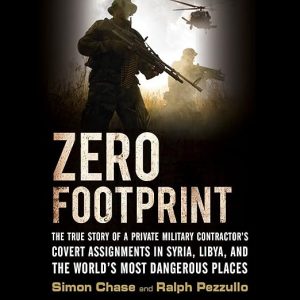
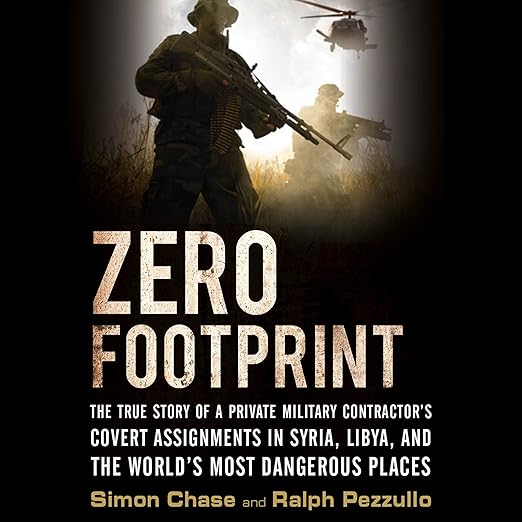
Simon Chase's insider account of private military contracting earns its bestseller status through sheer procedural specificity, and this audiobook benefits from narrator Gildart Jackson, who treats every mission briefing like classified information finally being declassified. Ralph Pezzullo, a co-author with a long resume of collaborating with former special operators, structures Chase's career (tracking Bin Laden in Afghanistan, responding to the Benghazi consulate attack, defusing bombs, guarding convoys) into a single throughline rather than a loose collection of war stories, and the nine-hour-twenty-eight-minute runtime moves accordingly.
Jobs Designed to Leave No Trace at All
Pezzullo's fingerprints are all over the book's structure, and that is a genuine asset. He has co-written accounts with operators from SEAL Team Six and other elite units before, and that experience shows in how cleanly Zero Footprint organizes Chase's career into escalating danger: from routine convoy protection up through the zero-footprint missions the title references, jobs designed to leave no trace of who carried them out or that they happened at all. Jackson's narration matches that escalation with measured control rather than forced intensity, letting the material's own weight do the work instead of overselling it vocally.
Zero Footprint reached national bestseller status by tapping into a genuine and growing public appetite for insider accounts of the post-9/11 private security industry, a category that expanded rapidly as Western militaries drew down their own footprint abroad while private firms increasingly filled the resulting gaps. Chase's account benefits from that context without spending much time explaining it directly, which is one place a listener with a bit of independent background on the industry's growth will get more out of the book than one coming in cold.
What separates this from a more generic special-operations memoir is the specificity around anonymity itself. Chase and his colleagues operate without government backup, without air rescue, and, if they die on a mission, without military honors or public acknowledgment. That is a genuinely different emotional register than the celebrated-hero framing most military memoirs use, and the audiobook sits with that discomfort rather than resolving it into triumph. Reviewer mopic notes the book leans more on background and context than on constant action, which tracks with a narrative more interested in the machinery of contracting than in nonstop set pieces.
Pezzullo's co-authorship credits include collaborations with decorated Navy SEALs on their own memoirs, a track record that shows in how naturally Zero Footprint moves between Chase's individual voice and the broader operational world he describes. That ghost-writing skill, making a single subject's account read, and here sound, like one coherent voice rather than a stitched-together as-told-to product, is easy to take for granted until a lesser example makes the seams visible.
Jackson's Range Keeps Contractors and Diplomats Distinct
Jackson's steady, controlled delivery is well matched to material that depends on restraint for its credibility. A memoir about operators who work specifically to avoid being noticed does not benefit from a narrator who oversells the drama; the tension here comes from procedural precision, the tradecraft of burner phones, armored logistics, and untraceable missions, rather than from action-movie pacing, and Jackson's pacing respects that distinction throughout.
Jackson's British theater and voice-acting background gives him range across accents and registers that a book spanning multiple countries and operational theaters can use; contractors, diplomats, and local fixers each need a slightly different vocal texture to stay distinct, and that range keeps Zero Footprint's geographically sprawling account from blurring into a single undifferentiated voice.
Reviewer EVAGGELOS IOANNIDIS, reading despite a newborn and a toddler at home, calls out the book's view into both the missions themselves and the politics behind them, and that dual focus is where the audiobook earns its keep. Listeners get the operational detail true-crime and military-thriller fans want, plus the geopolitical context that turns individual missions into a coherent picture of how private contracting actually functions inside larger state interests.
The book's title phrase, zero footprint, is itself worth unpacking: in the world of private contracting, it specifically means missions structured so no trace, no equipment, no paperwork, no acknowledgment, connects back to the government or client that ordered them. Jackson's narration treats that term with the precision it deserves the first time it comes up, since the entire moral and emotional weight of the book depends on a listener understanding exactly what that anonymity costs the people living inside it.
A Likely Pseudonym Standard for This Subgenre
Reviewer mopic's assessment, more background than expected and occasionally light on stark impact, is worth taking seriously as a calibration note. Listeners primed by trailer-style marketing for constant action should expect a slower, more explanatory ride: Zero Footprint spends real time on the world contractors operate inside before and between the highest-stakes jobs, not just the jobs themselves.
Because Simon Chase is very likely a protective pseudonym, standard for this subgenre of active-adjacent operator memoirs, listeners should not expect the same kind of publicly verifiable biographical detail available for a retired general or a named politician. That anonymity is the book's whole premise, not a data gap to hold against it, but independent verification of specific claims is not really possible from outside sources.
The book's own cover copy explicitly calls this a national bestseller, and that commercial success suggests Zero Footprint found an audience well beyond the niche of readers already following private military contracting news, likely helped by the same broad true-crime and espionage crossover appeal the audiobook itself trades on.
The three attached reviews land in slightly different places on enthusiasm, worth noting for calibrating expectations. EVAGGELOS IOANNIDIS calls it essential reading for anyone following private military contracting, mopic finds real value but wanted a bit more edge in places, and Rick lands more neutrally, describing solid, well-written work without elevating it to essential status. That spread suggests Zero Footprint satisfies readers already interested in the subject matter more reliably than it converts skeptics into enthusiasts.
True-Crime Podcast Listeners Will Feel at Home
Listeners who gravitate toward military memoirs for the procedural and political texture, not just the action, will find real value here, and Jackson's restrained narration is exactly the right register for a book that trades in secrecy rather than spectacle.
Listeners drawn to this book by true-crime or espionage podcasts more than traditional military memoirs will likely find themselves right at home; the anonymity, tradecraft, and moral ambiguity here have more in common with an intelligence thriller than a conventional war story.
Skip Zero Footprint if you want nonstop action set pieces or a memoir built around a single, sustained mission narrative. This audiobook moves at the pace of a career retrospective assembled from many separate jobs, and listeners wanting tighter narrative momentum should look elsewhere in the genre first.
Common Questions
Does this audiobook focus more on action or on the politics behind contracting work?
Both, with real weight given to context and the political dynamics behind each mission, not just the missions themselves, according to attached listener reviews.
Is this audiobook connected to a specific special operations unit?
Simon Chase's background touches on units like Navy SEAL Team Six and the UK's Special Boat Service, and co-author Ralph Pezzullo has written with veterans of similar units before.