Quick Take
- Narration: Toby Sheets delivers Ralston’s dense, recursive prose with patience and clarity, keeping the listener oriented through material that deliberately resists easy summarizing.
- Themes: Body awareness as practice, structural alignment, the relationship between mind and physical presence
- Mood: Meditative and demanding, like a class that refuses to let you coast
- Verdict: A genuine challenge for anyone willing to take their body’s relationship with attention seriously, though it demands more than passive listening.
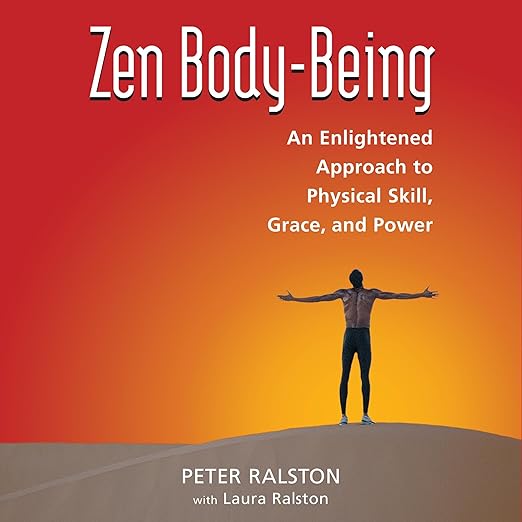
I started listening to this one during a period when I had been sitting too much and feeling it in the particular way that sedentary work eventually makes itself known: a low-grade stiffness, a sense of inhabiting myself badly. I was not looking for a fitness program. I was looking for something that might change how I thought about the problem. Zen Body-Being is exactly that kind of book, and it is also exactly the kind of book that audio might seem poorly suited to convey. Toby Sheets’ narration proves that assumption wrong, slowly and methodically, over just under seven hours.
Peter Ralston has been teaching his approach to body awareness and martial arts for more than three decades. This book, published through North Atlantic Books and originally from a smaller press before that, draws on that teaching practice rather than summarizing it. It is not a book you can skim or listen to with half your attention on something else. One reviewer noted that it “requires by design you to read it more than once,” and the audiobook version carries that same quality: the ideas build on each other in ways that demand that you stay present.
Our Take on Zen Body-Being
The book’s central distinction, between teaching what to do and teaching how to be, is the frame for everything else Ralston says. Most guides to physical practice tell you to perform specific actions: hold this position, repeat this movement, follow this sequence. Ralston is interested in the prior question of what quality of attention produces effective physical action, and he works backward from the results he has observed in his students to describe the mental and physical states that generate them.
The five principles for an effortlessly effective body and the fourteen points on structural alignment are the most concrete sections, but even these are presented as objects for contemplation rather than checklists. Ralston is explicit about this: he wants the reader to feel the principles rather than understand them in the abstract. That is a difficult thing to convey in writing, and it is the book’s central tension. He navigates it better than most.
Why Listen to Zen Body-Being
For martial artists, this is probably required reading, as one reviewer with internal martial arts experience described it. Ralston’s concepts around structural alignment, spatial awareness, and what he calls feeling-imagery have direct applications in practice. But the book is explicitly addressed to anyone interested in mind-body transformation, and the applications extend well beyond combat or physical training: the quality of attention Ralston describes is relevant to any physical activity, and to everyday embodiment.
Sheets’ narration handles the repetitive, circling quality of the prose well. Ralston deliberately returns to his central concepts from different angles, which can read as redundant but is actually a teaching strategy: he is trying to approach something that resists direct statement from multiple directions until it can be felt. Sheets does not rush through the repetitions; he trusts them to do their work.
What to Watch For in Zen Body-Being
This is a demanding listen. One reviewer was honest that “deciphering the principals from the language used required slower, more thoughtful reading than I’m used to.” In audio form, that means you may need to pause frequently, to replay sections, to sit with a concept before moving on. Ralston’s language can be deliberately oblique, especially in the earlier sections on beginner’s body-being and the three aspects of body awareness. Patience is not optional here; it is the prerequisite.
There is also some repetitiveness that even sympathetic readers have noted. One reviewer described moments of wondering “if he has anything new left to say,” before concluding that he does. That is an accurate account of the book’s arc. Push through the middle sections and the later material, particularly on “opening a door” and the five steps to transformation, feels earned.
Who Should Listen to Zen Body-Being
Martial artists, movement practitioners, and anyone who wants to think more seriously about how they inhabit their body will find this rewarding. It is also suited to listeners who have found conventional fitness or mindfulness books too prescriptive, who want a different kind of engagement with embodiment rather than another program. Skip it if you want clear, sequential instruction and measurable outcomes. Come to it if you are willing to be changed in ways you cannot predict before you start listening.
Frequently Asked Questions
Is Zen Body-Being specifically for martial artists, or is it useful for people with no martial arts background?
Ralston comes from a martial arts background and the examples reflect that, but the book explicitly addresses anyone interested in body awareness and mind-body transformation. You do not need martial arts experience to get significant value from it.
Can the exercises and concepts in Zen Body-Being be practiced while listening to the audiobook?
Some of the feeling-imagery exercises are simple enough to engage with while still, but the book works best when listened to with full attention and applied in separate practice sessions. Trying to do both simultaneously would dilute both.
Does Toby Sheets’ narration handle the philosophical and technical vocabulary clearly?
Yes. Sheets reads with patience and precision, which is exactly what the material needs. He does not simplify the language or rush through complex passages, and the pacing allows the ideas space to register.
Is the description of this as a ‘Zen’ approach accurate, or is it more secular and practical?
The Zen in the title is more of an orientation than a religious framework. Ralston draws on Zen’s emphasis on direct experience over conceptual understanding, but the book is not a religious text and does not require any particular spiritual background.