Quick Take
- Narration: Laurel Lefkow delivers a calm, measured performance that suits the contemplative tone without becoming monotonous across 7 hours.
- Themes: Buddhist-informed mindfulness, resilience and equanimity, practical psychology for daily life
- Mood: Grounded and hopeful, with an encouraging rather than prescriptive quality
- Verdict: A genuinely practical Buddhist-inflected mindfulness guide that earns its depth through specificity, 50 tools that feel usable rather than theoretical.
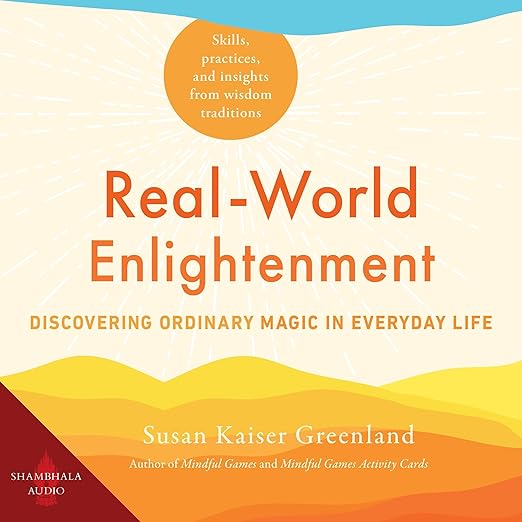
I was halfway through a particularly stressful Thursday when I put on Real-World Enlightenment during a walk. Susan Kaiser Greenland opens with the premise that enlightenment isn’t a lofty destination but something accessible in ordinary moments, and she means it practically, not as a marketing slogan. By the time I was back at my desk, I had mentally flagged three of her “catchy slogans” for immediate use. “Don’t play the scene before you get there” is one I’ve returned to several times since.
Greenland is a longtime Buddhist practitioner and bestselling mindfulness author, and this book draws on that background without demanding that listeners share it. The 50 practical tools she offers are organized around universal themes, Change, Humility, Interdependence, Concentration, Joy, Kindness, Discernment, and each is grounded in science, psychology, and personal narrative as much as Buddhist teaching. The result is a book that can be read as a secular stress management guide or as a deeper exploration of contemplative tradition, depending on where the listener is coming from.
Our Take on Real-World Enlightenment
What distinguishes this from the crowded mindfulness shelf is the combination of intellectual rigor and genuine warmth. Greenland isn’t dumbing anything down, she engages seriously with concepts like interdependence and discernment, but she never loses sight of the practical question: what do I do with this today? The slogans she offers (“right now, I’m okay,” “drop the baggage”) are deliberately simple, because simplicity is the point when you’re trying to interrupt a spiraling thought at 2pm on a Wednesday.
Reviewer Steve Reidman noted the book “could not have come out at a better time,” and that kind of comment appears across multiple reviews. There’s a quality of timeliness to this material that reflects how Greenland has calibrated her message: the shift from “survival-driven frame of mind” to one “grounded and as vast as the sky” is a frame that resonates in the current climate without being preachy about it.
Why Listen to Real-World Enlightenment
At seven hours and ten minutes, this is not a quick listen, but it doesn’t need to be consumed in order. The thematic structure means you can navigate by what you need. Struggling with change? Go there. Overwhelmed by relationships? There’s a chapter on interdependence that addresses it. One reviewer who self-identifies as a seasoned practitioner notes there is “plenty in there for anybody,” which is a useful calibration: the book is designed with experience in mind but doesn’t gate-keep.
Laurel Lefkow’s narration is measured and clear. She doesn’t push the material toward performative serenity, which would feel incongruous with Greenland’s down-to-earth approach. The listening experience is comfortable without being soporific, which is the right balance for this kind of content.
What to Watch For in Real-World Enlightenment
The meditation methods Greenland offers are accessible but require some engagement. This is not a purely passive listen. She asks you to notice things, sounds, sensations, the movement of your thinking. Listeners who want information to wash over them may find the participatory quality slightly demanding. But that quality is also the point: the methods don’t work unless you use them, and Greenland is clear-eyed about that.
The science-and-psychology framing will appeal to listeners who find purely Buddhist language alienating. Greenland is careful not to require any prior familiarity with contemplative tradition, though listeners who do have that background will recognize what she’s drawing on. This makes it genuinely cross-audience in a way that not many books in this space manage.
Who Should Listen to Real-World Enlightenment
Listeners dealing with anxiety, overwhelm, or a general sense of reactivity will find the most immediate value here. It also works for anyone curious about Buddhist-inflected mindfulness who wants a rigorous but accessible entry point. Lifelong meditators will find the synthesis interesting even if some ground is familiar. Skip it if you want a narrative-driven memoir or a strictly academic treatment of Buddhist philosophy, this occupies a practical middle ground that not every reader will need.
Frequently Asked Questions
Do I need to be a Buddhist or have meditation experience to get value from this audiobook?
No. Greenland draws from Buddhist tradition but frames everything through science, psychology, and personal narrative. Beginners will find it accessible; experienced practitioners will find the synthesis worthwhile.
What are the 50 tools, are they guided exercises or more conceptual?
Both. Some are practical slogans designed to interrupt negative thought patterns (“right now, I’m okay”). Others are sensory-based attention practices or meditation methods. Most require some active engagement rather than passive listening.
How does Laurel Lefkow’s narration hold up over 7+ hours?
Lefkow’s delivery is measured and calm without becoming flat. She suits the contemplative tone of the material well. Several listeners who typically find narrated nonfiction dry found this easy to stay with.
Is this more self-help or more spirituality?
Genuinely both, in roughly equal measure. Greenland explicitly bridges the two, using Buddhist frameworks to address practical psychological problems. If you want one without the other, this may feel slightly off-center, but for listeners comfortable with the overlap, it’s a strength.