Quick Take
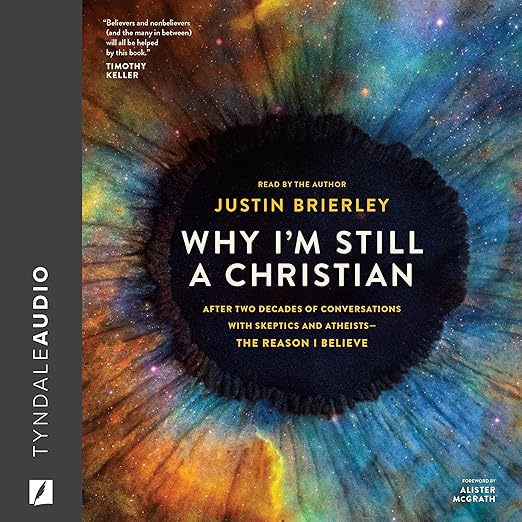
- Narration: Justin Brierley narrates his own book, which works powerfully here since the argument is built on conversational authenticity and the texture of real debate.
- Themes: Christian apologetics, faith and doubt, conversations with skeptics
- Mood: Thoughtful and genuinely dialogic, neither defensive nor dismissive
- Verdict: An accessible apologetics audiobook that earns its format by being centered on real conversations rather than abstract argument; best for curious skeptics and doubting believers alike.
I spent a Saturday afternoon with this one, partly because I was curious about Brierley’s track record, and partly because the premise is genuinely unusual for apologetics writing. Most books in this genre argue from principle: here are the logical reasons Christianity is true, here are the counterarguments, here is why they fail. Brierley’s approach is different. He’s been running a radio show and podcast for over two decades that puts believers and skeptics in the same room, and this book is essentially his accounting of what he learned from all those conversations, including conversations with Richard Dawkins and Philip Pullman, among others. That’s a different kind of argument than the armchair philosophical kind.
The book is described as a revised and updated edition of an earlier title called Unbelievable, published in 2017, with a new chapter on deconstruction added. That chapter addition is timely given how much public conversation about faith in the last several years has centered on people leaving or reconsidering their Christianity. Brierley addresses it with the same candor he applies to the more traditional apologetic questions.
Our Take on Why I’m Still a Christian
What Brierley does well is maintain intellectual honesty about the strength of the objections he’s heard. He’s not the kind of apologist who dismisses atheist arguments as obviously wrongheaded. Reviewer Iola noted appreciating that Brierley doesn’t build his case on false logic, the kind of argument that treats any sin by any Christian as evidence against God’s existence. That’s a lower bar than it sounds, given how much apologetics writing does exactly that. Brierley engages the strongest versions of the objections and explains specifically why, after hearing them repeatedly from serious interlocutors, he finds them unpersuasive rather than unanswerable.
The questions he works through, why would God allow suffering, whether Christianity and science are compatible, whether there’s evidence for the resurrection, are the right questions. Reviewer Faithful Intellect gave it seven out of ten and noted it’s a great summary of common arguments for and against Christianity, accessible even to those new to apologetics, without providing a genuinely new argument for faith. That’s an accurate description. This is not a book for academic theologians or philosophers of religion looking for novel ground. It’s a book for people who want a thoughtful, honest account of why one well-informed person still finds Christianity compelling.
Why Listen to Why I’m Still a Christian
Brierley narrating his own book is the right call. His voice carries the conversational authenticity the argument requires. When he describes what it was like to sit across from Richard Dawkins or Philip Pullman, the texture of the experience comes through in a way that a professional narrator couldn’t replicate. The book’s central claim is that good conversations, including hard ones, are themselves evidence for something: that truth can be approached through dialogue rather than despite it. That argument lands differently when you’re hearing it from the person who actually had those conversations over twenty years.
Rev. Paul A. Tullberg’s review, noting the book was so useful he gave away three copies, reflects the way this works as a gift to people on the edge of conversations about faith. It’s not a book that demands you agree. Reviewer GMJ noted one objection: placing science above scripture in the discussion of evolution and Genesis. That friction is worth knowing about in advance. Brierley’s engagement with science is integrative rather than literalist, which will feel like intellectual honesty to some readers and like a concession too far to others.
What to Watch For in Why I’m Still a Christian
At six and a half hours, this is a manageable listen. The chapters are organized around specific questions rather than a cumulative argument, which means you can revisit individual sections without needing to hold the full structure in mind. That’s unusual and useful for a book that people may want to return to when a specific question comes up in their own conversations or thinking.
The deconstruction chapter is the newest addition and arguably the most timely. Brierley’s treatment of people who’ve left Christianity or who are in the process of questioning it is notably non-defensive. He doesn’t frame deconstruction as apostasy to be argued against. He tries to understand it, which makes this chapter useful even for readers who are themselves in that process.
Who Should Listen to Why I’m Still a Christian
Skeptics genuinely curious about why thoughtful, intellectually engaged people remain Christian will get more from this than from most apologetics writing. Believers wrestling with doubt, particularly those in deconstruction processes, will find Brierley’s approach respectful rather than dismissive. Academic theologians or philosophers wanting novel argumentation should look elsewhere. This is accessible, honest, and built on real conversations rather than theoretical ones, which gives it a texture that more abstract apologetics lacks.
Frequently Asked Questions
Is this a revised version of an earlier book?
Yes. This is an updated edition of Brierley’s 2017 book Unbelievable, revised and expanded with a new chapter addressing the deconstruction movement in contemporary Christianity.
Does Brierley engage seriously with atheist arguments, or does he dismiss them?
He engages seriously. His argument is specifically built on having heard the strongest objections repeatedly from people like Richard Dawkins and Philip Pullman, and explaining why, after all that, he remains convinced. The tone is dialogic rather than triumphalist.
Is this suitable for someone with no background in Christian apologetics?
Yes. Reviewer Faithful Intellect specifically noted it is accessible to those new to apologetics, and the organization around practical questions rather than academic philosophy keeps it approachable. It includes helpful anecdotes from Brierley’s interviews alongside the logical arguments.
How does Brierley handle the science and faith question, particularly evolution?
He takes an integrative approach rather than a literalist one, which one reviewer found uncomfortable. He treats Christianity and science as compatible rather than competing, and engages evolutionary biology without treating Genesis as a scientific text. Listeners with a young-earth perspective should know this in advance.