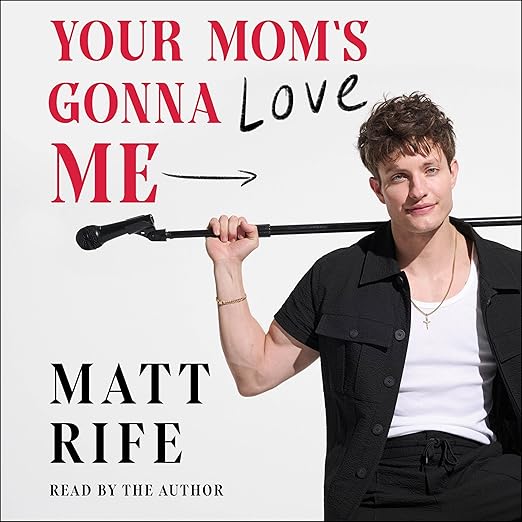
Matt Rife narrates his own audiobook, and within the first ten minutes that choice becomes the entire argument for the project. This memoir-comedy hybrid, written and performed by Rife himself, clocks in at 5 hours and 46 minutes and reads more like a long-form comedy special than a conventional celebrity memoir. If you have already watched his Netflix specials and wondered what shaped the persona behind them, this is the closest thing to a direct answer you are going to get - and if you are coming in new, the Ohio backwoods origin story he builds in the opening act is distinctive enough to carry an uncommitted listener past the first chapter.
His Voice Turns Softer for Grandfather Steve
What sets this audiobook apart from the routine comedian-writes-memoir template is Rife's willingness to let the material turn genuinely uncomfortable. The Ohio upbringing he describes is not played for nostalgia or easy laughs. He portrays his early home life, the loss of his father, and a stepfather he clearly despises with a rawness that catches you off guard. The foul-mouthed but loving grandfather Steve becomes the emotional anchor of the first act, and Rife's voice shifts when he talks about him - softer, less performative, more honest. That tonal contrast is what lifts the material above standard celebrity autobiography. The comedy is real but so is the damage underneath it.
The rap battles with ex-cons, the Justin Bieber tramp stamp incident, the grinding club circuit that stretched from Columbus to Atlanta before Rife had turned twenty-one - these episodes are told with comic precision but they also accumulate into a credible portrait of someone who had very little to fall back on. When he describes finally hitting puberty at twenty-two, it is played as a punchline, but the years of adolescent awkwardness that preceded that admission read as genuine injury. Readers who expect the audiobook to be wall-to-wall bravado will be surprised by how often Rife punctures his own mythology, and how the moments of genuine self-exposure are the ones that land hardest in audio format.
Comic Timing Built Into the Prose Itself
The self-narration here is non-negotiable value. Rife's comic timing translates directly into the prose - the beat before a punchline, the speed-up during a humiliating anecdote, the deliberate slowdown when something costs him emotionally. A professional narrator reading this same text would lose roughly half of what makes it work. His delivery of the depression material is notably careful: he does not play it for laughs, does not rush through it to get back to safer ground. A reviewer named Carmella described finishing the entire audiobook in a single day, and that pacing achievement belongs as much to the narration as to the writing itself.
The comedy club material in the middle section is where the audiobook earns its runtime most fully. Rife's account of cutting his teeth in front of crowds who were not there to see him specifically - who actively dared him to hold their attention - is vivid and specific in ways that abstract advice about perseverance never manages to be. He names rooms, describes the demographic of the audience, recalls specific heckles. That granularity makes it land. By the time the TikTok explosion is addressed in the final stretch, the backstory he has built makes it feel earned rather than accidental. The standup material from his Atlanta years also gets enough development that listeners who have not seen his filmed specials can form a real sense of what his live performance style demands from a room.
A Sustained Counterweight to the Aggression
Two things require honest flagging. First, the audiobook is unapologetically shaped by Rife's self-image. He is the protagonist of every anecdote and the universe tends to confirm his worth by the end of each episode. That is not unusual for the form, but listeners hoping for self-examination over self-promotion will find the balance tilted. Second, the controversy surrounding him - specific public incidents that trailed the release of this book - is not engaged with in any serious depth. He acknowledges being polarizing and frames that polarizing quality as his audience's interpretation problem, not his. Whether that reads as admirably blunt or as a dodge depends on what you bring to the listening.
The humor is genuinely foul-mouthed throughout. The grandfather Steve sections set the register early: this is not a memoir that softens its language for the sake of accessibility. For fans who already follow Rife's work, that is exactly the promise. For anyone coming in cold with lower tolerance for profanity-heavy comedy, the register will feel relentless. The depression material, handled with more restraint, is the one sustained counterweight to the aggression of the surrounding tone.
So Much of the Delivery Is the Content
Existing Matt Rife fans get what they came for and then some: the backstory is richer than his specials have had time to develop, and the self-narration rewards the familiarity you already have with his voice. Listeners who enjoy comedian memoirs where the performer narrates their own material - where comic timing is structural rather than decorative - will find this a satisfying entry in that genre. It works best as audio because so much of the delivery is where the content lives.
If you need a narrator to be a neutral vessel for the material, this format will frustrate you. Rife is playing himself, for himself, to his audience, and the audiobook does not pretend otherwise. Skip it if you want balanced reflection, measured distance from the subject, or a conventional narrative arc with genuine reckoning at the end. The 4.6 rating across nearly a thousand reviewers reflects the satisfaction of an audience that already knows who it is listening to and came to hear exactly this.
Do you need to be a Matt Rife fan to enjoy this audiobook?
Prior familiarity with Rife's standup definitely helps since the book functions as extended backstory to his comedy persona. That said, the early Ohio childhood material and the club circuit sections are compelling enough on their own terms that someone new to him can follow and enjoy the arc.
How does this audiobook compare to his Netflix specials?
The audiobook goes substantially deeper into his childhood, family dynamic, and depression than any of his filmed specials have. The specials are punchy and crowd-driven; this is more sustained and confessional, though the same voice and comic rhythm runs through both.
Is the audiobook format necessary, or does reading the print version work just as well?
Audio is strongly the preferred format. Rife's standup timing and tonal shifts carry a significant portion of the emotional and comedic weight. Much of what makes the depression material land quietly and the comedy land hard is in the delivery, not just the words.