Quick Take
- Narration: Arlan Hamilton reads her own work with conviction and warmth, and the self-narration adds authenticity that a hired voice could not replicate.
- Themes: Entrepreneurship as access, ownership preservation, building generational wealth outside traditional pathways
- Mood: Direct and energizing, with personal storytelling grounding the practical advice
- Verdict: A business book that is honest about who has historically been excluded from wealth-building conversations and offers concrete tools alongside the motivation.
I was on a flight when I started Your First Million, which turned out to be an unexpectedly good environment for it. Arlan Hamilton does not waste time, and neither does the audiobook. At four and a half hours, this is a lean production, which reflects something about Hamilton’s philosophy: she is not interested in padding, in the comfortable recitation of familiar advice with new packaging, or in the kind of false modesty that business books sometimes use to signal relatability. She has a point of view, it is clearly stated, and she applies it consistently.
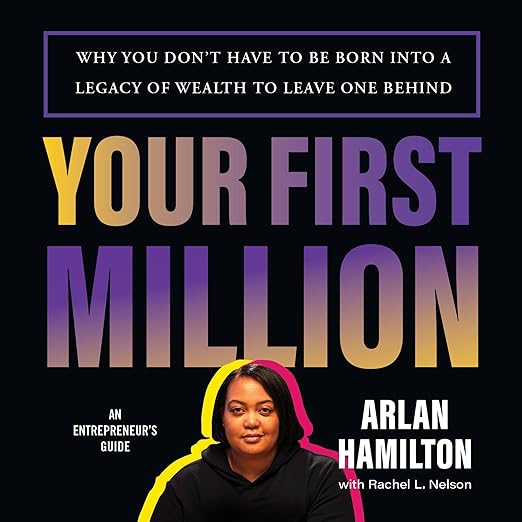
Published by Little, Brown Spark and narrated by Hamilton herself, this is her second book after the successful It’s About Damn Time. Where that book established her story as one of the most unusual in Silicon Valley, one of the few Black women to break into venture capital, having been largely homeless before her success, this book shifts the emphasis from inspiration to application. The subtitle matters: the focus is on how to get your first million, not on how to already be Hamilton.
Our Take on Your First Million
Hamilton’s central argument is structural rather than motivational. Money is power, she argues, not because power is about domination but because money provides options: the ability to pursue what matters, absorb risk, and change your circumstances. Entrepreneurship is her preferred path to that power specifically because it offers ownership in a way that employment rarely does. That framing reorients the familiar wealth-building conversation by asking who has historically been denied access to these tools and why.
The book covers identifying unmet market needs, raising money while preserving equity, choosing collaborators, building multiple income streams, and converting specific knowledge and experience into profitable businesses. Those are standard entrepreneurship topics, but Hamilton applies them with a particular lens: she is writing for people who have been told the rules are not for them. One reviewer describes the book as the first they have read that provides practical steps toward wealth and legacy building for people who feel excluded from standard business narratives.
The most-cited passage in reviews involves Hamilton purchasing a 1956 Chevy that had belonged to Janet Jackson at a Beverly Hills auction. The story works because of what Hamilton makes of it: not that she could afford the car, but that she could afford it. The distinction is about psychological shift, about moving from the position of someone for whom such things are impossible to someone for whom they are not. That is where Hamilton is most effective: using personal story to illustrate principle without making the principle dependent on replicating her specific circumstances.
Why Listen to Hamilton Read Her Own Work
Author narration in business books varies enormously in effectiveness. Some writers who have compelling ideas are flat readers, and the audio suffers. Hamilton is not a flat reader. She delivers her own material with the kind of conversational urgency that makes four and a half hours feel like a long conversation rather than a lecture. There are exercises embedded in several chapters, and she cues them with enough specificity that listeners who want to engage actively with the material can do so.
The personal anecdotes, which Hamilton uses strategically rather than decoratively, land differently when you hear them in her own voice. The story behind her first book is present as context, but she does not require listeners to know that history. The authenticity of self-narration is one of the format’s genuine advantages here.
What to Watch For in the Structure
At under five hours, the book is significantly shorter than most business titles. That brevity is a strength in terms of pacing and listener retention, but it also means some topics get less development than they might warrant. The fundraising sections, in particular, could support more detail. Listeners who are actively building a business and need deep tactical guidance will likely need to supplement this book with more specialized resources.
The book is not a memoir and not a narrative. It is structured as business guidance with personal story as illustration, and listeners who come expecting the story-driven approach of It’s About Damn Time will find this more direct and less narrative in its construction.
Who Should Listen to Your First Million
This audiobook works best for early-stage entrepreneurs or people who are seriously considering starting a business and want a framework that addresses both mindset and mechanics. It is particularly valuable for listeners who have felt that standard business books are not written for them, whether because of race, background, or economic starting point.
Listeners who are already experienced entrepreneurs looking for advanced strategic content will find the book valuable for its framing but may want more tactical depth than four and a half hours can fully provide. And readers who come looking for a motivational book without practical content will find Hamilton more demanding than that: she expects you to do the work, and she tells you what the work actually is.
Frequently Asked Questions
Is Your First Million suitable for someone who has never started a business before?
Yes. Hamilton writes for aspiring entrepreneurs rather than experienced ones, and the book explains concepts from the ground up. The practical exercises embedded throughout make it actionable for someone at the very beginning of the process.
How does this compare to Hamilton’s first book, It’s About Damn Time?
It’s About Damn Time is more memoir and inspiration; Your First Million shifts toward practical guidance with personal story as illustration. Reviewers who have read both tend to find this one more immediately actionable, though less narrative in structure.
Does Hamilton’s self-narration add to or detract from the listening experience?
Adds significantly. Hamilton delivers her own material with conversational urgency and genuine conviction that a hired narrator could not replicate. The personal anecdotes land differently when you hear them in her own voice.
Is the book primarily about mindset, or does it provide specific financial and business strategies?
Both, but the balance is roughly equal. Hamilton covers identifying market needs, preserving equity when raising money, building multiple income streams, and turning specific knowledge into businesses. Mindset is a frame rather than the entire content.