Quick Take
- Narration: Cardone narrating his own material means you get the full intensity of his speaking style, for better or worse. There is no interpretive distance between the author and the listener.
- Themes: wealth accumulation, passive income, generational wealth mindset
- Mood: High-energy and declarative, like a motivational seminar in audiobook form
- Verdict: Effective for listeners already aligned with Cardone’s framework; less useful as a first introduction to personal finance.
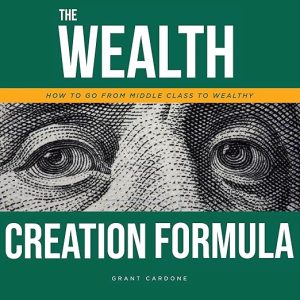
Grant Cardone is not a writer who requires much introduction, and he does not offer one. The Wealth Creation Formula opens at full volume and stays there. I listened to the first two hours on a weekday morning, and I will say this: Cardone’s self-narrated delivery does something a third-party narrator cannot replicate. When he describes going from thirty thousand dollars a year to generational wealth, you hear the experience behind the claim, not just someone performing confidence on someone else’s behalf.
That said, this is a book with a specific audience, and being honest about that distinction matters. Reviewers who responded most enthusiastically already had prior exposure to Cardone’s methods through earlier books or his Masterclass. The framework here, three phases of wealth building, a nine-step formula for income growth, passive income as the central goal, is consistent with his existing body of work rather than a departure from it.
Our Take on The Wealth Creation Formula
The book is organized clearly and sequentially, which is one of its genuine strengths. Cardone works through his formula in strict order, explaining not just what to do but why a deviation from the sequence creates problems. One reviewer specifically appreciated that structure, noting how it made the material feel systematic rather than aspirational. Another found that it validated a business they were already planning to restart, which speaks to how the book functions: less as a revelation and more as a framework that confirms and organizes existing instincts.
The content covers a recognizable set of personal finance concepts: reversing what Cardone calls poverty mindset, building multiple income streams before investing large, treating passive income as superior to earned income, and eventually using capital to acquire assets. These are not ideas unique to Cardone, but the packaging is his, and the voice is insistent enough to make familiar concepts land with fresh urgency for listeners who respond to that kind of delivery.
Why Listen to The Wealth Creation Formula
The self-narration is an asset here. Cardone’s speaking style is one of the reasons his audience has followed him across books, courses, and social media for decades. Reading him on a page and listening to him narrate are genuinely different experiences, and the audio version captures the energy that his readers respond to. At nearly nine hours, the book has room to develop its ideas beyond bullet-point depth, and Cardone uses that space to illustrate his formula with personal examples rather than just abstract principles.
For existing Cardone followers, this is the book that consolidates the wealth-building argument he has been developing across his career. The addition of material on generational wealth and the framing of the full arc from poverty mindset to financial freedom gives it a scope that earlier books did not always attempt.
What to Watch For in The Wealth Creation Formula
The review pool for this title is thin and skews heavily positive, with very few critical voices to balance against. That is worth noting when evaluating claims about the book’s universality. Personal finance advice that works in one economic context does not always translate, and Cardone’s formula assumes a level of capital access and risk tolerance that is not uniform across listeners.
The title’s framing, moving from middle class to wealthy, also carries assumptions about what constitutes the middle class and what counts as wealth that the book does not interrogate. Listeners coming in without an existing Cardone framework may find the early chapters more declarative than explanatory. This is a book for people who are ready to be told how, not a book that spends much time convincing you that the goal is worth pursuing.
Who Should Listen to The Wealth Creation Formula
Best suited to listeners already familiar with Cardone’s work who want his complete wealth-building argument in one place. Also useful for listeners in sales and real estate who are specifically looking for a framework they can apply to their existing business rather than general financial literacy content.
Less useful for listeners new to personal finance, those seeking academic rigor or balanced perspective, or anyone put off by high-intensity motivational delivery. The formula works for Cardone’s audience. Whether it is your audience is the question worth answering before you press play.
Frequently Asked Questions
Is The Wealth Creation Formula suitable for someone new to Grant Cardone’s work?
It can work as an introduction, but the book is more effective as a consolidation of his existing framework. Listeners unfamiliar with his prior books or courses may find the early chapters heavy on assertion and light on background context.
Does Cardone narrating his own book affect the listening experience?
Significantly, and for most of his existing audience, positively. His speaking style is the product as much as the content. Those who find motivational delivery grating should opt for the print version.
How specific is the 9-step formula, and does it apply to any income level?
The steps are presented sequentially with examples, but they assume the listener already has some income to redirect. The book is less useful as a starting-from-zero guide and more useful for those at the stage of optimizing existing earnings.
Is this book substantially different from Cardone’s earlier books like The 10X Rule?
The focus here is specifically on the wealth-building arc from poverty mindset to generational wealth, which gives it a more targeted scope than The 10X Rule’s broader motivational framing. Reviewers describe it as complementary rather than repetitive.