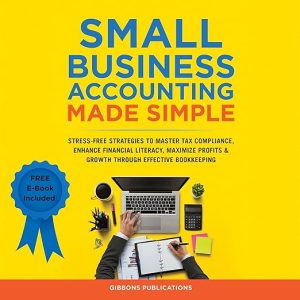
Anyone who has ever stared at a profit-and-loss statement for their small business and felt a specific kind of dread will recognize what Small Business Accounting Made Simple is reaching for. Not quite fear, more like the sense that everyone else learned this somewhere and you missed it. The audiobook, narrated by Kim Miller and published by Gibbons Publications, runs five hours and directly addresses the gap between owning a business and understanding what your numbers mean. Miller's narration is one of the title's genuine assets: she reads with the patience of someone who has explained these concepts many times and knows exactly where the confusion usually sits.
The accounting and bookkeeping space is crowded with books that promise to demystify the field and then promptly bury you in a different kind of jargon. This audiobook takes a different approach, deliberately targeting listeners who describe themselves as not finance-savvy and giving them practical frameworks rather than theoretical grounding. The five-hour runtime is well-chosen for this audience: long enough to cover the essential terrain, short enough to keep the material accessible without demanding a serious endurance commitment.
Specific Expense Advice, Built as Standalone Modules
The book earns its title more often than similar guides do. The section on tracking expenses, highlighted by one reviewer as particularly useful, demonstrates the kind of specificity that distinguishes practical accounting guides from generic overviews. Rather than simply telling you to track your expenses, the audiobook provides the reasoning behind categorization choices and their downstream impact on tax compliance. That kind of mechanistic explanation, here is the step, here is why the step matters, here is what happens if you skip it, is what makes accounting knowledge actually stick for non-specialists.
Gibbons Publications structured the content around several core pillars: deciphering financial terminology, managing cash flow for stability, tax compliance and deduction maximization, accounting software selection, and time-saving bookkeeping routines. In audio form, this structure holds together because each section can function as a standalone lesson. Listeners can absorb the cash flow chapter on one commute and the tax compliance chapter on another without needing to hold the entire framework in their head simultaneously. That modularity is an underrated virtue in practical business audiobooks.
Miller Makes Once-Feared Accounting Feel Learnable
Kim Miller's performance deserves specific mention. Accounting content narrated woodenly becomes genuinely punishing to sit with for five hours. Miller keeps things moving without rushing, and her tone conveys that this material is learnable rather than inherently complex. For an audience that approaches these topics with anxiety, that tonal calibration matters more than it might seem. One reviewer who described a lifelong hatred of accounting found the audiobook a genuine turning point, which says something real about how Miller and the material work together.
The book also addresses accounting software selection, a topic many small business guides either skip or treat as a brand endorsement opportunity. The guidance appears to be genuinely tool-agnostic, walking through the criteria for choosing software based on your business type and workflow rather than pointing to a specific platform. In a market where this kind of content often reads as sponsored, the independence is worth noting. The accompanying PDF available in your Audible library with purchase supports any visual elements that accounting concepts sometimes require.
Thirty Days Is Marketing, Follow-Through Is the Real Work
The book's audience positioning is very specific: non-finance entrepreneurs who need a starting point. Listeners with even a moderate accounting background will find the coverage too basic to sustain five hours of attention. Certified public accountants, bookkeepers, or anyone who has taken accounting coursework will be well past the content before the first chapter ends. This is not a criticism of the book, which is honest about its intended audience, but it should calibrate expectations for listeners who approach without checking that alignment first.
The online community component mentioned in the synopsis, where listeners can connect with other small business owners, is worth verifying as an active resource before treating it as a selling point. Community features associated with books can be robust or essentially dormant depending on the publisher's ongoing investment in them, and the audiobook's core value stands independent of whether that community functions well.
Listeners who find the five-hour runtime ambitious can also treat individual sections as standalone listening. The cash flow chapter, the tax compliance chapter, and the bookkeeping routines chapter each build on prior material but can be revisited independently once you have completed the full audiobook once. That flexibility matters for small business owners who learn best by returning to a specific topic when a real situation makes it relevant, rather than trying to retain everything in a single pass.
The promise of mastering small business accounting in thirty days is part of the book's marketing framing rather than a realistic benchmark for most listeners. What the audiobook actually offers is a structured orientation across its five hours, one that can meaningfully shift how a small business owner thinks about their numbers and their obligations. Whether you achieve full mastery in thirty days depends entirely on how actively you implement what you hear. The audiobook gives you the map; the journey requires action outside the listening session.
Sole Proprietors Avoiding Their Numbers Will Benefit Most
This audiobook is best suited for sole proprietors, freelancers, and early-stage founders who have been avoiding their financial systems out of genuine confusion about where to start. If you currently use personal bank accounts for business expenses, file taxes late because the categorization process overwhelms you, or have never produced a cash flow projection, this is a useful five hours. Listeners who are already working with a bookkeeper but want to understand what that bookkeeper is doing will also benefit. The audience that will not get full value here includes anyone with formal business education or prior accounting experience, and anyone looking for advanced tax strategy beyond foundational compliance basics.
Before You Listen
Does this audiobook require prior accounting knowledge to follow?
No. The material is specifically designed for small business owners who have no finance background, and Kim Miller's narration reflects that. The language avoids jargon where possible and explains terminology clearly when it must be used.
Is the audiobook format effective for learning accounting concepts?
Reviewers who engaged with this audiobook found it effective, partly because the structure allows each topic to stand alone as a focused lesson. The accompanying PDF in your Audible library supplements the audio for any concepts that benefit from visual reference.
Does the audiobook cover tax deductions and compliance for small businesses?
Yes. Tax compliance and deduction maximization is one of the core pillars of the book, with step-by-step strategies for tracking deductible expenses and meeting compliance requirements. The treatment is introductory rather than jurisdiction-specific.
How practical is the accounting software guidance in this audiobook?
The book provides criteria for choosing accounting software based on your business type rather than endorsing a specific platform. This makes the guidance more durable than product-specific recommendations, though you will need to do current market research before making a final software choice.