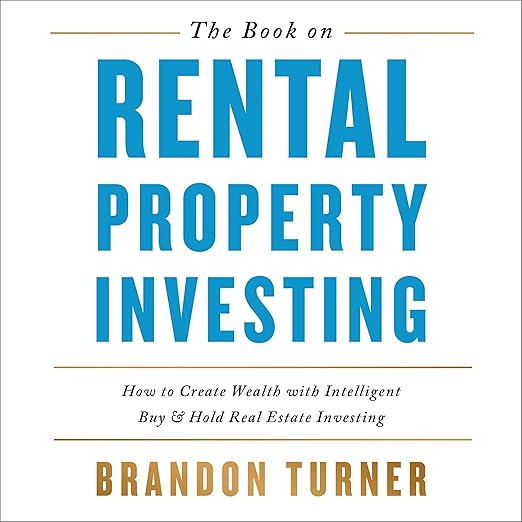
Brandon Turner built his reputation on the BiggerPockets platform before this book existed, and The Book on Rental Property Investing carries that platform's characteristic tone: direct, practically oriented, and confident without being arrogant. Turner self-narrates this audiobook across nearly twelve hours, which is a significant commitment of time, but also a signal of how much ground the book actually covers. This is not a pamphlet dressed up as a book. It is a comprehensive treatment of rental property investment from initial mindset to ongoing portfolio management, and the self-narration gives it an immediacy that a third-party narrator would likely not replicate.
Turner structures the book around the full investor lifecycle rather than any single phase of it. He opens with the psychological landscape, specifically the reasons most real estate investors fail, which is an unusually honest starting point for a book that could easily have led with enthusiasm alone. That choice to begin with failure modes rather than success stories reflects a practical intelligence about what new investors actually need: not inspiration before they understand the risks, but an honest reckoning with where the common traps are.
The sections on finding deals, analyzing properties, and building a team are detailed enough to function as working frameworks. The financing chapter is particularly strong, offering creative approaches to funding rentals even when capital is constrained, which addresses one of the most common barriers that new investors cite as their reason for not starting. Turner is not writing for people who have large reserves ready to deploy. He is writing for people who want to build cash-flowing assets and need to understand the range of financing tools available to them before they conclude that real estate requires wealth to access.
The property management discussion reflects a real philosophy about building systems rather than owning jobs. Turner's framing around not needing to touch a toilet, paintbrush, or broom is memorable, but the substance behind it is serious: the difference between an investor who scales and one who gets stuck is usually the difference between professional management structures and hands-on landlording. That distinction drives several of the book's most useful strategic recommendations.
Reviewers consistently describe Turner's writing and delivery as engaging and easy to digest, which is a genuine achievement for a book that includes detailed business math, financing structures, and tax optimization strategies. Complex concepts like cash-on-cash returns, debt service coverage ratios, and cap rates are handled without condescension, but also without assuming prior knowledge. The balance is difficult to achieve and Turner maintains it throughout.
Turner Sounds Like a Familiar Podcast Voice
Turner's self-narration is the book's most distinctive feature. He sounds like someone who has given these explanations many times in podcast conversations and knows exactly where listeners get confused. The analogies are well chosen and the pacing adjusts to the complexity of each concept. The inspirational stories woven through the analytical material serve a real function, illustrating how the frameworks translate to actual investor outcomes rather than simply decorating what is otherwise a technical manual.
The nearly twelve-hour runtime gives Turner room to develop ideas rather than summarizing them. Listeners who have worked through shorter real estate audiobooks and found them too surface-level will appreciate the depth here. The self-narration also creates continuity across the book's range of topics, making the whole feel like a coherent philosophy rather than a series of disconnected tactical chapters.
Genuinely Useful and Honest About the Limits
The book's confidence occasionally veers toward optimism that does not fully account for market variability. Turner writes from a specific period in real estate history, and some of the deal structures and financing assumptions may sit differently in higher interest rate environments or tighter housing markets than they did when the content was developed. Listeners should treat the frameworks as durable and the specific numbers as illustrations that require calibrating to their actual market conditions.
The book is also unapologetically focused on the US market. Financing structures, tax law references, and market dynamics are American-specific throughout. International listeners can extract the analytical frameworks and deal-finding logic, but the tactical details around 1031 exchanges, depreciation schedules, and local market specifics will need significant translation before they apply elsewhere.
The tax strategy chapter deserves specific mention because it is one of the areas most inadequately covered in comparable audiobooks. Turner walks through depreciation, the pass-through deduction, and the mechanics of maximizing tax advantages during portfolio building years with enough specificity to be genuinely useful, while making clear that the details require working with a qualified CPA rather than relying on a book's overview. That kind of calibrated depth, useful but honest about its limits, runs throughout the book.
For a First or Second Rental Portfolio
New to intermediate investors who want a single comprehensive resource that covers deal finding, analysis, financing, and management without requiring supplemental reading will find this exactly what they need. Listeners who have read lighter entry-level real estate books and want a more rigorous treatment will find Turner's depth a significant upgrade. The self-narration also makes this a natural complement for BiggerPockets Podcast listeners who already trust Turner's voice and approach.
Experienced investors looking for advanced portfolio optimization or discussions of commercial real estate will find this pitched below their level. The book is genuinely foundational in the best sense, thorough and honest about complexity, but its target audience is someone building their first or second rental portfolio, not managing their fifteenth. Within that audience, the book delivers real practical value at a depth the genre rarely sustains.
Before You Press Play
- Voice: Brandon Turner self-narrates, which gives the material a direct, podcast-friendly energy that suits his conversational teaching style perfectly.
- Big ideas: Cash flow and portfolio building, creative financing strategies, practical real estate deal analysis
- Atmosphere: Energetic and practical, with the confidence of someone who has done exactly what they are teaching
- Worth it?: One of the more substantive audiobooks on rental property strategy available, particularly for listeners who want both the math and the mindset covered in the same place.
Good to Know
Does Brandon Turner narrate this audiobook himself and does that change the experience?
Yes, Turner self-narrates across nearly twelve hours. His familiarity with BiggerPockets listeners and years of podcast hosting make the delivery conversational and precisely calibrated to where new investors typically get confused. It feels closer to a mentoring session than a conventional audiobook.
Is this audiobook suitable for complete beginners to real estate investing?
Yes, Turner explicitly addresses beginners while also providing enough depth for intermediate investors. He starts with common failure patterns and mindset before moving into deal analysis and financing, making it a solid starting point for anyone considering their first rental property.