The Short Version
- Narrator: Millian Quintero handles a list-heavy strategy brief where pacing between items matters more than character or color.
- Subjects: AI-assisted marketing, e-commerce and affiliate monetization, global localization for a beginner audience
- Tone: Brisk, upbeat and promotional, closer to a seminar than to a manual
- Bottom line: A usable orientation for absolute beginners, weakened by unsourced numbers and a title with an expiry date.
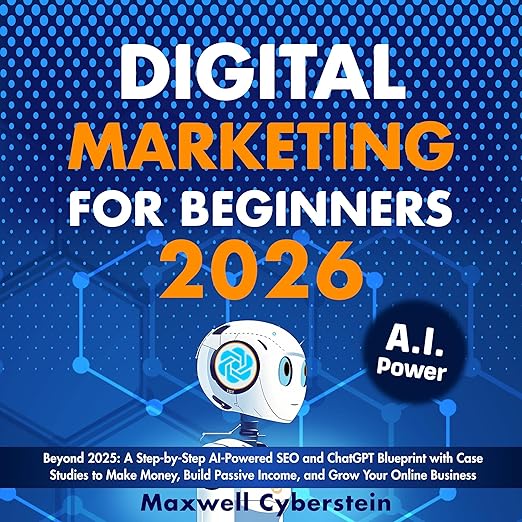
The year in this title had not started when the recording went on sale. Maxwell Cyberstein's audiobook was published in September 2025 under a name that promises 2026, which is a small thing and a revealing one, because a book that dates itself has made a claim about currency that the calendar will eventually test. Everything worth knowing about this listing follows from how seriously it takes that promise.
Nothing Identifies What Book 1 Was
Five promises organize the description. Artificial intelligence tools including ChatGPT and predictive analytics, applied to content, ad optimization and campaign personalization. Marketing tailored to the American market and then localized globally, with WeChat and Naver named as examples. Step-by-step blueprints for social campaigns and online stores. Case studies of people who made money. And a monetization section covering affiliate income, digital products and advertising.
That is a wide sweep for a recording of this size, and the width is deliberate. The intended listener is somebody with a side hustle or a new store who does not yet know what the vocabulary means, and for that person a fast orientation across the whole territory has real value. Nobody learns paid acquisition from a survey. Everybody has to learn what paid acquisition is before they can decide whether to pursue it.
Sales language deserves a moment of attention here. A side hustle becomes a thriving empire, the book is a treasure trove and a ticket to success, and the last line instructs you to click and grab your copy now, which is text written for a page somebody scrolls rather than a recording somebody plays. Language pitched that high rarely stops at the description, so expect enthusiasm as the default setting throughout.
Naming is where this page becomes confusing. The product is called Book 2, while the description calls the work simply Digital Marketing for Beginners 2026 with no number at all, and no series or volume number appears on the listing at all. Nothing identifies what Book 1 was, whether it is required, or whether the two overlap. The author name and the publisher name are also identical, which at least explains how an inconsistency of that size survived to publication.
Quintero's Job Is the Break Between Items
For a genuine beginner, the argument for this format is orientation without commitment. A survey this length can be finished in an afternoon and repeated a week later, and the conceptual material, meaning the vocabulary and the reasoning behind the tactics, is exactly the part that loses nothing on the way to a recording. Terminology, the logic of a funnel, the difference between owned and paid reach: those land fine in a voice.
Millian Quintero is named in the reader credit. Material like this asks for pace management above all, since a list of five tactics followed by a list of six platforms followed by a list of four revenue streams becomes a drone in the wrong hands, and a beginner needs the breaks between items more than the items themselves. Nothing else about the production reaches the page, not a director, not a studio.
Case studies are the part most likely to justify the purchase. A blogger reaching six figures and a retailer lifting engagement with augmented reality are the sort of concrete outcomes a beginner can picture, and stories anchor abstractions better than definitions do. How much detail sits behind each example is the open question, and the copy offers no way to check.
A Countdown Printed Into the Title
Step-by-step blueprints are what audio handles worst. The copy promises exactly that: follow-along guides for launching campaigns and optimizing stores, which in practice means dashboards, settings and sequences of clicks. No companion PDF or supplementary file is mentioned anywhere on the listing. Anyone intending to implement while listening should expect to be pausing, rewinding and reconstructing procedures from memory, which is a poor use of both formats.
Numbers in the copy arrive without attribution. A retail giant boosting engagement by 500 percent, a blogger earning six figures, a seven-figure digital business: no company, no name, no date, no source accompanies any of them. Marketing books traffic in these figures as a matter of course, and a beginner is precisely the reader least equipped to notice that a percentage with no denominator behind it is a decoration rather than evidence.
Currency is the structural risk. A book naming specific tools and platforms in a category that changes every few months has a shelf life, and the year printed in the title is a countdown rather than a badge. Buyers reaching this page well after the release should assume the tool names have moved on, and should value the strategic scaffolding, which ages slowly, over the software instructions, which do not.
Geography is promised on a scale larger than a short book can carry. The copy offers marketing tailored to the American market and, in the same breath, localization for platforms it names without situating them, which are two substantial subjects rather than one. At this length each can be introduced and neither can be taught. Read the international section as notice that these platforms exist, not as preparation for selling on them.
A Unanimous Score With No Explanation Attached
Ratings offer no help at all here. Eight people have rated this recording and the display shows a clean 5.0, which with eight whole-star votes means every one of them chose five stars. Not one of those eight has written anything. A unanimous score from a group that small, with no explanation attached, is a number to note rather than a number to rely on.
The Triple Filing Is Unusually Accurate for Once
Somebody starting from zero who wants the map before the territory is the target, and on that basis this is a defensible purchase. The triple filing under business, technology and money is unusually accurate for once, because the book really does touch all three, and a listener who has been putting off learning any of it will get a usable vocabulary out of a single afternoon.
Anyone already running campaigns will find nothing here, and anyone wanting sourced case studies or a durable reference should look at longer, credentialed work instead. Buyers who intend to implement step by step should pair this with something they can read on a screen while clicking. Treat it as an orientation lecture with a countdown printed on the cover, and it will do the job it was built for.
Questions Listeners Ask
What is Book 1, and do I need it before this audiobook?
The listing does not say. The product is titled Book 2 while the description names the work without any number, and no series number appears anywhere, so no way exists to identify an earlier volume or confirm one is needed. Treat this as a standalone survey.
Can I follow the step-by-step guides while listening?
Not comfortably. The copy promises blueprints for launching campaigns and optimizing stores, which means interfaces and click sequences, and no companion file is mentioned on the listing. Use the recording for concepts and keep a written source open when you actually build something.
Will the 2026 material still be current when I listen?
The strategy will outlast the software. Tool names and platform tactics in this category move quickly, and the title itself sets a date, so treat specific product references as examples of an approach rather than as instructions. The underlying logic of funnels and monetization ages far more slowly.
Is three and a half hours enough for the scope this audiobook promises?
Just about enough for orientation, and nowhere near enough for execution. The recording covers artificial intelligence tools, localization, campaign building, case studies and monetization at survey depth, so expect to leave knowing what each area involves and needing another source before attempting any of them.