
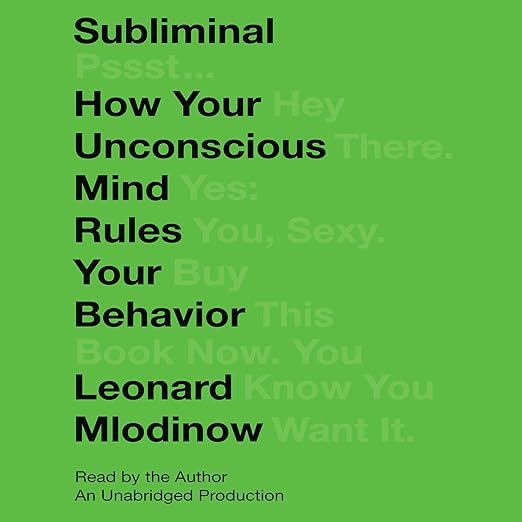
I came to Subliminal having already read some of the academic literature on unconscious cognition, curious whether Mlodinow would add anything to what I had encountered in Kahneman's Thinking, Fast and Slow, which came out the same year. What I found was a book with a different temperament: less focused on economic decision-making and more interested in the social and relational dimensions of the unconscious. How we perceive other people. How we misremember our own motivations. How we tip our waiters.
Mlodinow is, first and foremost, a physicist and a storyteller. He worked with Stephen Hawking on The Grand Design, and he brings a scientist's instinct for elegant explanation to material that can easily tip into either oversimplification or jargon. The result is a book that covers genuinely complex research, including category processing, perceptual priming, unconscious bias, and the unreliability of autobiographical memory, in language that a motivated non-specialist can follow without feeling condescended to.
What Leonard Mlodinow Delivers
The book's central argument is that most of what we think of as conscious decision-making is post-hoc rationalization of processes that happen below the threshold of awareness. This is not a new claim, and Mlodinow acknowledges his predecessors, but he synthesizes two decades of research with a selectivity that keeps the book moving. The most useful chapters are the ones on social perception: how quickly we form impressions of strangers, how resistant those impressions are to revision, and how much our unconscious assessments of competence, trustworthiness, and status shape our interactions without our knowledge. These chapters feel both practically relevant and philosophically humbling.
What Leonard Mlodinow Gets Right
Self-narration in nonfiction can go either way. Here it works, because Mlodinow's voice carries the same calibrated wit and slight wryness that runs through the prose. He never rushes, and at just under eight hours the book is the right length for what it is trying to do. International reviewers in French and German singled it out as genuinely original within popular neuroscience, which is notable given how crowded that category had become by 2012. The bonus PDF of diagrams included with the audiobook is worth downloading if you are listening to the chapters on visual perception, where the illustrated experiments add something that audio alone cannot fully convey.
Where Leonard Mlodinow Loses Some Ground
This was published in 2012, which means some of the specific studies Mlodinow cites have since been subject to replication concerns, as happened broadly across social psychology in the years following the book's release. The priming research in particular, which was influential in the early 2010s, has faced significant scrutiny. Mlodinow is not responsible for this, but listeners who want to engage critically with the material should be aware that the field has moved since publication. The book is still a valuable survey of how unconscious processing works, but treat specific experimental results as data points rather than settled conclusions.
One practical note: Mlodinow includes a bonus PDF of diagrams with the audiobook version, and it is worth downloading before you start. Several of the perceptual experiments he describes are visual in nature, and the diagrams help the explanations land more precisely than description alone allows. The chapters on face perception and perceptual priming in particular benefit from having the images available.
A note for listeners who want to go deeper: Mlodinow provides a useful reading list and source notes that contextualize the experiments he cites. The audiobook does not include these in the audio itself, but they are available in the print edition and worth consulting if the research prompts curiosity. The chapters on memory distortion and social categorization pair particularly well with follow-up reading in current cognitive science.
Who Should Pick Up Subliminal
Recommended for anyone who has not already read extensively in behavioral psychology or cognitive science and wants an accessible, intellectually honest introduction. It pairs naturally with Kahneman's work for the economics dimension, or with Robert Cialdini for the persuasion angle. Less suited to specialists who have already read the primary research, or to listeners who prioritize the very latest findings over a well-constructed synthesis. For general listeners curious about why they do what they do, this remains a reliable entry point.







