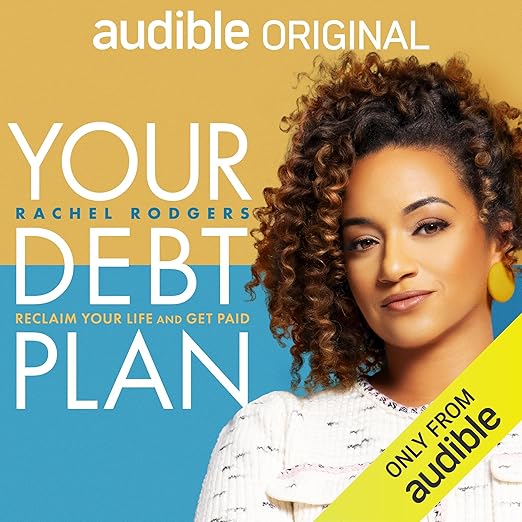
Quick Take
- Narration: Rachel Rodgers narrates her own work, and the result is close to a live coaching session, energetic, direct, and radiating the conviction of someone who has lived through exactly what she’s describing.
- Themes: Debt reframing, wealth-building mindset, shame and financial healing
- Mood: Urgent and empowering, occasionally evangelical in tone
- Verdict: A short, high-energy Audible Original that functions best as a motivational reset for people in active debt paydown rather than a comprehensive financial education.
Two hours is a very specific audiobook format. It’s not a podcast episode and it’s not a full-length book; it occupies a space that requires a particular kind of focus and compression. Rachel Rodgers, the attorney-turned-entrepreneur behind We Should All Be Millionaires, uses those two hours as if she has rehearsed this speech a hundred times and has finally found exactly what to cut and what to keep. Your Debt Plan is an Audible Original, which means it was built for the format rather than adapted from a print book, and that intention shows.
Rodgers opens with her own story: $357,984 in student loan debt at the starting point, millionaire status seven years later. That number is specific enough to be credible and striking enough to be memorable, which is exactly the right way to open a financial audiobook. She doesn’t dwell on the horror of that original debt total; she uses it as proof that the system she describes is grounded in real experience rather than theoretical optimization.
Our Take on Your Debt Plan
The book’s central concept, the distinction between what Rodgers calls Broke-Ass Debt and Million-Dollar Debt, is the organizing idea that separates this from generic debt-payoff content. Broke-Ass Debt is the kind that drains without building anything: high-interest consumer debt that compounds against you. Million-Dollar Debt is the kind that purchases assets or capabilities, student loans that led to a legal career that enabled wealth-building, business debt that leverages future income. The practical and psychological implications of that distinction are what the six-step system is built around.
That framing is genuinely useful. Many debt-payoff frameworks treat all debt as equivalent and focus entirely on tactical elimination. Rodgers argues that understanding what a debt was purchased with, what it bought you, changes the emotional relationship to it and therefore changes the likelihood of successfully navigating out of it. For listeners carrying shame around student loans or medical debt, that reframe has real value.
Why Listen to Your Debt Plan
Rodgers narrating herself is the right call for this material. Financial shame is a vulnerable topic, and her willingness to detail her own debt publicly and specifically, rather than offering a sanitized rags-to-riches narrative, creates a quality of trust that a professional narrator reading her words could not replicate. She is talking to you the way a mentor talks, not the way a book talks. That informality is a feature rather than a production limitation.
The Audible Original format also means the material has been specifically structured for audio consumption. There’s no feeling of an author fighting against a chapter structure that made sense on the page but doesn’t translate. The pacing is confident; she knows when to slow down and when to push forward.
What to Watch For in Your Debt Plan
At under two hours, Your Debt Plan is necessarily a framework rather than a complete financial education. Listeners who want detailed tactical instructions, specific interest rate strategies, snowball versus avalanche payoff methods compared in depth, will need to supplement with more comprehensive resources. Rodgers is making a mindset and framework argument; the operational details of executing the framework are left to the listener to work out.
The book also has no reviewer data to draw on at time of writing, which means its real-world reception from the AudiobookDaily audience isn’t yet established. The 4.8 average rating with 190 responses suggests strong early response, but without specific feedback there’s a limit to how granular an assessment can be about what the book delivers versus promises.
Who Should Listen to Your Debt Plan
This is a strong listen for anyone currently in debt who needs a motivational and conceptual reframe before they can engage with the tactical work of getting out of it. It’s particularly suited to listeners who have tried and abandoned debt payoff plans because the emotional relationship to the debt itself was in the way. Rodgers’s experience as a Black woman who built wealth despite systemic obstacles also gives the book a quality of perspective that generic personal finance content often lacks. Skip it if you’re looking for a detailed tactical financial guide; this is the conversation before the spreadsheet, not the spreadsheet itself.
Frequently Asked Questions
Is Your Debt Plan a standalone audiobook or does it require reading We Should All Be Millionaires first?
It stands completely alone. Rodgers provides all the necessary context within the two-hour runtime, and the framework she presents here complements but doesn’t depend on her previous book.
What does Rodgers mean by the difference between Broke-Ass Debt and Million-Dollar Debt?
The distinction is between debt that purchases assets or income-generating capabilities (Million-Dollar Debt, like education debt or business investment) and consumer debt that compounds without building anything (Broke-Ass Debt, like high-interest credit card balances). The framework argues that your emotional and tactical relationship to each type should differ.
At under two hours, does Your Debt Plan provide enough detail to actually implement a debt payoff strategy?
It provides a mindset framework and a six-step system overview rather than detailed tactical implementation. Listeners will need to supplement with more comprehensive resources for specific mechanics like interest rate optimization, but the reframe this book offers can unlock the motivation to actually use those resources.
How does the Audible Original format affect the listening experience compared to a typical narrated book?
The material was built for audio rather than adapted from print, which means the pacing and structure feel natural for listening. Rodgers narrating her own work adds a coaching quality that a professional narrator could not replicate; the result is closer to a keynote speech than a traditional audiobook.