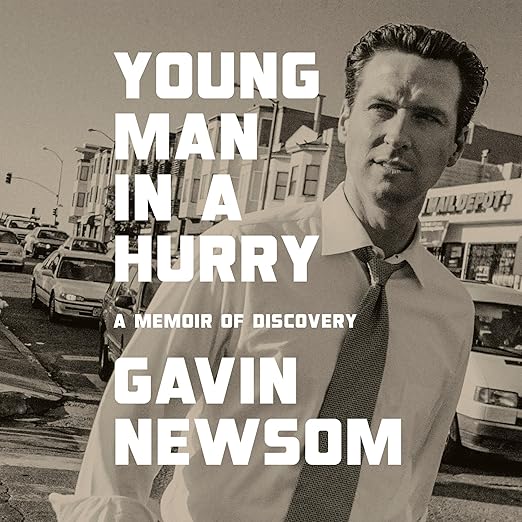
Politicians write memoirs for reasons that rarely include telling you anything. Gavin Newsom's is more interesting than that, partly because he reads it himself and partly because the childhood at its center is genuinely strange: a boy shuttled between a mother working three jobs and a father moving through San Francisco society, carrying undiagnosed dyslexia through all of it. The audiobook runs just under eight hours and traces the forces behind the ambition rather than cataloguing the terms in office.
A Difficulty Nobody Named at the Time
Dyslexia is the detail that changes how you hear this. The copy places it in his childhood as a difficulty nobody named at the time, compounding the dissonance of a boy pulled between two households and two social worlds. An author with that history reading his own prose aloud for eight hours is doing something with weight behind it, and it is precisely the kind of thing an audio edition can carry in a way a printed page structurally cannot.
Mary Cleopatra, five stars on March 8, opened by admitting to being a tough critic who did not expect to like the writing, and then liked it anyway. What that account valued most was not the personal material but the political observation: how Newsom thinks about larger issues, and about the unglamorous mechanics of getting elected at all. It is a useful signal, because it suggests the book holds up for people arriving for the analysis rather than the biography. Political memoirs rarely pass that test.
Divorce sits at the origin of the whole structure. The description sets out a childhood spent being tugged between a mother working three jobs to care for her children and a father, a close friend of the Getty family, who brought his son into a world of wealth and connections. Newsom's own reading is that the dissonance was frustrating and the vantage point was valuable, and that he took perseverance from one parent and a reverence for California from the other. Both inheritances show up in the prose.
Newsom Reads It Himself and Has a Good Voice
Peter S., five stars on March 7, described the effect directly: the storytelling comes out of a deep respect for family, the book carries its tragedies alongside its successes, and the stories land as captivating whether they are strictly factual or inherited family lore. That last qualification is honest and worth repeating, because a family narrative reconstructed across a century and a half is going to contain a certain quantity of legend. Newsom does not pretend otherwise, and neither does that response.
Elizabeth S., five stars on March 9, went straight to the recording, recommending the audio version because Newsom reads it himself and has a good voice, and adding, from a working writer's vantage, that the prose was startlingly good. Two accounts out of five single out the reading itself, which is the clearest evidence anywhere on this page that the recorded edition is the one worth choosing over the printed one.
Memoir of this kind stands or falls on voice, and self-narration removes the interpretive gap altogether. When Newsom describes being pulled between two households, the person describing it is the person it happened to, with whatever hesitation or emphasis that produces in the moment. Nothing on the record indicates an abridgement, which matters on a book assembled out of accumulated small scenes rather than a few large set pieces. Cutting any of them would have cost more than it saved.
The Four-Star Grade Behind Squirrels Like Nuts
Richard, five stars on March 7, identified the book's one structural problem and declined to soften it. The chapters covering the family's past generations defeated that reader, who could not keep the names straight, eventually gave up, and skimmed the first sentence of every paragraph until the section ended. That is a specific and believable failure, and it locates the exact stretch where an interested reader's patience runs out.
Skimming, however, is not available to you. A listener cannot run an eye down the opening sentence of each paragraph, so the genealogical passage that one reader escaped by scanning has to be taken in real time at the speaker's pace. Anyone who finds extended family history heavy going should know the section exists and that the recording offers no route around it beyond the speed control.
All five written responses landed between March 7 and March 17, 2026, inside three weeks of release, and they do not match the number above them. Four award five stars and one awards four, an average of 4.8 against a displayed 4.4 across 194 ratings. That four-star repays a closer look: Squirrels Like Nuts bought the book as a gift and then quoted the recipient's verdict word for word, so the grade belongs to the buyer while the assessment, including a note that it occasionally feels slow, belongs to somebody who never posted anything.
A Proposition With Something Genuinely at Stake
Californians will get the most out of this, and the book makes no attempt to pretend otherwise. Newsom has never lived anywhere else, and the argument running underneath the memoir is that the state's promise has to keep extending to each new generation or it stops functioning as a promise at all. Listeners with no stake in California will still find the family material strong and the civic material comparatively thin. Geography turns out to be the load-bearing element of this memoir.
Policy readers should adjust their expectations before starting. Marriage licenses issued to same-sex couples in violation of state law more than a decade before the Supreme Court settled the question, climate initiatives, mental health care, gun safety and the wildfires that met his first term as governor all appear, but they appear as biography rather than as argument. Nobody looking for a governing agenda will find one laid out, and opponents will find nothing built to persuade them.
Whatever you make of the man, the recorded edition is the right way to take this one, and for once the written record on the page agrees. A memoirist who spent a childhood struggling with words he could not reliably read, reading the whole of his own book aloud, is a proposition with something genuinely at stake inside it. The genealogy will test your patience. Almost everything around it moves, and moves faster than the subject's own elders wanted him to.
Frequently Asked Questions
How long is the Young Man in a Hurry audiobook, and which house produced it?
Seven hours and fifty-seven minutes, published by Penguin Audio and released on February 24, 2026. The record shows no series information and no sign of a companion volume, so it stands alone as a single-book account of the years leading up to and through his elected career.
What does the title of the Young Man in a Hurry audiobook refer to?
The description opens on the advice Newsom says his political elders gave him: go slow. The title is his answer to it, since by his own account he has never known that speed. The phrase frames the whole book as a study of impatience and where it came from.
What is the California Dream thread running through the book?
It begins in County Cork, six generations back, with the family the California Dream drew out of Ireland. His great-great-grandfather, a police officer, walked a beat in San Francisco, and roughly a century and a half later Newsom was elected mayor of the same city, which is the arc the memoir keeps returning to.
What do the bestseller claims on the listing actually refer to?
The description leads with a number one USA Today placement and an instant New York Times listing. Those are book-chart positions rather than anything measuring the recording, and they carry no information about the audio edition, its production or how listeners in particular received it.