Quick Take
- Narrator: Tom Perkins is credited alone on a book that amounts to one sustained argument, which is the shape a single voice carries best.
- Subjects: A disputed death, contested identity, evidence against folklore, the Old West as national myth
- Tone: Brisk and prosecutorial, a case laid out rather than a life recounted
- Bottom line: Absorbing taken as advocacy, and the wrong first stop if you want the standard account of Billy the Kid.
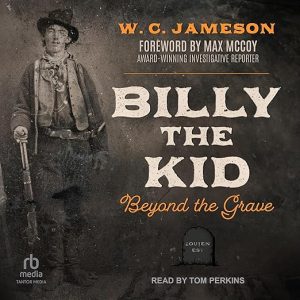
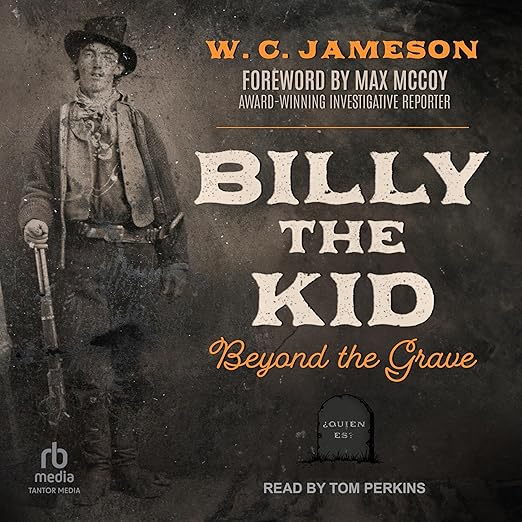
Fort Sumner, New Mexico, 1881. Pat Garrett kills a man, the file closes, and American folklore keeps the ending it has held ever since. W. C. Jameson's book asks whether the wrong body went into that grave, and whether the outlaw went on living as William Henry Roberts until 1948. This audiobook, read by Tom Perkins and issued by Tantor Media in February 2026, puts that question in front of you as a case to be weighed rather than a legend to be retold, and it runs five hours and twenty-three minutes.
Jameson's method is why this holds up as more than a curiosity. The book traces the life of the famous desperado and then works through the evidence for survival, including what the description calls new technology brought to bear on the question. That framing matters. This is not a retelling with a twist saved for the end; it is a reexamination that spends its length on documents, testimony and physical evidence, and it expects you to weigh them instead of simply enjoying them.
Brushy Bill Roberts is the name at the center of the counter-history, and the reviews show how deep the argument runs. A five-star account from December 2005 calls for exhuming both Roberts, buried in Hico, TX, and Catherine Antrim of Silver City, New Mexico, adds in passing that Antrim was Billy's half-aunt rather than his mother, and states flatly that anyone unwilling to permit the exhumation is unwilling to accept the truth. That is the temperature of the debate this book walked into.
Booklist called it an enjoyable reexamination of a legendary piece of Americana, and the description leads with the line. Blurbs deserve skepticism, though this one is precise about register: enjoyable, and a reexamination. It stops short of claiming the matter is settled, and a trade review that praises the pleasure of a book without endorsing its conclusion is telling you something specific about how to read it. Jameson's own position is plain enough, yet the book presents itself as a contribution to a controversy still being argued, which is a more honest posture than popular history about the Old West usually adopts.
Presents the Case Like a Lawyer, Reviewer Says
Argument-driven history suits audio unusually well, because a case unfolds in order. You are not flipping back to compare a footnote. You are following a sequence of claims, each resting on the one before it, which is how a listener receives information anyway. A book built around one question, spending its whole length answering it, has a shape your attention can hold. Narrative history with a crowded cast of names is far harder work in the ear.
MATTHEW HAHN put the appeal precisely in an October 2017 five-star review: Jameson presents the case like a lawyer, supported by facts drawn frequently from primary sources, and by logic. The same review names the deeper attraction, a tradition older than the Bible in which heroes refuse to die young and instead reach old age and a death in bed. Whether or not you end up buying the thesis, that is a fair account of why it is so hard to resist. That reviewer's display name also doubles as an advertisement for a book of their own, so it pays to read the handles as closely as the star counts.
Compression works in this book's favor. A single-thesis biography does not need three decades of context to land its point, and Jameson keeps the frame tight: the life, the disputed death, the survival claim, the evidence for it. Tom Perkins is credited alone, which fits material that amounts to one sustained argument. The usual risk with short popular history is thinness. The risk here runs the opposite way, since a tidy case invites you to accept it too readily.
Every Visible Review Predates This Recording
Every visible review predates this recording. The most recent, a one-word five-star endorsement posted on the eleventh of February 2026, arrived thirteen days before the audio edition went on sale on the twenty-fourth. The oldest dates from December 2005, more than twenty years earlier. All five respond to earlier editions of the book, and the 194 ratings sitting above them were gathered across those same editions, so the 4.6 belongs to Jameson's book and not to this reading of it.
J. raised the objection that matters, and raised it generously. That four-star review calls the evidence compelling, admits the book has convinced its reader, and then asks whether an equally well-researched book exists arguing the other side. It is the correct instinct with any single-thesis history. Jameson is advocating rather than adjudicating, and a listener arriving with no prior knowledge of the case will finish with one side of it argued extremely well.
Nothing on this page marks the book as part of anything larger. The series entries are blank, so a listener who finishes it and wants more of the same method has no route from here to a companion title, assuming companion titles exist. On a catalog page whose whole job is helping you find the next thing, that is a small failure carrying a real cost. Search by author instead of trusting the navigation you are given.
An Unembarrassed Case That Pat Garrett Was Wrong
This lands hardest with listeners who enjoy a historical argument they can test. Anyone drawn to cold cases, contested identities and the machinery of evidence will find the shape familiar and the subject better documented than most legends of its kind. It suits Old West readers who absorbed the standard account in childhood and never questioned it, and it suits anyone who reads true crime for the reasoning rather than for the atmosphere around it. Skeptics get more out of it than believers do, since the pleasure lies in deciding which pieces of the case actually hold.
Avoid it if you want a rounded life of Billy the Kid, because the disputed death is the organizing question and every other chapter serves it. Nor will it satisfy anyone who wants both sides weighed, since the case for survival is the case being made. And listeners who need their history hedged with academic caution will find the confidence uncomfortable, particularly where new technology is invoked in support without the page saying what that technology was.
Whether Pat Garrett shot the right man in 1881 is a question American history has never quite closed, and Jameson makes an unembarrassed case that he did not. Heard as advocacy rather than as settled fact, the book is absorbing, and its brevity keeps it from sprawling into speculation. Just remember that every written review on this page belongs to editions that existed long before anyone recorded a word of it.
A Few Questions About Billy the Kid
Does this audiobook claim Billy the Kid survived 1881?
Yes, that is the whole thesis. Jameson argues Pat Garrett killed the wrong man at Fort Sumner and that the outlaw lived on as William Henry Roberts until 1948. The book assembles evidence for that position rather than presenting competing theories and leaving the verdict open.
Is it a full biography or only about the death?
Both, weighted toward the controversy. The description says the book traces the life of the desperado, but the disputed death organizes everything, so early chapters largely establish what has to be true or false for the survival case to work. Expect a life told in service of an argument.
Why are all the reviews older than the audiobook?
Because they belong to earlier print editions. This recording was released in February 2026, while the visible reviews run from December 2005 to February 2026, every one of them posted before it existed. The 194 ratings come from that same stacked history, so almost nothing in the score can be about the reading.
What kind of evidence does Jameson present?
Primary sources, testimony and physical evidence, plus what the description calls new technology. One five-star reviewer from 2014 focuses on the claim that Brushy Bill Roberts knew details of battles and events that were not common knowledge at the time, and which later research is said to have confirmed.