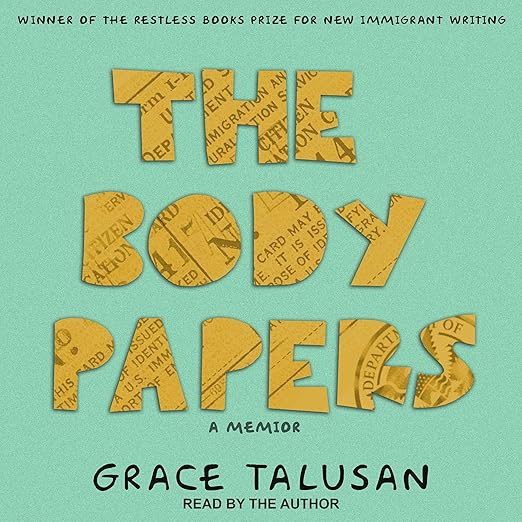
Grace Talusan's memoir arrived with the Restless Books Prize for New Immigrant Writing and a reputation built slowly by word of mouth among readers who pressed it into other people's hands. Encountering it as an audiobook, with Talusan reading her own prose over six hours and twenty-four minutes, changes the experience in ways that matter. This is a book about what bodies carry and what voices finally say out loud, and hearing Talusan narrate her own history closes a circuit that print alone cannot complete.
A Memoir Built to Accumulate, Not Unfold
Talusan structures the memoir in sections that accumulate rather than unfold chronologically. She begins in the New England suburb where her family settled after leaving the Philippines in the 1970s, and from the first pages she is tracking parallel forms of exposure: the racism of being one of the only brown faces in her school, the nightly violations by her grandfather that her family's silence absorbed, the revelation in her teens that her family had been living in legal precarity, their status "hung by a thread" for years. These threads, racism, abuse, immigration anxiety, are not presented as separate chapters in a life but as forces that shaped each other, producing the particular way Talusan learned to live in and away from her own body.
Talusan's prose is clear and controlled, and she reads it the same way: without performance, without the kind of vocal modulation that signals to a listener that they should feel something now. The understatement is deliberate and devastating. When she describes her grandfather's visits to her childhood room, she uses simple declarative sentences, and that simplicity is precisely the aesthetic and ethical choice that distinguishes this memoir from confessional writing that aestheticizes trauma. Reviewer Han, who rated the audiobook five stars, called it "a beautiful and honest book of personal exploration and reckoning" and highlighted Talusan's faith and intellect. Both are present in the narration, and they are held in genuine tension with each other rather than resolved into easy consolation.
A Self-Narrator Fluent in Her Own Filipino Names
The argument for the audiobook format over the print edition is stronger here than for most memoirs. Talusan's voice is quiet and precise, occasionally betraying something she does not editorialize in the prose itself. A slight pause before a particular phrase, a steadiness that feels effortful in the best way. Self-narrated audiobooks by writers who are also skilled readers are rare, and Talusan belongs in that category. The Filipino pronunciation of names and places is correct and unself-conscious in a way that signals cultural fluency rather than performance for a non-Filipino audience.
The memoir also takes on, in its later sections, the inheritance of cancer that runs through her family. After surviving abuse, navigating immigration uncertainty, and managing its long shadow on her adult relationships and mental health, Talusan faces a body that carries threat inside it in a different register. The fellowship section, where she and her husband return to the Philippines and she revisits her family's ancestral home, is where the memoir reaches its most complex emotional territory: grief, reclamation, and the partial impossibility of recovering a self that was shaped by forces too large and too intimate to be undone by a single journey. Listening to Talusan read these passages is not comfortable. Reviewer JS described the book as showing how "family protects us, but it can also bind us and sometimes victimize us." That dual truth is audible in her voice throughout.
Abuse and Immigration Status, Told Without Softening
Listeners should be aware that The Body Papers contains detailed, non-graphic accounts of childhood sexual abuse, discussion of trauma's long-term effects on mental health and relationships, and material about undocumented immigration status rendered in personal rather than political terms. Talusan is not writing a policy argument; she is writing what it felt like to be a child who learned that her family's presence in the country was legally precarious and who was, simultaneously, processing a form of violation her family's culture of silence had no language for. These are not things the audiobook softens, and they should not be.
Six Hours Where Each Section Earns Its Ending
The memoir is also relatively short at six hours and twenty-four minutes, which some listeners, including reviewer katdlr who noted wishing for "a few more chapters," may find too brief. Talusan does not overexplain or extend what is already complete. Each section earns its ending. But those who want the kind of memoir that slowly builds a comprehensive world over many hours will want to know in advance that this one operates differently, in concentrated, precise units that deliver more weight per word than most audiobooks in this category.
Talusan's account of returning to the Philippines on a fellowship, walking through the ancestral home where her family's violence began, is one of the memoir's most complex passages. The audiobook's self-narration makes this section feel like an act of reclamation rather than performance: Talusan is not dramatizing her grief for a listener but working through it in real time, which is the quality that separates the best self-narrated memoirs from professional productions that are technically superior but emotionally more distant.
Recommended Alongside Machado and Roxane Gay
Readers drawn to the intersection of immigration narrative and trauma memoir, work by writers like Carmen Maria Machado or Roxane Gay, will find Talusan's register familiar but her particular vantage distinct. Filipino American voices remain underrepresented in mainstream literary audiobooks, and this one is among the most accomplished in the catalog. Anyone who has experienced the particular silence that Catholic Filipino family culture can impose on certain truths will hear something they recognize here. Listeners who need emotional distance from the subject matter should approach cautiously: Talusan's narration keeps the experience close by design, and that closeness is the point.
At a Glance
- Performance: Grace Talusan self-narrates, and the intimacy of hearing her own voice carry these memories creates an immediacy that a professional narrator simply could not replicate.
- What it covers: Immigration and legal precarity, childhood sexual abuse and survival, the body as site of cultural and medical history
- Feel: Quiet, precise, and devastating in the way only true things are
- Our call: Talusan's memoir is one of the most unflinching accounts of intergenerational trauma you will find in audiobook form, and her narration makes it essential rather than merely recommended.
A Few Questions About The Body Papers
Does Grace Talusan narrating her own audiobook affect how the memoir lands compared to reading it in print?
Significantly. Talusan's voice carries a quiet steadiness that communicates what the prose does not editorialize. Self-narrated memoirs about sexual abuse and trauma are rare in part because the emotional demand is so high, but Talusan's control throughout makes the audiobook a distinct experience from the print edition.
Is the audiobook version of The Body Papers appropriate for book groups, or is the content too difficult for group discussion?
Talusan herself notes the memoir is suited to group discussion, particularly around themes of family silence, immigration, and bodily autonomy. The audiobook format works well for book clubs because the six-hour-twenty-four-minute runtime is manageable in a single day of listening. Content warnings around childhood sexual abuse should be shared in advance.
How does The Body Papers handle the immigration and legal precarity aspects of Talusan's family's story?
Talusan frames the immigration material in personal and emotional terms rather than political ones. The revelation that her family had been living without secure legal status for years is presented as a child's disorientation, not a policy critique. It is one of several simultaneous silences her family maintained, and the book examines what those silences cost.
How does the Filipino American cultural context shape what this audiobook is and is not able to say?
Talusan is explicit about the role Catholic Filipino family culture plays in creating and enforcing silence around abuse and trauma. Her return to the Philippines and her ancestral home in the memoir's final section is an attempt to reclaim a cultural identity that has been mediated by silence and harm. The audiobook's self-narration makes this cultural dimension feel present rather than explained.