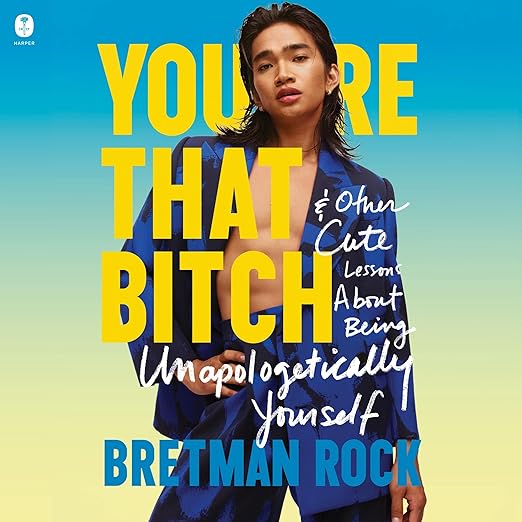
Bretman Rock Sacayanan's audiobook You're That Bitch opens in the Philippines, with childhood, and with all the years before the influencer career existed as a recognizable category. Rock narrates this memoir himself across six hours and twenty-six minutes, and the decision is so obviously correct that it requires no argument: he is the content. His voice, his timing, the precise way he delivers a punchline or pivots into something unexpectedly serious, these qualities are not supplementary to the essays but constitutive of them. Chelsea Handler described the book as "hilarious" in her blurb, and Rock narrating himself is the specific reason the humor works: nobody else could replicate the rhythms of how he thinks.
What Bretman Rock Delivers
Rock arrived at social media fame in a specific way that the book traces with more care than most influencer memoirs attempt. He was fourteen, making content while working the school cafeteria line, running track for his school's varsity program, and maintaining honor roll. The simultaneity of glamour and ordinary teenage life is not presented as a cute contradiction but as the actual texture of his early years, and he is clear-eyed about what that combination cost him and what it gave him. He became a first-generation digital celebrity before the infrastructure for that role existed, before there were managers who understood the specific pressures of that scale of attention or communities of people who had navigated it before. The book is partly about what it means to have built something unprecedented without a map.
The Filipino identity and immigration experience are central rather than decorative. Rock is a first-generation immigrant, and the book's opening in the Philippines establishes that origin as load-bearing for everything that follows: his aesthetic sensibility, his relationship to family and community, his specific form of humor, and the values that have remained consistent across the fame. Reviewer Abby noted that you "walked alongside him through his childhood home in the Philippines, laughed and cried as he shared his early life experiences," which is the right description of how the book handles the biographical material: with enough specificity to generate genuine feeling rather than biographical summary.
What Bretman Rock Gets Right
Reviewer Brian observed that "the narrative of this book is truly in the voice of the author" without "unnecessary embellishment," and that authenticity is what the self-narration delivers. When Rock describes dealing with cancel culture, he sounds like someone who has processed that experience rather than someone performing equanimity about it. When he talks about heartbreak and difficult family situations, the same quality of direct honesty applies. The audiobook format allows his code-switching, between registers of camp and sincerity, between Filipino cultural reference and mainstream American internet culture, to function as intended: as an expression of identity rather than as tonal inconsistency.
The book is structured as a collection of essays and how-tos, and the how-to sections, presumably guides to Rock's actual beauty and lifestyle expertise, represent his public persona entering the text alongside the memoir material. Reviewer KRISTA R. MENDOZA described it as "empowering and very inspiring" for anyone "interested in finding themselves and embracing their journey through life regardless how different and difficult it is." That is the argument the book is making through its combination of formats: that Rock's specific path, Filipino immigrant, queer, internet-famous at fourteen, self-taught in multiple crafts simultaneously, is not a template to follow but a demonstration of what following your own specific path looks like in practice.
Where Bretman Rock Loses Some Ground
The essay collection structure means some chapters are more developed than others. The how-to sections are lighter in narrative weight than the personal essays and memoir pieces, representing a tonal shift for listeners primarily interested in the reflective and biographical material. They are consistent with Rock's brand, which has always combined personal candor with aesthetic instruction, so they are not incongruous within the overall project. Listeners who want sustained memoir without the lifestyle content interspersed may find the structure occasionally disruptive.
The book addresses cancel culture and online drama without naming specific incidents in detail. Rock is deliberate about this: the book is about who he is rather than about the specific controversies of his public career. That choice reflects a particular relationship with disclosure that some readers will appreciate for its restraint and others will find evasive. The personal material he does include, on family, childhood poverty, and the psychological costs of early fame, is genuinely unguarded, which makes the areas of deliberate opacity more noticeable by contrast. The book is honest about the things it chooses to be honest about, which is perhaps all a memoir can honestly claim.
Who Should Pick Up You're That Bitch
This audiobook works for listeners already familiar with Rock's online presence who want to understand what is behind the persona, and equally for listeners who have never encountered him and want a memoir that is funny, honest, and specific about what it means to grow up Filipino-American and become famous on the internet before that was a well-mapped path. It suits readers who appreciated Roxane Gay's Bad Feminist for its combination of personal essay and cultural commentary delivered in a genuinely distinct voice, or who found Jenny Zhang's Sour Heart valuable for its insistence on the specificity of the immigrant experience. Skip it if you want a conventional celebrity biography with chronological career narrative; Rock's structure is essayistic and associative rather than biographical in the traditional sense, and the how-to sections will be a non-negotiable part of the experience.
Does Bretman Rock narrate the audiobook himself, and is that essential to the experience?
Yes, and yes. His self-narration is not a supplementary feature but the primary reason to choose the audio format. His voice, comic timing, and the way he shifts between registers of humor and seriousness are as much the content as the words on the page. The audiobook is significantly richer than the print edition for this reason.
How does this audiobook compare to other influencer memoirs in terms of depth and candor?
More candid and more specific than most. Rock addresses genuine difficulties including financial instability in childhood, cancel culture, and heartbreak with directness rather than the managed disclosure typical of celebrity memoir. Reviewer Brian noted that the book functions as motivational despite not being structured as self-help, which captures its particular combination of honesty and generosity toward the reader.