Quick Take
- Narration: Alan Watts narrating his own lectures is obviously the only version that makes sense. His voice carries the irreverence, warmth, and timing that has made these recordings beloved for fifty years.
- Themes: Non-dual awareness, the cosmic game, Taoism and Zen for Western minds
- Mood: Playful and expansive, with occasional repetition across the fifteen talks
- Verdict: For existing Watts listeners, this collection is a pleasure despite some overlap with his other recorded sets. For newcomers, Out of Your Mind may be the better starting point.
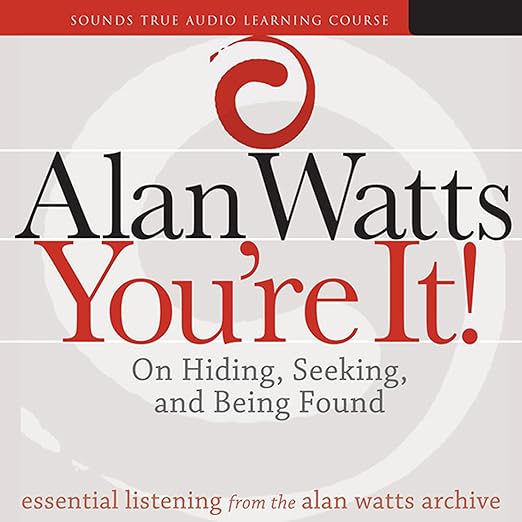
I have been listening to Alan Watts recordings since I was in my mid-twenties, when a friend handed me a burned CD of a lecture on the Tao and said, with the solemnity only possible at that age, that it would change how I thought about thinking. It did, a little. You’re It! collects fifteen of those talks, selected and compiled by Watts’ son and archivist Mark Watts, covering a range of themes from Taoist philosophy to Zen, from the nature of consciousness to the absurdity of using the mind to improve the mind.
Watts called himself a stand-up philosopher, and the description is accurate. His method is not academic. He is performing ideas in front of a live audience, and the restored audio quality here captures the room, the laughter, the rhythm of a man who has said these things hundreds of times and still sounds like he’s discovering them fresh.
Our Take on You’re It!
The central thesis is consistent across all fifteen talks: the universe is engaged in a game of self-concealment, and you, the listener, are not a separate observer of that game but a participant in it. The mirror metaphor that the synopsis describes, reaching the top of the mountain only to find a mirror, is Watts’ way of saying that what you’re seeking through spiritual practice has always been what you already are. It’s an old idea, present in Vedanta, in Zen, in aspects of Christian mysticism, but Watts makes it accessible to Western audiences who might otherwise find it too abstract or too Eastern to engage with.
What works particularly well in this format is the live audience dynamic. You hear the laughter, the appreciation, the occasional extended silence that suggests a room genuinely sitting with something. Watts was performing as much as teaching, and the audio preserves that performance quality better than any transcription could.
Why Listen to You’re It!
Watts’ voice is its own argument. One reviewer described it as something that finally made a difficult concept click, the sense that the experiencer is the experience, after reading several other teachers on the same topic. Part of what Watts does better than most is translate. He makes Taoist non-duality legible through jazz analogies, through wordplay, through the kind of self-deprecating humor that keeps the listener from taking the ideas too seriously in the wrong way.
At twelve hours across fifteen lectures, this is not designed for linear listening, and it doesn’t need to be. One longtime fan described poking in and out from session to session and still picking up jewels, which is the most honest description of how these compilations tend to work. Each lecture is self-contained enough that you can dip in, reflect, and return without losing the thread.
What to Watch For in You’re It!
The primary limitation noted by reviewers is repetition. Some stories and nuggets of wisdom appear more than once across the fifteen talks, occasionally almost verbatim. This is an inherent feature of compiling lectures from what was essentially a one-man lecture circuit career: Watts had his greatest hits, and they show up across collections. One reviewer who has worked through multiple Watts recordings noted that Out of Your Mind offers a more varied and expansive journey from start to finish, and that is probably accurate.
If you come to this expecting systematic philosophical argument rather than repeated circling around a central insight from different angles, the format will frustrate. Watts is not building toward a conclusion. He is illuminating the same territory from different positions, and whether that feels revelatory or repetitive depends significantly on your familiarity with the material and your tolerance for the circular nature of non-dual thought.
Who Should Listen to You’re It!
Existing Watts enthusiasts who have not yet encountered this particular compilation will find it consistently enjoyable, with the caveat about some repetition across the set. Newcomers to Watts would benefit from starting with The Wisdom of Insecurity or Out of Your Mind before coming to You’re It!, simply because those productions are more carefully curated for the first-time listener. Philosophy and spirituality readers who have found other teachers on non-duality too abstract will likely find Watts’ playful, anecdote-driven approach more accessible. This is not for listeners who want structured argument, empirical grounding, or practical techniques. Watts is in the business of reorientation, not instruction.
Frequently Asked Questions
How does You’re It! compare to Watts’ other recorded lecture compilations like Out of Your Mind?
Most longtime listeners consider Out of Your Mind more cohesively curated and less repetitive. You’re It! has some wonderful sessions but also shows more overlap with other Watts recordings. If you’re choosing between the two as a starting point, Out of Your Mind is the stronger introduction.
Is the audio quality good given these are restored older recordings?
The restoration is described as well done and the live-audience quality is preserved rather than cleaned away, which means you hear the room, the laughter, and the occasional ambient sound. For listeners who find this authentic, it adds to the experience. For those who prefer studio-clean production, it may be distracting.
Are the fifteen talks organized in any logical progression, or is the collection random?
Mark Watts, who selected and compiled the sessions, has arranged them in what is described as a somewhat logical progression. That said, each talk is essentially self-contained, and reviewers consistently note that dipping in non-linearly works fine. There is no developing argument that requires the full sequence.
Does Watts address any particular tradition in depth, or does he move across Buddhism, Taoism, and Hinduism?
He moves across all of them, and this is central to his method. Watts is interested in the common insight underlying the major wisdom traditions rather than the doctrinal specifics of any one. The talks cover Zen, Taoist thought, Vedanta, and touches of Western mysticism. If you want depth in a single tradition, this is not the right collection.