Quick Take
- Narration: Author-narrated by Nick Wallis, who has lived with this story for over a decade. The proximity to the material shows in how he reads individual testimony.
- Themes: Institutional corruption, wrongful prosecution at scale, the long fight for justice
- Mood: Enraging and heartbreaking, with the slow accumulation of detail that good investigative journalism demands
- Verdict: The definitive audio account of one of the UK’s largest miscarriages of justice, narrated by the journalist who refused to let it disappear.
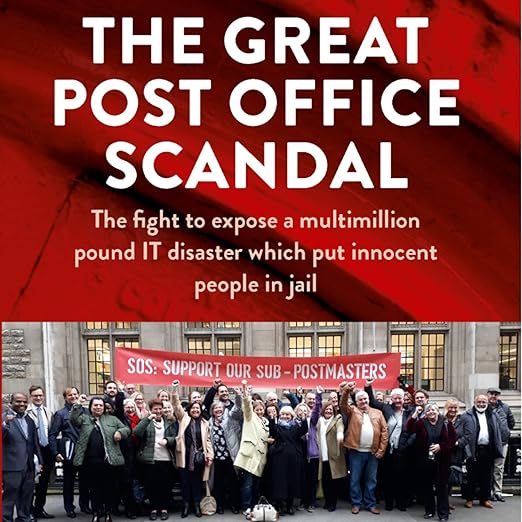
I came to The Great Post Office Scandal knowing the broad shape of the story. The ITV dramatization Mr. Bates vs The Post Office had made that much unavoidable. What I did not expect was how different the experience of the book would be: not just more detail, but a different emotional register entirely. When Wallis describes how he first heard about the scandal from a taxi driver in 2010, whose pregnant wife had been imprisoned for a crime she did not commit, the intimacy of that origin story does something a television dramatization cannot. It reminds you that this investigation began with one person telling another person something that should not have happened.
The facts of the case are substantial and worth laying out. Between 2000 and 2013, the UK Post Office prosecuted 736 sub-postmasters for theft, false accounting, and fraud. The evidence was drawn almost entirely from Horizon, a deeply flawed software system that generated duplicate entries, lost transactions, and made erroneous calculations. When the software showed a shortfall, sub-postmasters were required to cover it from their own pockets, sometimes for tens of thousands of pounds. Those who could not pay were prosecuted. Some went to prison. Three died before the Court of Appeal quashed convictions in April 2021.
Our Take on The Great Post Office Scandal
What Wallis has produced is investigative journalism at the length the story requires. Eighteen hours is a significant commitment, but the material earns every one of those hours. The book moves from the ill-fated deal that brought Horizon into existence, through years of half-truths and obstruction, to the tearful scenes at the Court of Appeal, without losing the individual human lives at the center of each section. Alan Bates, who began as a lone voice of dissent against the Post Office and ultimately beat them at two of the highest courts in the land, emerges as a figure of remarkable persistence rather than a dramatic hero, which is more honest and ultimately more affecting.
The author-narration carries particular weight here. Wallis has interviewed dozens of victims, reviewed hundreds of documents, and spent over a decade pursuing this story. When he reads testimony from the people whose lives were shattered, you hear someone who knows those people rather than an actor interpreting them.
Why Listen to The Great Post Office Scandal
Listeners who watched the ITV series report that the book provided depth the dramatization could not accommodate, particularly around the institutional mechanisms that allowed the scandal to continue for so long. The Post Office’s refusal to accept responsibility, the government’s role in concealing its failings, the legal complexity of fighting a public institution with essentially unlimited resources, all of this receives the detailed treatment it deserves.
One reviewer described the book as likely to inspire generations of talented people to become lawyers. That is an unusual compliment for true crime and legal history, but it captures something about what the book does at its best: it makes you feel the weight of what justice requires when institutions fail.
What to Watch For in The Great Post Office Scandal
At eighteen hours, this is one of the longer listens in its genre, and the density of legal and institutional detail in the middle sections demands attention. This is not background listening. The UK context is central to the story, and while Wallis does not assume detailed knowledge of British law or government, listeners unfamiliar with how sub-postmasters fit into the Post Office’s structure may need to adjust their understanding early on. The book was written before the full public inquiry concluded, so it describes a story still in motion at time of publication.
Who Should Listen to The Great Post Office Scandal
Essential for anyone who watched the ITV dramatization and wants the full account. More broadly, this belongs in the listening library of anyone interested in how institutions protect themselves over the people they harm, how investigative journalism actually functions across years rather than news cycles, and what it takes for ordinary people without resources to fight back against institutional power. Not suitable for casual or background listening; this requires the kind of focused attention the victims themselves deserve.
Frequently Asked Questions
Do I need to have watched Mr. Bates vs The Post Office before listening to this audiobook?
No prior knowledge is required. Wallis builds the story from its origins, and the book stands completely on its own. That said, listeners who watched the ITV series report finding the book substantially deeper in its coverage of how the scandal developed and who was responsible.
Why is the audiobook 18 hours long, and is it justified?
The length reflects the scope of the investigation. Wallis covers 736 prosecutions across 13 years, the development of the Horizon software, the legal battles at multiple court levels, and the individual lives of many of the sub-postmasters. Reviewers consistently felt the length was earned, not padded.
Does the book address what happened after the Court of Appeal ruling in April 2021?
Wallis covers events up to and through the Court of Appeal ruling that quashed 39 convictions. He notes at that point that the story is not over, with calls for a full public inquiry still ongoing. The book was published in 2022, so later developments in the inquiry are not included.
How does Nick Wallis’s author-narration compare to a professional narrator for a story this emotionally heavy?
The author-narration is one of the book’s strengths. Wallis has spent over a decade with this material and has interviewed many of the people whose testimony he reads. That familiarity is audible and gives the reading a gravity that a professional narrator working from a cold script would be unlikely to match.