Quick Take
- Narration: Mary Sarah brings quiet intensity to a profoundly emotional text, allowing Tracey Corbett-Lynch’s grief and fury to come through without over-dramatizing passages that are already harrowing enough on their own.
- Themes: Family grief and advocacy, true crime, cross-Atlantic custody and justice battles
- Mood: Raw, partial, and often devastating; this is testimony more than journalism
- Verdict: A powerful and clearly partial account of the Corbett family’s fight for justice that is most valuable for what it reveals about the human cost of high-profile murder cases, even after conviction.
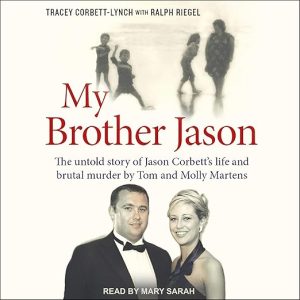
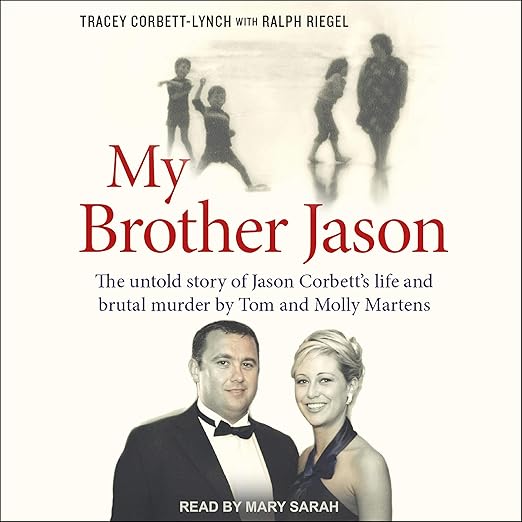
I came to My Brother Jason already knowing the broad outlines of the case. The murder of Jason Corbett by his wife Molly Martens and her father Tom Martens, an ex-FBI agent, in their North Carolina home in August 2015, received extensive coverage on both sides of the Atlantic. The custody battle that followed, the online campaign by Molly Martens, and the eventual murder conviction: all of it had been reported. What Tracey Corbett-Lynch’s account offers is something none of that reporting could: the experience of being Jason’s family, across an ocean, watching a nightmare unfold through a legal system and a media environment that didn’t always prioritize their perspective.
I listened to this one over two evenings. Mary Sarah’s narration suited the material: she doesn’t perform the grief, which is the right call because Tracey’s writing performs it already. The challenge of memoirs like this one is that they are explicitly and necessarily partial. Reviewer Book Fanatic noted the book’s bias upfront: Jason’s sister wrote it, so Jason is treated with a fullness and generosity that Molly Martens is not. That’s not a flaw. It’s the nature of the form. The more interesting question is whether the partiality obscures anything the reader needs to know, and here I think Corbett-Lynch is more careful than she might need to be. She’s honest that this is her account. She doesn’t claim judicial authority.
Our Take on My Brother Jason
What the book does best is recover the human texture of a case that, in media coverage, tends to reduce to its most sensational elements. The beating death of Jason Corbett with a baseball bat and a brick while his children slept nearby is the kind of detail that dominates headlines and can obscure the person who was killed. Tracey’s account of her brother as a widower raising two children after his first wife Mags Fitzpatrick died of asthma in 2006, the way he stayed connected to his Irish family, his decision to eventually bring the children home to Ireland, gives Jason a life that the crime reporting rarely provides space for.
Reviewer Shawn Weaver described finding the book so heartbreaking that he had to step away from it at times. That response feels accurate to the material. The sections dealing with the custody battle for Jason’s children after his death are genuinely painful. Corbett-Lynch and the Irish family fighting a cross-Atlantic legal process while processing grief and managing an online hate campaign is a story that could sustain its own separate book.
Why Listen to My Brother Jason
Mary Sarah’s nine-hour narration is the right length for this material. The book doesn’t pad. Tracey has a lot to cover: Jason’s life, his marriage to Molly, the events of August 2015, the investigation, the trial, the custody fight, and the online campaign against her family. That’s a substantial amount of ground and Sarah moves through it at a pace that allows emotion without wallowing. The Irish perspective on American legal proceedings is something the Dateline and documentary coverage of this case doesn’t adequately capture, and the book provides it.
Reviewer kristi09nc described it as a family’s quest for justice written by a courageous sister. That framing matters. This isn’t journalism or neutral case analysis. It’s advocacy in the form of memoir, and it makes no apology for that. The question of whether Molly Martens’s appeals or subsequent legal proceedings alter the picture Tracey paints is left open, as it must be, since those proceedings were ongoing at various points during the book’s development.
What to Watch For in My Brother Jason
The reviewer who gave this four stars and called it very passionate but biased identified the central tension that any reader should hold in mind. Tracey presents Jason as essentially good and Molly as essentially manipulative and calculating. That portrait may be accurate. It may also leave out dimensions of a complex marriage and family situation. This is Tracey’s account, and she’s not obligated to provide balance, but readers who want a more detached analysis of the case would need to supplement this with reporting from other perspectives.
The online hate campaign section is particularly harrowing and deserves more attention than true crime culture tends to give it. The way social media was weaponized against Tracey’s family while they were simultaneously dealing with grief, custody battles, and transatlantic legal proceedings is one of the book’s most distinctive contributions to the conversation about how murder cases unfold in the contemporary media environment.
Who Should Listen to My Brother Jason
True crime listeners who followed the Jason Corbett case on Dateline or in news coverage will find this adds depth and texture that documentary coverage couldn’t provide. Those interested in cross-Atlantic crime, Irish-American legal dynamics, or the experience of victim families in high-profile cases will find it particularly illuminating. Readers who need balanced journalism rather than testimony should know this is explicitly the family’s account. Mary Sarah’s narration is a strength throughout.
Frequently Asked Questions
Is My Brother Jason a neutral account of the case or does it take a clear side?
It is explicitly the Corbett family’s account, written by Jason’s sister. It presents Jason with full humanity and Molly Martens as a calculating manipulator. This is memoir and advocacy, not journalism. Reviewer Book Fanatic noted the bias but gave it four stars because the passion and storytelling quality are genuine.
Does the book cover the trial in detail, or primarily the family’s experience?
Both. There is substantial coverage of the trial proceedings, but filtered through the Corbett family’s experience of sitting in a North Carolina courtroom as Irish nationals in an unfamiliar legal system. The perspective is personal throughout, even in the trial sections.
How does Mary Sarah’s narration handle the emotional weight of the material?
Sarah’s narration is suited to the material: she doesn’t over-dramatize passages that are already painful enough on their own. Her approach supports the text without overperforming it, which matters particularly in testimony-style memoir where emotional authenticity is everything.
Does the book address subsequent legal proceedings or appeals by Molly Martens?
The book was published in 2020, and its coverage reflects the state of proceedings at the time of writing. Molly Martens’s subsequent appeals and legal history would need to be followed through news sources for updated context on how the case has developed since publication.