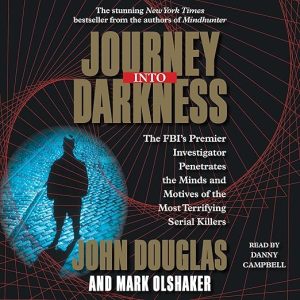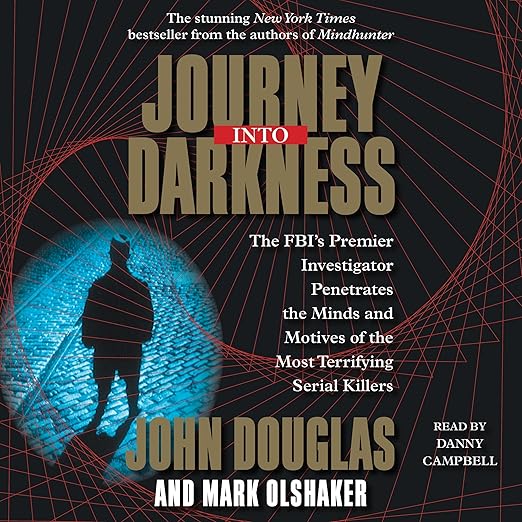
Quick Take
- Narration: Danny Campbell delivers Douglas’s blunt, authoritative voice with steady conviction, though the clinical tone can feel relentless over fifteen-plus hours.
- Themes: Criminal profiling, child safety, behavioral science as law enforcement tool
- Mood: Unsettling and methodical, with moments of genuine moral weight
- Verdict: If you came to John Douglas through Mindhunter and want more of his casework thinking, this delivers, though its child predator focus demands real emotional preparation.
I put off starting this one for weeks. I had Mindhunter on my shelf for years before I finally listened to it, and when I did, I had to pace myself through the uglier passages. Journey into Darkness is, in many ways, the follow-up that assumes you already know what you’re signing up for. I finally started it on a quiet weeknight when I knew I wouldn’t be interrupted, and I kept the lights on.
John Douglas spent years as the head of the FBI’s Investigative Support Unit, the team that essentially built criminal profiling as a discipline. Mindhunter introduced that career in broad strokes. This book goes narrower and harder, zeroing in on cases involving serial killers, rapists, and child molesters, with particular sustained attention on pedophiles and child abductors. It is not comfortable material. Douglas doesn’t intend it to be.
Our Take on Journey into Darkness
What separates Douglas from crime writers who simply catalogue horror is his insistence on utility. He’s not recounting these cases to disturb you. He’s recounting them because he believes understanding is the only meaningful response. The Polly Klaas abduction and murder, the Suzanne Marie Collins case, Megan’s Law’s tragic origin story: these aren’t presented as cautionary tales in the lurid sense. Douglas is deliberate about not glorifying any of these men. What he does instead is anatomize. The Clairemont killer, Richmond’s first serial murderer, the schoolgirl murders: each case is used to illustrate how behavioral science catches patterns that traditional detective work sometimes misses.
The book’s most practically minded section addresses child safety directly. Douglas includes eight rules for safety, a chart organized by age showing what safety skills children should have, tips on detecting sexual exploitation, and guidance on how to talk to children about danger without terrorizing them. A reviewer named David put it well: he appreciated Douglas’s approach of teaching safety without generating fear. That’s not easy to do in a book this dark, and Douglas pulls it off.
Why Listen to Journey into Darkness
The audiobook version runs over fifteen hours, narrated by Danny Campbell, who handles Douglas’s voice with appropriate gravity. Campbell doesn’t dramatize or editorialize, which is exactly right for this material. Douglas’s prose style is blunt and direct, sometimes almost conversational, and Campbell mirrors that without adding artificial urgency. One reviewer noted that the book can feel long-winded in places, with too many names stacked together. That’s a fair criticism. Douglas has never been a stylist, and the sheer density of case detail occasionally creates a kind of white noise effect where individual victims blur together. That’s a structural limitation of the material, not a flaw in Campbell’s performance.
The cases that work best are the ones Douglas personally investigated or had deep involvement with. When he’s recounting his own reasoning process, the book comes alive. When he’s summarizing cases at a remove, it can feel encyclopedic in the less engaging sense of that word. The Polly Klaas section is particularly strong. Douglas’s frustration with what could have been prevented, and what the system failed to do, comes through with unmistakable clarity.
What to Watch For in Journey into Darkness
This book does not romanticize the profiling career. Douglas is honest about the psychological toll of the work, about cases that stayed with him, about the ways repeated exposure to human cruelty reshapes how you see the world. Amy’s Bookshelf Reviews called it inspiring. I’d say it’s more sobering than inspiring, which is probably more valuable. Douglas ends with a note of cautious optimism: that behavioral science, applied well, might let law enforcement identify warning signs before a killer strikes rather than after. Whether you find that reassuring depends on how much faith you have in institutions. Douglas has complicated feelings about that himself, and he doesn’t try to paper over them.
One thing worth knowing before you start: the rating count on Audible is unusually low for a book of this profile, which likely reflects the specific format this edition was released in rather than the book’s reach. In print, Journey into Darkness has a substantial readership. The audio version feels well-suited to the material since Douglas’s voice is at its most persuasive when you can follow his thinking in real time.
Who Should Listen to Journey into Darkness
Listeners who found Mindhunter compelling and want to go deeper into Douglas’s casework will get significant value here, particularly from the child safety material if they have kids or work with children. Listeners who are sensitive to detailed descriptions of violence against children should approach with real caution. This is not light true crime. It’s the kind of book you listen to because you want to understand something difficult, not because you want to be entertained by darkness.
Frequently Asked Questions
Do I need to have listened to Mindhunter before starting Journey into Darkness?
It helps significantly. Journey into Darkness reads as a companion to Mindhunter and assumes familiarity with how the FBI’s Investigative Support Unit operates. You can follow it without that background, but the context it provides makes the case discussions considerably richer.
How explicit is the violence in this audiobook?
It’s substantial. Douglas describes crime scenes and victimology in clinical but unflinching detail. The sections on child abduction and sexual predation are especially difficult. He is deliberate about not sensationalizing, but the material itself is genuinely disturbing.
Is the child safety section practical or just theoretical?
It’s genuinely practical. Douglas includes age-specific safety skill charts, eight concrete rules for child protection, and guidance on how to teach children to protect themselves without creating debilitating fear. Several reviewers specifically praised this portion of the book.
Does Danny Campbell’s narration work for Douglas’s first-person style?
Yes. Campbell keeps the delivery measured and authoritative without overperforming the more emotional passages. Douglas’s prose is deliberately unsentimental, and Campbell honors that register throughout the fifteen-plus-hour runtime.