In Brief
- Narration: Adenrele Ojo carries a philosopher's history of conjure work, told generation by generation across four centuries.
- Themes: conjure and root work, Black women's medicine, Voodoo queens and granny midwives, the commercial afterlife of folk practice
- Mood: Warm, revisionist and quietly furious
- Verdict: A genuinely reframing history, best heard for the argument and revisited in print for the names.
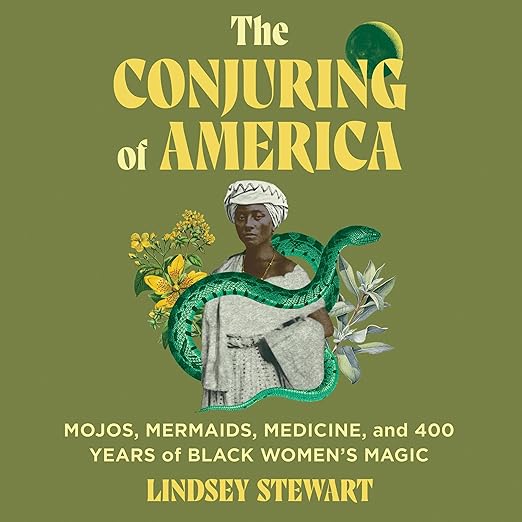
Vicks VapoRub and the blue jean both turn up in the description of this audiobook, alongside Voodoo queens, granny midwives and a 2023 Disney film. Lindsey Stewart is making an argument about where a great deal of American culture actually came from, and the route runs through Black women who practiced conjure in secret across four centuries. Adenrele Ojo reads the result across ten hours and thirty-nine minutes.
Chronology organizes the book, generation by generation of practitioners. Negro Mammies during slavery, Voodoo Queens and Blues Women through Reconstruction, Granny Midwives and textile weavers under Jim Crow. Each group is read as a working technology rather than a curiosity: spiritual belief, herbal ritual and therapeutic remedy combined with whatever was available locally, assembled into what the copy calls a secret well of health and power hidden from their oppressors.
Readers keep reacting to that reframing rather than to the history itself. One describes the shock of seeing basic survival practices demonized, repressed and then repackaged, and calls the recognition another level of deception unlocked. That same notice goes further, describing the shame attached to instincts that felt entirely natural, and the realization that the shame had been engineered. A book that produces that reaction is doing something beyond assembling facts, which is a different measure of history writing from accuracy and a rarer one to meet.
Stewart comes to the subject as a philosopher rather than a historian, which the description states outright, and the earlier title credited to the same author is The Politics of Black Joy. That background shows in the choice of sources: letters from the enslaved set alongside accounts drawn from Oshun and other African mystical traditions. A trained historian would probably hesitate before placing those two categories on the same footing. The result is a book about meaning as much as about evidence.
Where the book gets genuinely strange is in the commercial afterlife of all this. A chest rub, a pancake brand, a pair of jeans and a recent animated film are offered not as trivia but as the argument's proof: knowledge developed under secrecy and criminalization did not disappear, it got bought, renamed and sold back. One reader arrives at the same place independently, reporting African-rooted traditions alive across the United States, the Caribbean and Latin America, simply rebranded on the way. That thread is what will carry a listener through the harder historical chapters, and it is the one the marketing copy is least shy about.
Portraits Carry the Argument, No Charts Needed
That same reader makes the case for this format directly and without prompting, recommending it to audio listeners on the way to work or on a long drive, then explaining why: the book supplies historical context for traditions you may never have recognized as traditions, and widens what the word conjuring is understood to cover. Somebody who found the argument personally reordering is also telling you it survives being heard rather than studied.
Structurally, the material rewards that approach. This is narrative history assembled from portraits, each generation of practitioners a self-contained run of stories, so the argument never depends on a chart, a genealogy or a table. A stretch about Blues Women or about granny midwives works as a sequence of people and practices, and sequences are what a recording handles best.
Reception has been unusually warm even measured against other well-received history. Five written responses, all at five stars, sit under an aggregate of 4.8 across 113 votes, and none of the five hedges in the way readers usually hedge about a book that argues something. One reader logs the book as the thirty-second title of a year spent mostly on nonfiction and puts it in first place. Another reports learning Black history never encountered before, despite having taken college-level coursework in the subject.
Two Readers, Two Very Different Ways of Listening
Opposite advice about how to consume this book arrives from two separate readers, and both positions are defensible. The reader quoted above on commuting is one of them. The other instructs you to slow down, mark passages and let them settle, which is a set of instructions no recording can follow. A four-hundred-year history crossing religion, medicine, textiles and food carries more proper nouns than most listeners will hold, and the listing offers no companion reference of any kind. That is the trade you are making: the shape of the argument arrives intact and the particulars slide past.
Flag one of those notices for a different reason. Its text carries a follower count and a second date, February 13, 2026, stitched into the opening line, while the page above it records March 5, 2026. That is a review written elsewhere and pasted here with its profile furniture still attached. A small thing on its own, and a useful indication of how loosely this pool has been assembled.
Filing is loose in another direction too. The book sits in three categories simultaneously, history, politics and social sciences, and religion and spirituality, under a single geographic tag. All three are defensible and none is sufficient, because the argument runs through traditional medicine, labor, folklore and the commercial afterlife of Black domestic knowledge. Somebody hunting for a history of American medicine would want this and will not find it under medicine. Somebody browsing spirituality will find it and may expect a practice manual. Anybody working a single shelf is going to walk past it.
Chest Rub and Blue Jeans, Origins Explained
A listener who wants American history retold from an angle the standard survey leaves out is the obvious buyer, provided they are comfortable with a philosopher's approach to what counts as a source. The commercial thread alone justifies the hours: how remedies passed down in secret ended up inside a jar of chest rub, and how a pancake brand and the all-American blue jean acquired the origins they now carry.
A poor fit, though, for anyone wanting strictly documentary history with every claim anchored in the text, given that the material named in the copy runs from letters written by enslaved people to the lore of Oshun. Wrong too for anyone who needs to retain a large cast of names and dates precisely, because a recording gives you exactly one pass at each of them.
Its two most practical readers disagree about whether this book should be heard or annotated, and that disagreement is the most useful thing on the page. Its argument lands cleanly in a recording, and its names will not stay put without a printed copy nearby.
Questions Listeners Ask
Does The Conjuring of America work as an audiobook?
Its readers split on exactly that question. One recommends the audio without reservation; another wants you reading slowly with a pencil in hand and time to let each section settle. The argument survives a recording intact. Four centuries of names, places and practices do not, and no companion reference is offered anywhere on the page.
What does Lindsey Stewart mean by conjure?
The copy frames it as a working system rather than superstition: belief, plant medicine and healing craft assembled from whatever was available nearby and transmitted in secret across generations. One reader describes the scope as four hundred years of traditional practice, African religion, Louisiana voodoo, and community birthing history.
Which figures does the audiobook cover?
It advances chronologically through the Negro Mammies of the slavery era, then the Voodoo Queens and Blues Women of Reconstruction, and finally the Granny Midwives and weavers of the Jim Crow decades. Its material includes correspondence written by enslaved people and the lore surrounding Oshun and other African mystics.
Why does the listing show three different categories?
Three shelves claim it simultaneously: history, social science, and religion, alongside one regional label. Each holds part of the book and none holds all of it, because the argument crosses medicine, labor, folklore and commerce alike. Anyone browsing a single shelf walks straight past it.