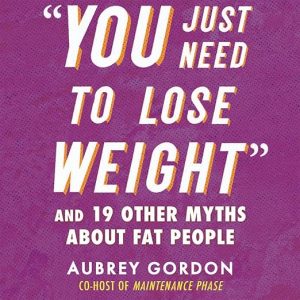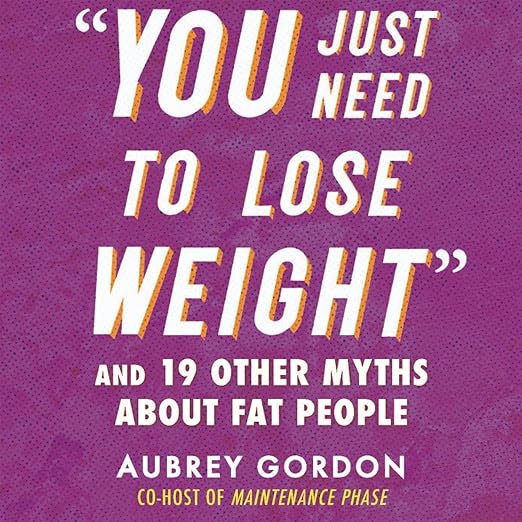
Aubrey Gordon arrives in this audiobook with twelve years of community organizing behind her, a co-hosting slot on the Maintenance Phase podcast with Michael Hobbes, the Your Fat Friend column, and a New York Times bestseller list placement for the book itself. The title is the myth, positioned in quotation marks precisely to signal that framing. This is not a weight loss audiobook; it is a book about the arguments used to justify discrimination against fat people, and it is narrated by Gordon herself in the same measured, research-grounded voice that makes Maintenance Phase one of the more useful podcasts currently addressing health and wellness with actual rigor. Podcast listeners will recognize the register within the first thirty seconds. At seven hours and eleven minutes, the audiobook gives that approach considerably more room to develop than any single episode can, and the extra space is used well.
The book's organizing logic is worth understanding before you commit to it. Gordon is not writing a comprehensive history of anti-fat bias or a broad cultural account of fat justice as a movement. She is writing a specific kind of activist manual: a guide to the most common myths about fatness and weight, with the rhetorical tools required to dismantle each one in actual conversations. The myths are familiar to anyone who has been in those conversations - that weight loss is simple arithmetic; that fat people are inherently unhealthy; that we are in the midst of an obesity epidemic that demands urgent intervention; that fat acceptance is the same thing as glorifying obesity; that the BMI is an objective and scientifically neutral measure of size and health. Gordon takes each myth apart with primary research citations, historical context, and the kind of precision that comes from someone who has had these arguments in public organizing spaces for over a decade and has learned exactly where the counterarguments need to land.
What Works
Gordon self-narrating is the correct format choice, and the reasoning goes beyond authenticity. She is a podcast host, which means she knows how to structure an argument for the ear, how to signal transitions, how to deliver a research-grounded claim with the authority of someone who has verified it rather than merely read it. The seven hours of listening feel well-paced in a way that academic books on the same subjects often do not, and the Maintenance Phase cadence - accessible rigor, maintained throughout - makes the technical content genuinely absorbable rather than requiring the sustained concentration of a denser text.
One reviewer who identified herself as having a background in experimental psychology and measurement science described this as probably the best scientific summary of weight loss and weight discrimination research she had encountered for a general audience - a meaningful endorsement from someone professionally positioned to evaluate the quality of scientific translation. The book's handling of the BMI's origins and limitations, the evidence base for long-term weight loss intervention outcomes, and the research on weight discrimination in healthcare are particularly strong. Gordon cites specific researchers and study findings throughout rather than making general appeals to what science shows, which is what distinguishes the book from more rhetorically satisfying but less rigorously grounded writing in adjacent spaces.
The intersectionality framework is integrated throughout rather than appended as an afterthought or a separate chapter. Gordon draws on her own experience as a fat queer woman, and the book consistently addresses how anti-fat bias compounds with racism, sexism, and class inequality rather than treating fatphobia as a phenomenon that operates in isolation from other systems of power. Several reviewers specifically noted and valued this attention to intersectionality, and it is one of the elements that distinguishes the book from single-axis advocacy that can treat fatness as the only relevant dimension of a fat person's experience.
The practical rhetoric orientation also distinguishes Gordon's book from more purely academic treatment of the same subject matter. She has spent twelve years in community organizing contexts where these arguments need to be made quickly, clearly, and in ways that can actually shift someone's position rather than simply performing the speaker's correctness. That organizing background shapes the book's entire structure, and it is what makes it function effectively as an audiobook - the frameworks are designed for use in conversation, not just for understanding in private.
Before You Commit to "You Just Need to Lose Weight"
The book is structured as a myth-debunking guide, which means it is most useful when you already have some engagement with the subject and want specific argumentative tools. Listeners coming to fat justice conversations entirely fresh may find the book occasionally assumes more familiarity with the policy and cultural landscape than it explicitly provides. Gordon wrote this for the moment when you are already in the conversation and need the specific counterargument - that rhetorical orientation means it functions less well as a broad introduction to these ideas and better as a resource for people who are already asking the right questions.
Committed Maintenance Phase listeners will also find some overlap with material the show has covered, since many of the myths Gordon addresses have been the subject of dedicated episodes. The book develops arguments more fully than episode format allows, but the terrain will not be entirely new. That is a mild limitation given the quality of the development in full form, but it is worth knowing for listeners hoping to encounter entirely fresh material relative to the podcast.
Who It's For
This audiobook is for anyone who wants to engage in fat justice conversations with more precision than general awareness currently provides - whether they are fat themselves and looking for language to respond to the myths they encounter daily, or working in healthcare, education, fitness, or adjacent fields where these misunderstandings cause direct and measurable harm. The research orientation makes it particularly useful for listeners who prioritize evidence over emotional appeal. Gordon's self-narration makes it accessible and natural as a listen; the Maintenance Phase podcast is a natural companion resource for anyone who wants to continue these conversations beyond the book. The title is the argument you will hear when you leave the audiobook behind.
Questions Listeners Ask
Is the "You Just Need to Lose Weight" audiobook connected to the Maintenance Phase podcast?
Yes - Aubrey Gordon co-hosts Maintenance Phase alongside Michael Hobbes, and the book extends arguments and research the podcast has explored in episode format. The audiobook stands entirely alone, but Maintenance Phase listeners will recognize Gordon's approach and find the book a welcome expansion of the show's frameworks.
How does Aubrey Gordon's self-narration affect the listening experience of this audiobook?
Gordon's podcast background makes her self-narration one of the audiobook's clear strengths. Her voice is familiar from Maintenance Phase, her cadence is suited to presenting research arguments accessibly, and the personal investment she brings to the subject matter is evident without becoming emotionally overwhelming. It is precisely the right format choice.
Does this audiobook rely on scientific research, and how rigorously is it cited?
Gordon cites specific studies, researchers, and data points rather than making general appeals to what science says. One reviewer with a research science and measurement background described it as probably the best scientific summary of weight loss and weight discrimination research for a general audience - the evidentiary standard is genuinely higher than most popular nonfiction in adjacent spaces.
Is "You Just Need to Lose Weight" appropriate for listeners who are not personally affected by anti-fat bias?
Yes - the book is explicitly written for anyone wanting to participate in fat justice conversations more effectively, including people in healthcare, education, or advocacy who encounter these myths professionally. Gordon's rhetorical toolkit approach is particularly useful for people whose roles put them in the position of needing to explain or counter these myths to others.