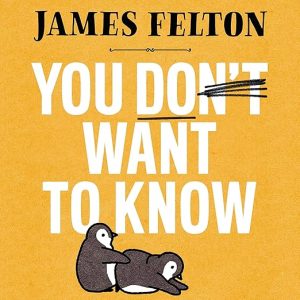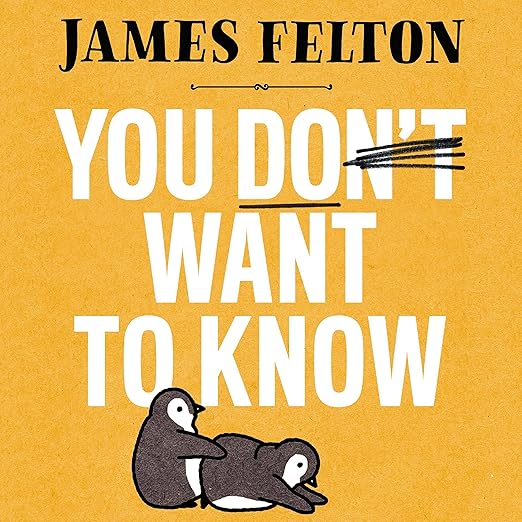
James Felton's You Don't Want to Know arrives with an honest title and a narrator - James Buckley, best known as Jay from the British sitcom The Inbetweeners - whose comic sensibility is perfectly calibrated for the material. This audiobook, running just under six hours, is a collection of historical, scientific, and natural world facts that occupy the overlap between fascinating and deeply inadvisable: the kind of information that, once encountered, cannot be unencountered. The synopsis makes this explicit, answering its own teaser questions with the kind of cheerful casualness that tells you exactly what register the book operates in throughout. The chainsaw was invented to aid childbirth. The 1970 Oregon beached whale was exploded with one hundred times the recommended dynamite, raining blubber on surrounding buildings. These are the entry points, and they accurately represent the collection's ambitions.
Buckley Times the Reveal Like a Punch-Line
Felton established his reputation delivering exactly this type of content to a massive Twitter following, and the book's style is unmistakably native to that platform: the compression of the setup, the timing of the reveal, the implicit understanding that the reader is sitting there slightly appalled and completely unable to stop. In audio, this requires a narrator who can replicate the comic timing of a written punch-line in spoken delivery, and Buckley does it consistently. His deadpan-to-incredulous range is the audio equivalent of Felton's written voice, and the combination is frequently funnier than either element would be alone.
The material spans history, biology, medicine, and natural science without any declared organizational system - Felton moves by association and comic contrast rather than category. The penguin section prompted one reviewer to declare that penguins are monsters, which is a fair summary of what the natural world biology sections are doing. The historical entries cover events from the ancient world through the twentieth century, with particular strength in the moments where official accounts and actual outcomes diverge by the widest possible margin. The medical history is, predictably, the most inadvisable in the way that medical history tends to be when you are looking at it from the outside. Across all of these categories, the quality control is high - Felton is not simply stringing together gross-out facts but selecting for the entries that have a genuine narrative shape, where the setup and reveal create a specific comedic or appalling effect.
An Accent Some US Listeners Can't Follow
The narrator casting is both this audiobook's biggest draw and its most discussed feature. Buckley has a distinctive, regionally marked British accent - not RP, not neutral - and his comic delivery is built around a deadpan-to-incredulous range that suits the material perfectly for listeners who are in tune with his voice. Reviewers who loved it report laughing hard enough that the book had to be paused to recover before continuing. The one-star reviewer who found his accent impossible to follow as an American listener is not wrong that the accent is pronounced and meaningfully different from American or mid-Atlantic English. A sample listen before purchasing is the sensible approach for any US listener who is not already familiar with that particular regional cadence from British television or podcasting.
The pairing of Felton's material with Buckley specifically is not accidental - Felton's online voice and Buckley's on-screen persona share a refusal to treat the absurd with more gravity than it warrants, and the cheerful willingness to linger in the detail of something terrible. Five hours and fifty-seven minutes in this mode is a lot of sustained commitment to a single comic register, and some listeners will find the density of dark trivia runs together in the middle third. Taking the audiobook in segments - commute installments, or a chapter at a time before sleep - preserves the impact better than a single extended session, giving each entry room to land before the next arrives.
Unmarked Chapters Make Navigation Difficult on Purpose
The book does not organize its facts thematically in any strict way, which is by design: part of the pleasure is not knowing which category the next entry will come from. However, listeners who prefer organized learning and want to return to specific sections will find navigation difficult without chapter markers for each individual entry. The format is built for forward listening rather than reference, and treating it that way produces the best experience.
The title's promise - facts you will wish you could forget - is partially delivered and partially aspirational. Some entries are genuinely unsettling in their implications, particularly in the medical history sections. Others are more silly than disturbing. Listeners expecting uniform horror will find a wider tonal spectrum than the branding suggests; listeners expecting a variety of registers within a generally dark-comic frame will find their expectations met accurately across most of the runtime.
UK Listeners and Buckley Fans Fit Best
UK listeners, fans of James Buckley's on-screen work, and anyone who has engaged with Felton's Twitter or social presence will find this a natural and highly entertaining listen that matches his written voice closely. US listeners who regularly engage with British comedy podcasts and are comfortable with non-neutral accents will have no trouble; those who are not should genuinely sample before purchasing. People who want organized, categorized trivia for reference will find the format resistant to that use. Those who want to laugh at history's worst decisions from a comfortable distance will find this very much to their liking.
Common Questions
Is narrator James Buckley's British accent difficult to follow in this audiobook for American listeners?
One reviewer specifically flagged this as a significant obstacle, rating the audiobook one star due to difficulty understanding the accent. Buckley's delivery is regionally marked rather than neutral, and it is meaningfully different from American or mid-Atlantic English. US listeners who are not familiar with British comedy or accents should listen to a sample before purchasing.
Does this audiobook work in short segments or is it best listened to in one extended session?
Better in segments. The density of dark trivia means that extended listening in a single session can make the entries blur together. Taking the audiobook in commute-length or chapter-at-a-time installments preserves the impact of each individual revelation and gives space to recover from the funnier entries before the next one lands.
Is the humor in this audiobook just gross-out trivia or does it have actual comedic craft?
Genuine craft. Felton's background as a Twitter writer gives him a strong instinct for the single-sentence setup and reveal, and Buckley's deadpan-to-incredulous delivery preserves that timing in audio form. The book ranges from historically disturbing to naturally bizarre to medically inadvisable, and the variety prevents any single register from dominating the full runtime.
Who is audiobook narrator James Buckley and why was he chosen for this project?
James Buckley played Jay in the British sitcom The Inbetweeners, a role that made him one of the more recognizable comic voices in British television. His deadpan delivery and willingness to commit to absurd material make him a natural fit for Felton's brand of dark, delighted trivia. The pairing specifically matches the written voice of a Twitter comedian with a narrator who operates in a compatible register.