Quick Take
- Narration: Kelsey McKinney reads her own work with the conversational ease you would expect from someone who hosts a popular podcast; it sounds like she is talking directly to you.
- Themes: gossip as social bonding, truth-seeking and storytelling, the ethics of information-sharing
- Mood: Smart, breezy, and genuinely curious
- Verdict: A witty cultural inquiry into why we gossip that takes the subject seriously without losing the pleasure of a good story.
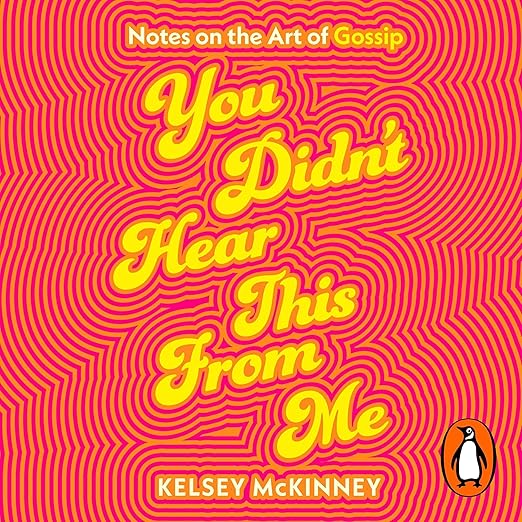
There is something fitting about listening to a book about gossip in audio format. Reading Kelsey McKinney’s You Didn’t Hear This From Me on the page would work, but hearing her voice, the same voice behind the Normal Gossip podcast that has attracted millions of listeners, adds a layer of intimacy that suits the material. I started this one on a Friday afternoon and finished it by Sunday evening, which tells you something about how it moves.
McKinney is a journalist whose podcast Normal Gossip has built its reputation on a specific premise: that gossip is not shameful but genuinely interesting as a social and anthropological phenomenon. This book extends that argument into a proper cultural inquiry, one that ranges from the Epic of Gilgamesh to The Traitors and takes in anthropology, narrative theory, and the question of why humans need to share information about other humans in order to feel connected to the world.
Our Take on You Didn’t Hear This From Me
The book’s central argument is more sophisticated than the breezy packaging might suggest. McKinney is not simply defending gossip against its critics. She is asking what gossip actually is, why it has been coded as sinful or petty across cultures, and what function it serves in social bonding and truth-finding. The range of cultural reference is genuinely broad, from ancient Mesopotamian texts to contemporary reality television, and McKinney moves between those reference points with the ease of someone who has spent years thinking carefully about storytelling and its purposes.
What she finds, essentially, is that gossip is a form of collective sense-making. When we lean over and whisper something salacious into a friend’s ear, we are not simply being indiscreet. We are processing information, testing our understanding of social norms, and seeking confirmation that our perception of events is shared. That framing does not rehabilitate gossip as some noble act, but it does make the impulse feel comprehensible and human rather than weak or vain.
Why Listen to You Didn’t Hear This From Me
McKinney’s background in podcast hosting gives her a natural relationship with the audio format that comes through clearly in her narration. She reads at a pace that suggests conversation rather than lecture, and the anecdotal sections, the places where she draws on specific gossip scenarios as case studies, are told with the timing of a practiced storyteller. At just over seven hours, the book sustains that energy without overstaying its welcome.
Published by Penguin Audio in February 2025, this release arrived at a cultural moment when questions about truth, misinformation, and the social dynamics of information-sharing have particular urgency. McKinney engages with those questions with enough wit that the book never feels like a dry media analysis, but with enough rigor that it is not simply a celebration of talking about other people. The balance is handled well.
What to Watch For in You Didn’t Hear This From Me
Readers expecting a primarily sociological or academic treatment of the subject will find it lighter than that. McKinney is a journalist and podcaster, and the book reads like a very well-researched and well-argued essay collection rather than an academic monograph. That is a feature for most listeners and a potential disappointment for those who want citations and footnotes as the primary mode of engagement.
The title carries a slight note of irony that runs through the whole book: McKinney is publishing, very publicly, a book about the secrets we whisper privately. That tension is acknowledged rather than resolved, and the book is more honest for sitting with it rather than explaining it away. The question of how much truth really matters in storytelling is one McKinney raises directly, and her answer is more nuanced than either a moralist or a nihilist would want it to be.
Who Should Listen to You Didn’t Hear This From Me
This audiobook will appeal to listeners who enjoy cultural criticism delivered with a light touch, fans of the Normal Gossip podcast who want to go deeper into McKinney’s thinking, and anyone who has ever wondered why gossip feels both irresistible and slightly guilty. It is also a good choice for listeners interested in narrative theory and why humans need stories about other humans to make sense of the world. Those who want either pure entertainment or rigorous academic analysis may find it sits in a middle space that does not entirely satisfy either expectation.
Frequently Asked Questions
Do I need to be a fan of the Normal Gossip podcast to enjoy this book?
No. The book stands entirely on its own as a cultural inquiry into gossip, storytelling, and truth. Familiarity with the podcast may add context, but McKinney builds her arguments from the ground up and does not assume you have listened to her show.
Is this book primarily entertaining or does it have serious intellectual content?
Both, though the balance leans toward accessible cultural criticism rather than strict academic analysis. McKinney draws on anthropology, narrative theory, and a wide range of cultural references from the Epic of Gilgamesh to reality television, but she writes with the wit and pace of a journalist rather than a scholar.
Does Kelsey McKinney’s podcast experience affect the narration quality?
Noticeably and positively. Her experience as a podcast host gives the narration a conversational ease and natural timing that makes a seven-hour listen feel much shorter. She reads as though she is talking to a specific person rather than performing for an audience.
Does the book reach a definitive conclusion about whether gossip is good or bad?
No, and that is a deliberate choice. McKinney is more interested in understanding gossip as a human phenomenon than in defending or condemning it. She ends up arguing that uncertainty about truth and the need to share what we know are both fundamental to human social life, which is a more honest position than a simple verdict would allow.