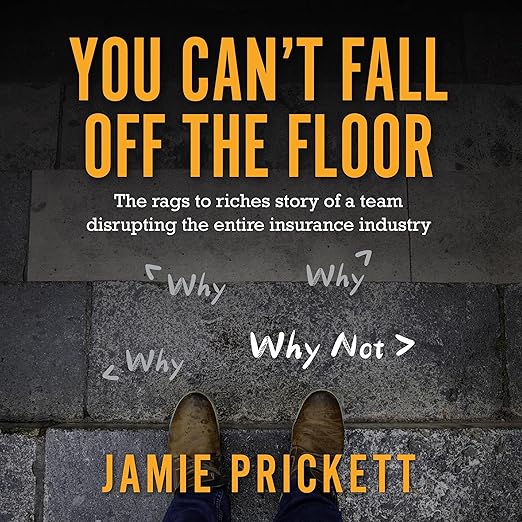
Quick Take
- Narration: Prickett reads his own book with the cadence of someone who has told these stories before; natural and unpolished in a way that fits the mentor-conversation tone.
- Themes: Insurance entrepreneurship and the Tribrid model, servant leadership, scaling from solo practice to organizational leadership
- Mood: Motivational and candid, like a long lunch with someone who has genuinely been through it
- Verdict: Most useful for insurance and financial advising professionals considering the leap from transactional work to building something larger; too niche for general business readers.
I came across this one through a recommendation thread specifically aimed at financial services professionals looking for something beyond the usual hustle-culture motivation fare. The title is blunt in a way that signals the book’s general disposition: Prickett is not interested in theoretical frameworks or case studies at a safe remove. He is interested in telling you what actually happened when he tried to build something.
Jamie Prickett built a business inside and around Experior Financial Group, which he describes using the term Tribrid model, a structure that blends elements of direct sales, agency building, and organizational leadership in ways that he argues distinguish it from conventional multi-level marketing setups. One early reviewer came in skeptical specifically because of MLM-adjacent associations, and Prickett addresses that skepticism within the book. Whether you find his response convincing will depend significantly on your prior exposure to the financial services industry.
Our Take on You Can’t Fall Off the Floor
At four hours and nine minutes, this is a short listen, which is itself instructive about the book’s approach. Prickett does not pad. The inside view of building a $50 million business is delivered with a directness that reviewers consistently describe as candor rather than salesmanship, and that is largely fair. He is willing to describe mistakes and false starts in a way that distinguishes this from purely promotional material.
The book’s title refers to a psychological posture rather than a financial one: the idea that when you have genuinely lost everything, or feel as though you have, the only direction available is upward. It is a framing Prickett applies to his own trajectory, and while it is not a new idea in entrepreneurial memoir, he grounds it in specific enough personal detail that it does not feel hollow.
Why Listen to You Can’t Fall Off the Floor
The author narrating his own work is the right call here. Prickett’s delivery has the rhythm of someone recounting events they have thought about often. One reviewer described it as like having a conversation with a trusted mentor who gives you the secret sauce advice to propel your business, and that captures something accurate about the listening experience. There is no performance anxiety in the narration; it is relaxed and occasionally informal in ways that a professional narrator’s polished delivery would have smoothed away.
For the target audience, specifically people who are already inside the insurance or financial advising world and are considering whether to build something beyond their solo practice, the practical texture of the book is the value. Prickett is not writing for people who have never thought about these structures before; he is writing for people who are weighing a specific kind of professional leap.
What to Watch For in You Can’t Fall Off the Floor
This is a book with a clearly defined audience, and if you are outside it, the specificity that makes it useful to industry insiders may feel limiting. The Experior Financial Group is referenced throughout, and while Prickett frames the lessons as broadly applicable to entrepreneurship, the texture of the examples is specific to insurance and financial services distribution. General business readers looking for broader strategic frameworks will likely feel under-served.
It is also worth noting that the community of readers reviewing this book is predominantly people with direct professional connection to Experior or to Prickett himself. The enthusiasm in the reviews is genuine, but it is coming from a close-knit audience. Take the uniformly high ratings with that context in mind.
Who Should Listen to You Can’t Fall Off the Floor
Insurance agents and financial advisors at a career inflection point, particularly those considering moving from individual production to building a team or organization. Listeners who enjoy founder memoirs that stay close to operational detail rather than floating into abstraction. Skip it if you are looking for general entrepreneurship content or if the financial services industry is unfamiliar territory.
Frequently Asked Questions
Is this book relevant to entrepreneurs outside the insurance and financial services industry?
The principles around team-building and scaling have broader application, but the specific examples, vocabulary, and strategic context are rooted firmly in insurance and financial advising. General entrepreneurs will find it thin compared to books written with a broader audience in mind.
What exactly is the Tribrid model Prickett describes?
Prickett uses Tribrid to describe a business structure that combines direct client service, agency development, and organizational leadership in a way he argues moves beyond transactional one-on-one work. The details are specific to the Experior Financial Group context.
How does this compare to other insurance industry books or sales culture titles like The Go-Giver?
Prickett’s book is more personally specific and operationally detailed than Go-Giver-style motivational parables. It reads more as memoir than as business philosophy. Listeners who want broader principle rather than one founder’s particular story may prefer something more explicitly framework-driven.
Is the Experior Financial Group affiliation disclosed clearly within the book?
Yes. Prickett is transparent about his connection to Experior, and the book is partly an account of what he built within and around that organization. Readers going in should understand this is a founder’s account of a specific venture, not an industry-wide analysis.