Quick Take
- Narration: Glen A. Campbell carries Rivera’s fragmented, poetic prose with appropriate weight, letting the white space breathe rather than rushing to fill it.
- Themes: EMS burnout, clinical intuition, the emotional cost of first response work
- Mood: Raw and introspective, like a debrief that finally says the true thing
- Verdict: A short, honest book for EMS providers who need to feel recognized more than they need to be trained, delivered by a narrator who understands when to get out of the way of the text.
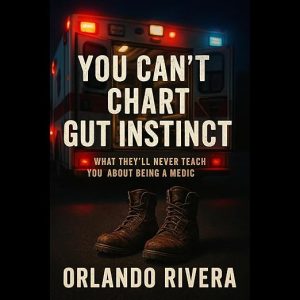
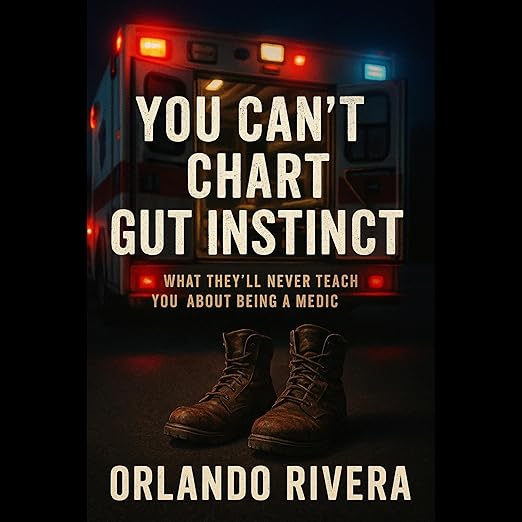
I picked this one up on a slow Tuesday evening, expecting something in the vein of emergency medicine career guides. Two and a half hours later I had listened to something closer to a prose poem about professional sacrifice. That pivot is worth knowing about before you begin. You Can’t Chart Gut Instinct is not a manual. It is not a training resource. It is a field report from the inside of a career that breaks people systematically while asking them to show up whole.
Orlando Rivera is an EMS physician and educator, and the authority in this book comes not from credentials but from accumulated recognitions. He writes in short, staccato paragraphs that one reviewer describes as formatted almost like poetry, easy to hang on every word. That structural choice is not decorative. It mimics the way trauma arrives in fragments, the way a shift accumulates experiences you cannot quite process in sequence. The form is the argument.
What the Synopsis Gets Right About Its Audience
Rivera is explicit that this book is for every EMT who has been called just transport, for every paramedic who knew something was off and was right, for every provider who whispered I’m fine when they weren’t. That is not marketing language; it is an accurate description of the territory the book covers. The reviewers who respond most intensely to it are working providers who describe it as the book that finally says what they have been thinking. One calls it a sucker punch of truth and reality. Another finished it in two sittings, which she describes as remarkable given her difficulty finishing books at all.
The gut instinct of the title refers to something more specific than clinical intuition in the general sense. Rivera is arguing that EMS providers develop pattern recognition that cannot be codified in protocols or captured in documentation, a felt sense of when a patient is sicker than their vitals suggest, when a scene is about to turn, when something is wrong that no chart field can account for. His argument is that this capacity is real, that it saves lives, and that the system’s inability to acknowledge it is part of what makes the work so isolating.
Burnout as the Book’s True Subject
Underneath the self-defense of gut instinct is a sustained examination of what the constant exposure to trauma costs. Rivera does not romanticize EMS work, and he does not minimize the damage. He writes about the black humor that serves as psychological insulation, the way providers learn to laugh at things that would otherwise be unmanageable, with an insider’s authority that avoids the voyeurism that sometimes infects outside accounts of first responder culture.
The sections on considering leaving the job are among the most honest in the book. Rivera does not argue that everyone should stay, and he does not pretend that passion is sufficient protection against systemic burnout. He is more interested in helping people understand what they are experiencing than in producing an argument for resilience.
Short Runtime, High Density
At two hours and thirty-two minutes, this is a short audiobook by most standards. That brevity is appropriate to the material, Rivera is not padding his argument, and the compressed form gives the prose its energy. Glen A. Campbell reads it with a measured gravity that suits the fragmentary structure. He does not editorialize or impose emotional intensity beyond what the text asks for, which is the right call with writing this spare.
The series name, You Can’t Chart Series, suggests Rivera intends further volumes in this register. If he maintains this standard of honesty and formal rigor, that is worth watching.
Who Should Listen and Who Should Skip
This is written for and will most fully reach EMS providers, paramedics, and emergency medicine personnel who have accumulated the specific kind of exhaustion Rivera describes. Healthcare administrators, medical educators, and anyone who manages first responder teams would benefit from understanding what this book is articulating. General listeners curious about EMS culture will find it accessible but may feel peripheral to the primary conversation. Do not expect procedural content or career advice. This is a recognition, not a guide.
Frequently Asked Questions
Is this book appropriate for EMTs and paramedics still early in their careers, or is it more for veterans?
Rivera’s concerns are most legible to providers with enough accumulated experience to recognize the patterns he describes, but the book explicitly includes those early in the work who are already feeling the weight of it. New providers who read it as a preview of what the career costs may find it useful as preparation rather than recognition.
Does the poetic, fragmented prose style work well in audio format?
Surprisingly well. Campbell’s pacing gives the short paragraphs room to land individually, and the silence between sections carries weight in a way that a more rushed narration would lose.
Is this only for EMS providers, or does it have value for other first responders, firefighters, ER nurses, police?
Rivera writes specifically from an EMS perspective, but the core material on burnout, uncharted clinical intuition, and the emotional cost of always showing up translates across first responder disciplines. Emergency nurses in particular will find significant overlap.
What does Rivera mean by gut instinct that cannot be charted? Is this a critique of evidence-based protocols?
Not exactly. He is not arguing against protocols but for the acknowledgment of a tacit knowledge layer that protocols cannot capture. His position is that dismissing clinical intuition as unscientific has costs that the system does not account for.