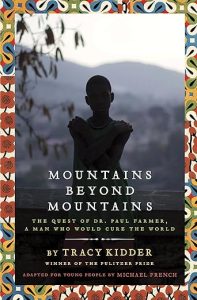
In Brief
- Voice: The narrator credit lists Eve herself, suggesting a non-standard production, audio quality and performance vary, and prospective buyers should preview before purchasing.
- Big ideas: Global health equity, personal mission against impossible odds, the ethics of radical commitment
- Atmosphere: Quietly urgent, like sitting with someone whose devotion makes you reconsider your own priorities
- Worth it?: One of the most compelling portraits of a physician-activist in recent memory, even in its adapted YA form, though production quality warrants a preview.
I first encountered Tracy Kidder's original Mountains Beyond Mountains during my graduate work in literary nonfiction, where it was passed around my cohort with the slightly hushed energy of something important. Kidder embedded himself alongside Dr. Paul Farmer for years, and the result was one of those books that does not feel like journalism, it feels like an argument about what a human life can be spent on. The YA adaptation by Michael French is necessarily compressed, but the essential force of that argument survives.
Dr. Paul Farmer grew up in genuine poverty, lived in a bus, and went on to earn a Harvard MD while simultaneously building a health clinic in one of Haiti's most remote and underserved regions. That biographical trajectory is extraordinary enough. What the book does with it is something else: it uses Farmer as a sustained provocation, a person whose choices make comfortable readers genuinely uncomfortable about their own.
The YA adaptation focuses on Farmer's foundational work in Haiti and his philosophy that drug-resistant tuberculosis in poor communities is not an economic problem but a moral one. The argument that expensive treatment is worth pursuing for the world's poorest patients, that the standard it is not cost-effective justification is itself a form of violence, is presented with enough clarity that younger readers will grasp it without the full complexity of the original being lost.
The narrator credit lists Eve herself, which is an unusual designation for a commercial audiobook release. Prospective listeners are encouraged to preview this production before purchasing, as the audio quality and narration style do not match the standard of major audiobook publishers. The underlying material carries considerable weight, but the listening experience may be uneven depending on the production values of this particular version.
Why It Works in Audio
One reviewer who spent fifteen years working in Haiti wrote that the book accurately captured the hardships these people face daily, the lack of basic needs, water, food, health care. That kind of verification matters. Kidder is not writing poverty tourism. He spent serious time in Haiti alongside Farmer and his Partners in Health organization, and the specificity of his observation shows up even in the adapted version.
The book is also, quietly, one of the most effective arguments against the kind of professional pragmatism that tells young people their idealism will eventually need to be scaled back. Farmer's response to that argument is basically his entire life. One reviewer described it as never boring or dry, and that is a meaningful achievement for nonfiction built around healthcare policy and epidemiology.
Before You Commit to Mountains Beyond Mountains
The YA adaptation is condensed, and some of the original's depth, particularly in Farmer's relationships with his mentor Jim Yong Kim and the academic world that both supported and frustrated his work, is compressed to essentials. Readers who respond strongly to this version will want to go back to the full adult text afterward. The original has approximately 340 pages of reported detail that the youth edition necessarily sacrifices.
There is also a temporal dimension worth noting: Farmer's trajectory continued beyond both editions of this book. He went on to serve as UN Special Adviser to Haiti and spent decades building Partners in Health into a global organization. His death in 2022 added retrospective weight to the story. The book captures an earlier chapter, not the full arc.
Who Will Get the Most From It
Students studying global health, medicine, or social justice will find this an accessible entry point to the ethical debates around healthcare access and international aid. Adults who missed the original and want an efficient overview of Farmer's early work will also benefit. It is genuinely useful for book clubs focused on biography or global affairs.
Listeners who want the full Kidder experience, his embedded journalism, his precise character observation, the relational texture of the original, should go directly to the unabridged adult version and treat this adaptation as an appetizer rather than the main event.
Who is the narrator, and is the production quality strong?
The credit lists Eve herself, which is an unusual designation for a commercial audiobook release. Prospective listeners are encouraged to preview the audio before purchasing, as the production values may not match standard commercial audiobook releases.
Does the book address Partners in Health's work beyond Haiti?
The adaptation focuses primarily on Farmer's foundational work in Haiti. Partners in Health's expansion to other countries, including Rwanda, Peru, and Siberia, is referenced in the original adult text but receives less attention in this shorter version.