
The Short Version
- Voice: Noah Ghree delivers a measured, respectful performance suited to biographical eulogy, his pacing gives Morris's tribute the gravity the subject demands without veering into propaganda territory.
- Big ideas: American conservatism, evangelical faith, political legacy
- Atmosphere: Reverential and politically charged
- Worth it?: A partisan tribute written with urgency; listeners who want critical distance should look elsewhere, but those seeking a sympathetic account of Kirk's influence will find it thorough.
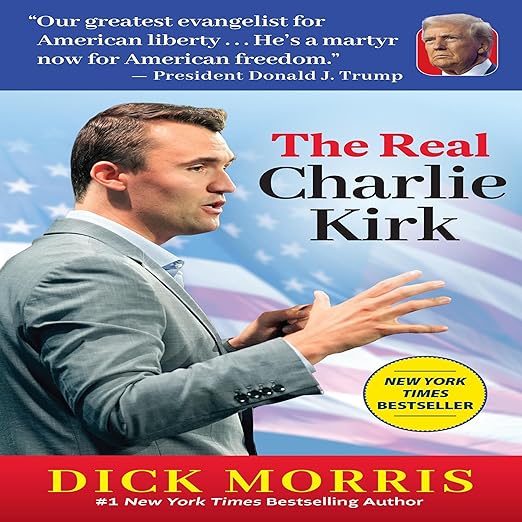
Dick Morris has built a career on speed. In The Real Charlie Kirk, the NEWSMAX contributor and #1 New York Times bestselling author works at his fastest, producing an audiobook that reads as tribute, eulogy, and political argument all at once. The subject, Charlie Kirk, founder of Turning Point USA and arguably the most visible conservative youth organizer of his generation, is framed here not as a figure whose record warrants scrutiny but as a martyr whose story demands to be told before the news cycle moves on. Narrated by Noah Ghree with the kind of careful solemnity the material seems to call for, this is a listening experience that will mean very different things depending on where you stand politically.
Morris structures his account around the key chapters of Kirk's life: his origins as a young conservative in Illinois, his founding of Turning Point USA while still a teenager, his rise to become one of the most recognized faces in the MAGA political coalition, and his deeply held evangelical Christian faith. The synopsis itself frames the project as context-setting, putting Kirk's life and times into political and religious context, and that framing is accurate. This is not an investigative biography. It does not grapple with controversies around Turning Point USA, the academic figures Kirk targeted, or the debates within conservatism about his approach. It is advocacy dressed in biographical form, and listeners should walk in knowing that.
Ghree Reads the Text as Written, Nothing More
What Morris does well is compress a life into legible narrative arcs. The book moves from Kirk's educational philosophy, rooted in a rejection of what Morris characterizes as liberal campus culture, through his cultivation of relationships with Donald Trump and his emergence as a galvanizing force for younger conservative voters. The chapter structure, as outlined in the synopsis, covers everything from his American beginnings to the legacy question of whether his influence will outlast the moment that created him. For listeners interested in understanding how the conservative youth movement built its infrastructure, this audiobook offers a ground-level account from someone who was close to the subject.
Noah Ghree's narration is a careful match for the material. He does not editorialize through his delivery, he reads the text as written, which is the appropriate choice for a book this politically specific. At just two hours, the audiobook is compact, and Ghree keeps the pacing brisk without sacrificing the weight that a biography of this kind requires. The performance is clean and professional, if not especially textured.
Earnestness Stands In for Rigor and Scholarship
The honest appeal of this audiobook is not literary, Morris writes in punchy, declarative sentences designed for impact rather than nuance, but as a document of a moment in American political life. For listeners who want to understand how Kirk was perceived by his supporters, who he surrounded himself with, how he framed his own Christian faith as central to his politics, and why his supporters describe him in terms that veer into hagiography, this two-hour listen provides a concentrated view. The endorsement from President Trump, quoted prominently in the marketing, tells you exactly the lane this book occupies. That is not a criticism; it is information the listener needs upfront.
The chapter on Kirk's evangelical faith and his stance on issues like abortion and transgender rights is presented as biography but reads as manifesto. Morris clearly shares his subject's worldview, and he makes no effort to hide that alignment. The resulting text has the earnestness of a memorial address rather than the rigor of scholarship. Listeners accustomed to biographical works that interrogate their subjects will feel the absence of friction.
The One Moment Morris Steps Back and Asks
The most revealing portions of the book concern Kirk's relationship with the college campus as a political battleground. His founding of Turning Point USA at nineteen, with a mission to recruit conservative students and push back against what he saw as the ideological dominance of American universities, is presented as nothing short of revolutionary. Whether you find that narrative compelling or troubling will depend on your own politics, but the account is specific enough to be useful. Morris draws on what reads as personal access and familiarity with his subject, and the details he provides about how Turning Point USA was built and how it evolved into a White House-adjacent organization are the most substantive passages in the book.
The final chapter, on Kirk's legacy, is the most philosophically interesting section. Morris raises the question of what movements built around singular personalities can sustain after the personality is gone, and the answer he arrives at, that Kirk's ideas must now be carried forward by those who shared his vision, is both a tribute and a challenge. It is the one moment in the audiobook where Morris steps back from the eulogistic register and asks something harder. At two hours, the book does not have space to fully develop this argument, but its presence gives the work a slightly sharper edge than its promotional framing might suggest.
Low Commitment, High Ideological Frame
Listeners who are sympathetic to Kirk's politics or want to understand the conservative youth movement from the inside will find The Real Charlie Kirk a useful and efficiently delivered account. It is short enough to finish in a single sitting and structured to give non-initiates a clear overview of who Kirk was, what he built, and why he mattered to the movement he helped create. Listeners seeking a biography that applies critical scrutiny, one that weighs the controversies alongside the achievements, will need to look elsewhere. This is a work written with admiration rather than ambivalence, and it does not pretend otherwise. At two hours, the commitment is low; the ideological frame is high. Go in with both of those facts in mind.
Questions Listeners Ask
Is this audiobook a balanced biography of Charlie Kirk or does it advocate a particular viewpoint?
It is explicitly sympathetic. Dick Morris was a political ally of Kirk and writes from a place of admiration. Critical perspectives on Turning Point USA or Kirk's methods are absent. Treat this as an insider tribute rather than a balanced account.
At just two hours, does the audiobook cover enough ground to be worthwhile?
Morris covers Kirk's founding of Turning Point USA, his evangelical faith, his relationship with Donald Trump, and his political legacy in compact but readable fashion. The brevity works for an overview but means no topic gets deep treatment.
Does the audiobook address Kirk's role in the 2024 presidential election?
Yes. Morris gives significant attention to Kirk's work mobilizing the youth vote and his influence on the conservative coalition that twice elected Donald Trump, framing this as one of Kirk's defining contributions.
How does narrator Noah Ghree handle the politically charged material in this audiobook?
Ghree reads the text with steady professionalism, avoiding any tonal editorializing. His delivery is respectful and clear, which suits the biographical format even when the underlying text veers into advocacy.







